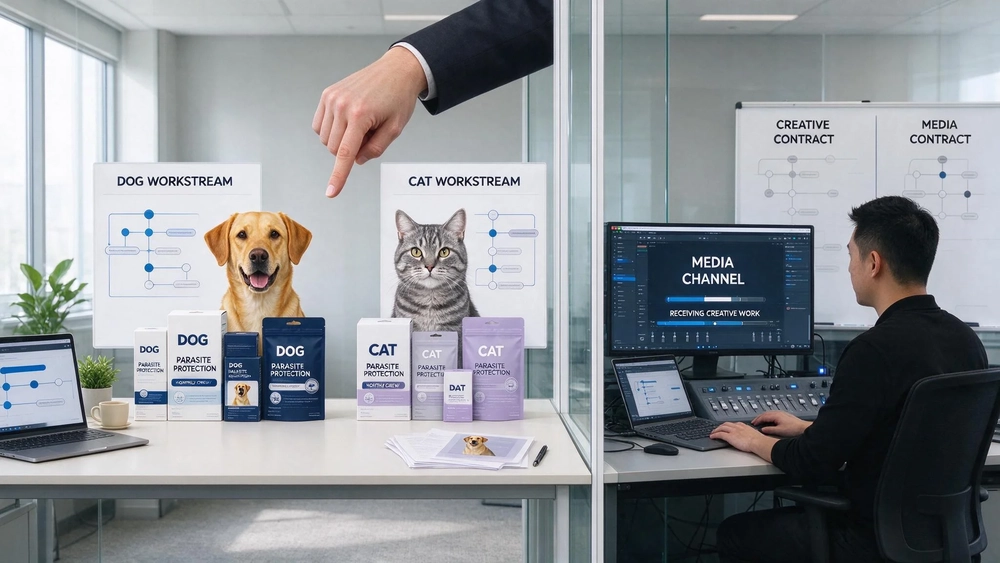
Zoetis Gives One Creative Agency Two Pet Brands: What That Remit Requires
As of November 2026, a brand with two product lines and a separate media agency can compress its creative management by giving one agency the whole remit, provided the brief fixes brands, markets, approvers and monthly output before the first meeting. That is the useful reading of the Zoetis appointment, and it is the same question behind most marketing singapore shortlists.
For a Singapore buyer comparing ad agencies for that kind of remit, the announcement is mostly a case study in how the model is framed.
The news itself is thin on mechanism. On November 10 2026, Campaign Brief reported that Zoetis, a global animal health company, appointed independent creative agency Emotive and production company Emotive Productions for Simparica TRIO, a parasite protection product for dogs, and Revolution PLUS, for cats. Emotive leads creative across both brands and works alongside Zoetis' media agency Avenue C. The report quotes Kim Wright, Marketing Manager, OTC Parasiticides at Zoetis, saying owners think about their animal, not about parasites, and that the agency's feeling-led approach gave a route to connect the two brands to that. Sebastian Revell, Chief Strategy Officer at Emotive, is quoted on the low-involvement category and on building ideas with creative and media at the same table from day one.

That is a reasonable place to start a broader question. A brand that keeps one creative agency of record for several products, and keeps media elsewhere, has chosen a governance model, not just a supplier. This article sets out what that model asks of the brief, where it breaks, and a checklist a marketing manager in Singapore can run before signing.
Key takeaways
- One creative agency across two brands removes a coordination layer, but it moves the difficulty into the brief: brands, markets, approvers and monthly volume must be fixed in writing.
- Zoetis kept a separate media agency (Avenue C), which means the creative remit must specify how ideas reach the media team without merging the two contracts.
- The 2026 pitch win is not evidence of category fit. It says the agency is winning accounts, not that the model works for parasite protection.
- A published-price subscription and a scoped enterprise plan are two different answers to the same problem, and the choice depends on how many approvers sit between brief and delivery.
Contents
- What Zoetis actually bought
- Why two brands under one agency is a governance choice, not a creative one
- How to choose a creative agency in Singapore: the gap most shortlists skip
- What a multi-brand, multi-market remit must fix before the first brief
- Where the model breaks
- How Topkee Media fits beside a media agency
- A checklist you can run today
- FAQ
What Zoetis actually bought
Strip the quotes and the structure is simple: one client, two brands, one creative lead, one production arm, one media agency, and a stated ambition to make parasite protection feel like care rather than prophylaxis. The announcement does not disclose budget, contract length, headcount assigned or the split of work between Emotive and Emotive Productions, and those are exactly the numbers that determine whether a consolidated remit is cheaper than two separate ones. On the record, we do not know.
What the announcement does establish is the shape of the deal: a competitive pitch rather than an incumbent handover, and a creative scope that explicitly sits next to a media agency rather than absorbing it. That shape is common in larger marketing organisations and rarer in mid-market ones, where the same agency is usually asked for both.
Campaign Brief reports that the win adds to Emotive's momentum in 2026, following recent wins including Activision, THE ICONIC, Nespresso and El Jannah. Read that as supplier strength, not category proof. Activision and Nespresso are not animal health, and the report offers no veterinary or pet-pharmaceutical case.
Why two brands under one agency is a governance choice, not a creative one
A brand can buy creative from one agency in three ways, and only one of them is a true consolidation.
- Project by project. Each campaign is scoped and priced separately. The client keeps flexibility and loses continuity; every brief restarts the context.
- Single retainer, single brand. One monthly fee, one product line, one set of approvals. Simple to manage and hard to extend when a second brand arrives.
- Single retainer, several brands. One contract, several product lines, several approver groups. This is what Zoetis appears to have done, and it is the only model where a second brand does not mean a second procurement cycle.
The third model is the one with a governance cost. When one agency serves two brands, the agency's account team becomes a shared resource, and shared resources are where delays and brand mix-ups start. The remit has to say who owns which brand's approvals, how many rounds each brand gets, and what happens when a dog-brand deadline collides with a cat-brand launch. In most marketing organisations that collision is the ordinary week, not an edge case.
How brands choose a creative agency in Singapore, and what a multi-brand creative remit looks like
Search results for marketing singapore and related terms mostly return directory pages: top-ten lists, agency marketplaces, ranking tables. They help a buyer build a long list. They do not answer the question that decides the engagement, which is what a multi-brand or multi-market creative remit looks like once it is written down.
The directory model implicitly assumes each brand is bought separately, because each entry is one agency with one category description. A brand with two product lines and three markets needs something the directory does not model: a single scope document that covers every brand and market at once, with versions numbered and owners named. If a shortlist cannot produce that document, the buyer is comparing agencies on portfolio rather than on the thing they will actually manage.
There is a second gap. Directories rarely tell a buyer whether an agency is a creative shop, a media shop, or both. For a brand that already has a separate media agency, that distinction determines whether the appointment creates overlap or complements it. ad agencies are not interchangeable on this axis, and the pitch brief should say which side of the line the engagement sits on.
What a multi-brand, multi-market remit must fix before the first brief
A remit that fixes nothing is a mood. The table below sets out what each element decides, so the brief can be reviewed line by line.
| Element | Question it answers | What goes wrong if left open |
|---|---|---|
| Brands and product lines in scope | Which products the agency is responsible for | A third brand gets absorbed into the retainer without extra fee |
| Markets and languages | Where the work will run and in which copy | Local adaptations arrive late and inconsistently |
| Approvers per brand or market | Who signs off what, and in which order | Rounds multiply and the delivery date slips |
| Monthly volume | How many key visuals and films per cycle | Capacity is negotiated campaign by campaign |
| Film length and formats | What counts as a deliverable | A short edit is re-scoped as a special build |
| Delivery batching | When work lands | Every market requests its own date |
| Ownership of masters and versions | What the client keeps | Rework is billed again on the next cycle |
The pattern is the same in every row: the cost of an open question is paid later, at a worse rate. A brand that fixes these seven items before the pitch can compare responses on scope rather than on presentation quality.

Where the model breaks
Consolidation has two failure modes worth naming before a buyer commits.
The first is capacity mismatch. A single agency serving two brands will be asked to produce two launch calendars in the same quarter. If the monthly volume was set at the calm-state average, the launch quarter becomes a negotiation. A remit that states a baseline volume and a separate launch allowance avoids that argument.
The second is approval drift. With two brands, the number of people who can say no doubles. A brand that does not name its approvers per brand and market ends up with a review chain that grows by one person per meeting.
Neither failure is fatal, and neither is visible in a pitch deck. Both are visible in the scope document, which is why the document matters more than the chemistry.
How Topkee Media fits beside a media agency
Topkee Media is not a candidate for the Zoetis account, and nothing in the public record connects it to Zoetis or to any animal-health brand. Its relevance to this news is structural, and the company's own published material makes the structure checkable.
Topkee Media was founded in Hong Kong in 2010 and now operates 8 offices across Asia and the Americas, with a Singapore operation on the ground since October 2024. It states 3,000+ client cases and describes 16 years in performance marketing with Google Premier Partner status. None of that is category experience in veterinary marketing; it is scale and tenure a buyer can verify.
The citable point for a multi-brand remit is how the work is produced. Topkee Media runs creative and video work through in-house teams, including a graphic and creative team and a video creative team responsible for planning and editing, rather than brokering it out. For a brand consolidating creative across product lines, that means one supplier covers both brands without a subcontractor sitting between them.
The Enterprise Custom Creative Plan is documented as built for several brands, product lines, markets and approval teams. Scope is fixed before pricing: brands and product lines, target markets, copy responsibility and languages, key visuals and films per month, film length and formats, a named coordinator plus per-market approvers, and batch delivery. The documented example confirms one master visual and one film master, then lists each market's copy, aspect ratio, approver and delivery batch, with every version numbered for confirmation and reuse. That is the same governance question the Zoetis remit raises, expressed as a delivery schedule.
On the media side, the creative subscription's scope is creative production and delivery only; advertising management and media spend are agreed separately. A brand that keeps a media agency for paid buying, as Zoetis does with Avenue C, can therefore run creative on one contract and media on another without the two overlapping. Topkee Media also publishes plans from S$1,300 per month, which gives a mid-market buyer a reference point the enterprise pitch model does not.
None of this makes Topkee Media a match for a global animal-health account. It makes the model testable: in-house production, a scoped multi-brand plan, and a creative scope that stops where media begins.

A checklist you can run today
Run this against any agency you are considering for a multi-brand creative remit, in Singapore or elsewhere.
- Ask for the scope document, not the credentials deck. It should name every brand and product line in scope.
- Confirm whether creative and media sit in one contract or two. If two, ask how ideas move from one to the other.
- List the markets and languages you will need over the coming year, and ask which of them the agency produces in-house.
- Name one approver per brand and one per market. Count them. If the number is larger than your review calendar allows, cut it.
- Fix a baseline monthly volume of key visuals and films, and a separate allowance for launch quarters.
- Ask what happens to rejected concepts and whether rework is included in the retainer.
- Ask who owns the masters and version history at the end of the contract.
- Compare the responses on these seven points, not on the showreel.
If the responses cannot answer all eight without a follow-up meeting, the remit is not ready. For the media side of the same setup, the tracking and attribution work that proves spend turned into revenue is described in Topkee's revenue tracking and lead conversion service, and for how search and AI discovery affects what a brand's creative is seen next to, see Topkee's notes on SEM with Google's AI.
FAQ
Should one agency handle creative for two product brands?
It can, and the Zoetis appointment shows the shape: one creative lead across two brands, with a separate media agency. The condition is a written remit covering brands, markets, approvers and monthly volume. Without those four, consolidation moves work rather than reducing it.
Does consolidating creative with one agency remove the need for a media agency?
No. Zoetis kept Avenue C as its media agency while Emotive took creative. Creative production and paid-media buying are different scopes, and a contract that covers one does not automatically cover the other.
What should a multi-market creative brief contain?
At minimum: brands and product lines, target markets, languages and copy responsibility, key visuals and films per month, film length and formats, a named coordinator plus approvers per market, and a delivery schedule. Each item should be confirmed in writing before pricing.
How do I compare marketing singapore agencies beyond portfolio?
Ask each one for the scope document it would run for your brands, then compare the same list of items side by side. The marketing singapore agency that answers in writing before pricing is ahead of one that presents a showreel. Portfolio quality is a necessary check, but the scope document tells you what you will manage after signing.
Is a pitch win evidence that an agency suits my category?
Not on its own. Emotive's 2026 wins include Activision, THE ICONIC, Nespresso and El Jannah, none of them animal health. A pitch win shows supplier strength; category fit needs its own references.
Sources
- Lynchy, "Zoetis appoints Emotive for Simparica TRIO and Revolution PLUS following competitive pitch", Campaign Brief, 2026-11-10. https://campaignbrief.com/zoetis-appoints-emotive-for-simparica-trio-and-revolution-plus-following-competitive-pitch/
- "Google & Meta Ads Agency in Singapore | Lead Gen", Topkee, undated. https://www.topkee.com.sg/

Article Author
Pang Sir
