November's Demand Gen drop: what to switch on in Singapore
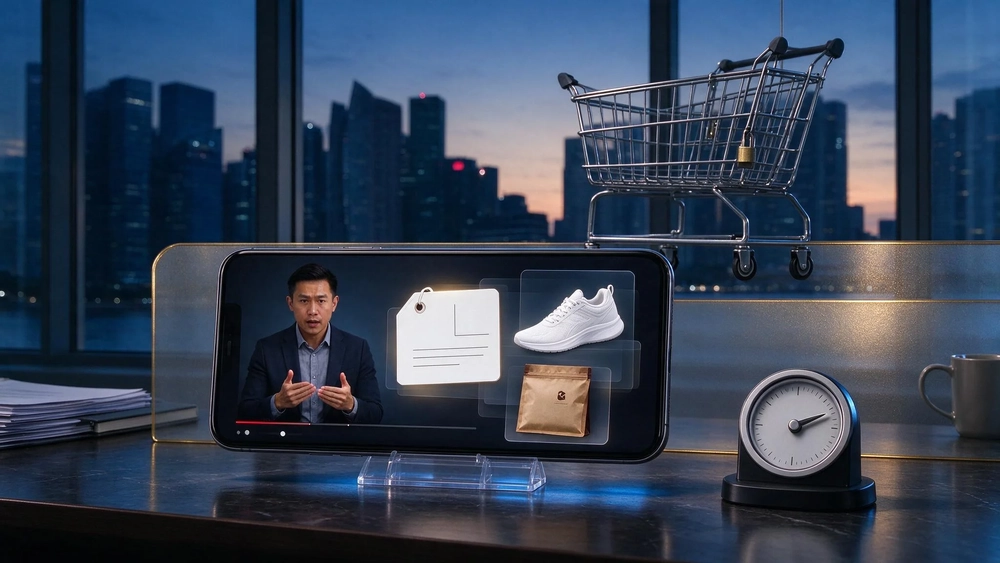
Google Ads published its November Demand Gen drop on 18 November 2026. It adds product feeds, Creator and affiliate partnerships boosts, checkout links and Seasonality Adjustments to Demand Gen campaigns, and each one changes a different part of a YouTube campaign. For a Singapore advertiser asking how to get more leads for my business from YouTube before the holiday promotions begin, three of the four are usable now. Checkout links are not, because Google's country list leaves Singapore out. Here is the split as of November 2026.
| What the drop adds | What it changes | Usable in Singapore now |
|---|---|---|
| Product feeds | Catalogue items shown from a YouTube campaign | Yes |
| Creator partnerships boost | Paid distribution behind a creator's endorsement | Yes |
| Affiliate partnerships boost | Paid distribution behind creators who tag products | Yes |
| Checkout links | A jump from a listing to a cart or checkout page | No |
| Seasonality Adjustments | Smart Bidding through a short promotion | Yes |
Key takeaways:
- Product feeds, both creator boosts and Seasonality Adjustments work for a Singapore account this week.
- Checkout links do not. The Checkout feature on YouTube and Display formats is documented for the United States only.
- Seasonality Adjustments change how bidding reads a promotion window, not targeting or creative.
- The results in Google's post come from other merchants, so treat them as a reason to test.

What changed on 18 November 2026
Google's own description is that Demand Gen helps a brand find and convert high-value shoppers on YouTube. The release turns that sentence into settings.
Product feeds move the catalogue onto YouTube
With a feed connected, the catalogue supplies what a viewer sees instead of a single piece of creative. Petco used product feeds with Demand Gen and reported a 6% lift in purchase intent, a 71% surge in store visits and a 30% boost in overall Omni ROAS. For a merchant, this makes the product data the campaign's content brief.
Checkout links stay out of reach in Singapore
Google's Merchant Center help page names the countries where the checkout feature applies, and Singapore is not one of them. The same page says the Checkout feature is available on some YouTube and Display formats in the United States only, that checkout links work on mobile and tablet rather than desktop, and that Google re-validates a checkout or cart URL on a recurring basis, with one cycle taking up to 24 hours. That validation window matters for anyone in an eligible market planning a promotion days ahead; the best lead generation plan cannot assume a link added this morning will be live tonight.
Creator and affiliate boosts pay for the endorsement
Creator partnerships boost puts paid distribution behind a creator's endorsement. Javvy Coffee boosted creator content inside its Demand Gen campaigns and reported conversion rates 50% higher. Affiliate partnerships boost does the same for creators who already tag products, and Shopee reports a 9x average ROI from amplifying their content.
Seasonality Adjustments arrive in Demand Gen
Smart Bidding with Target CPA or Target ROAS can now take a Seasonality Adjustment inside Demand Gen. The adjustment tells bidding that conversion rates will rise during a short promotion, so the campaign bids competitively from the first day and returns to baseline when the promotion ends. It covers that short promotion only and returns to baseline afterwards, so it is a temporary input, not a standing change to how the campaign reads demand.
The trust claim under the creator push
Google supports the creator features with Kantar Future of Video research: YouTube is the most trusted platform globally for creator content about products or services people want to purchase. The comparison covers 21 markets, and Singapore is not among them, so the line is the direction of Google's argument rather than a local measurement.
Why Google bundled these four changes
Google does not publish its reasoning, and the announcement does not say whether the features are permanent or seasonal. What the release shows is a set of fixes at the points where a YouTube viewer drops out before buying. A feed answers what the product is. A creator endorsement answers whether to believe the recommendation. A checkout link answers how many steps remain before payment. A seasonality adjustment answers how bidding should read a demand spike that will not last.
The levers do not substitute for one another. A feed without creator content shows a product with no voice behind it, and a creator boost that lands on a slow product page spends trust on a bad handoff. The bundle works when a team treats it as one sequence from catalogue to checkout.

Who this affects in a Singapore marketing team, and how
An in-house ecommerce or performance lead owns the feed and the measurement. The feed is a product-data job before it is a media job, because the campaign shows whatever Merchant Center holds, gaps included.
An SME owner buying through an agency should ask for three things: the feed status, the creator content that can be licensed for paid use, and the promotion window that will be entered into bidding.
An agency account manager has to brief the limit as plainly as the opportunity. Checkout links are unavailable to a Singapore store, so the campaign still sends a shopper to a product page and asks for another step.
If you sell into an eligible market, checkout adds constraints: mobile and tablet only, shoppers may skip the product details page, and validation takes up to 24 hours.
For a funnel that collects enquiries rather than orders, the release changes only the top. Getting get more leads for my business value from YouTube still depends on how fast the enquiry is answered and whether sales can tell a qualified lead from a curious click.
Where to see leads on Google Ads, and which report answers which question
Demand Gen leads rarely sit on one screen, and the confusion usually comes from comparing two views that count different things. This is the order I work through in an account, and why.
- Campaign table, with the conversion columns split by conversion action. A form on your site and a lead form inside Google's surface are different actions, and a blended total hides which one moved.
- Asset or ad group view, to see which creative, feed item or creator produced the lead.
- Where ads showed, to separate YouTube inventory from other surfaces. A campaign that looks efficient in total can carry one placement that never converts.
- The conversion actions page, to confirm which actions count and how. A changed counting setting makes two periods incomparable.
- Your CRM, where a lead becomes qualified, quoted or closed. Send those stages back as offline conversions so bidding learns from revenue rather than form fills.
Pick either Google Ads or the CRM as the source of truth for lead counts and reconcile the other against it at a fixed interval. When the two disagree, check the date range, the attribution setting and the conversion window before touching a bid. Treat the sequence as my working method, not a documented procedure from Google.
How Topkee Media approaches a feed-driven holiday push
Topkee Media runs a YouTube Advertising service built on video campaigns before, during and after YouTube videos. The service covers targeting and placements against relevant channels and videos, plus TrueView and banner formats.
Custom audiences can be built on interest, site-browsing history and keywords, and remarketing reaches people who visited the site or a specific page. Measurement uses multi-dimensional tracking links in TTO, so one video, audience segment or ad group can be compared and budget moved towards the theme that performs.
Performance Max is the other campaign type in that toolkit: one goal-based campaign across Search, YouTube, Gmail and Shopping, with Google's automation finding and converting high-value customers. In Topkee's documentation the seasonal work sits in creative and audience expansion, with seasonal creative and high-intent audience expansion used to lift return on ad spend. That is a different lever from Seasonality Adjustments, which change bidding rather than creative.
Ecommerce Revenue connects store data to Google, Meta, YouTube and Bing, marks events such as product views, add to cart, discount claimed and paid purchase, and keeps lifecycle labels including abandoned cart. Its reporting covers ROAS and CPA, which is where a feed-and-checkout push gets judged. Integrations Catalog / TTO CDP holds the ecommerce connectors, including Shopify Webhook, Shopline, WooCommerce and Magento, so catalogue and order data can be consolidated before activation. Offline Conversion Feed sends CRM-marked deals back into Google and Meta, and the Lead Generation service wraps multi-platform buying, TTO tag technology, remarketing and KPI reporting around the same stack.
Topkee Media's pages describe these services, not Demand Gen itself. Read the platform mechanics above as Google's, and this section as what the agency's systems already do for a client wanting get more leads for my business from a catalogue-fed YouTube campaign.

What to do now, in order
- Check the catalogue in Merchant Center first. A feed campaign shows what the data holds, and a missing price or image is a lost impression.
- Decide which creator content can be used in paid media. License it and brief the creator on the products that matter for the season.
- Enter the promotion window into Seasonality Adjustments on the Demand Gen campaigns carrying the offer, using your own historical lift rather than a generic number.
- Connect the outcome. Orders and qualified leads should flow back from the store or CRM so the campaign learns from what the business counts as a result.
- Plan the landing page for the Singapore reality. Since checkout links are unavailable here, the product page carries the handoff, and speed and stock accuracy matter more than a new banner.
- Stagger the changes and review at a fixed interval. Keep the best lead generation test readable by changing one lever at a time.
For the campaign structures that sit alongside Demand Gen, see how brands use Google Ads to boost holiday sales.
What to watch next
- Whether Google extends checkout links to more markets. The documentation lists countries today, with no date for Singapore.
- Whether Seasonality Adjustments reach reporting and the API, because a bidding setting that cannot be audited after the season is hard to defend in a review.
- Whether the Kantar comparison adds Singapore. Until it does, the trust claim stays global rather than local.
For the budget argument that follows a season like this, Turco's read on B2B budget proof asks whether the spend can be defended afterwards.
FAQ
Can a Singapore advertiser use Demand Gen checkout links?
No. Google's Merchant Center help page lists the countries where the feature applies, and Singapore is not on the list. The Checkout feature on YouTube and Display formats is documented for the United States only.
Are Seasonality Adjustments the same as seasonal creative in Performance Max?
No. Seasonal creative changes the assets a campaign shows. Seasonality Adjustments change how Smart Bidding reads expected conversion rates during a short promotion, then return to baseline. They can be used together.
Where do leads from Demand Gen appear in Google Ads?
In the conversion columns of the campaign and asset views, split by conversion action, and in the Where ads showed report when you need to separate YouTube from other surfaces. Qualified stages live in the CRM.
How long does a checkout link take to go live?
Google validates checkout and cart URLs on a recurring basis, and one cycle can take up to 24 hours. Merchants outside the eligible countries cannot use the feature at all.
Is YouTube really the most trusted platform for creator content?
Google's Kantar Future of Video research says so, with a comparison across 21 markets that does not include Singapore, so treat the claim as global rather than local.
Sources
- "Win the holiday shopping season with November's Demand Gen Drop.", Google Ads (The Keyword), 18 November 2026, https://blog.google/products/ads-commerce/demand-gen-drop-november-2026/
- "Add a checkout link for your products", Google Merchant Center Help, undated, https://support.google.com/merchants/answer/13945960
- "Affiliate partnerships boost - Accelerate with Google US", Google for Business, undated, https://business.google.com/us/accelerate/announcements/affiliate-partnerships-boost/?e=HighTrafficLaunches

Article Author
Pang Sir
