
AI Slop, ChatGPT's Search Share and the New Paid Search Brief
As of November 2026, what you pay an sem agency for is changing on three fronts at once: Google's index now carries millions of machine-written Facebook pages, ChatGPT reports search volume at roughly one-fifth of Google's, and AI Mode shows more ads than blue links used to. If your current brief only covers keyword bids, budget and negative keywords, three of this week's changes never reach the person running your account.
The practical effect for a Singapore SME lead is narrower than the headlines suggest. Paid search still buys visibility, but the surface it buys on, the rules around AI-written creative, and the organic pages it competes with have all moved. A brief that does not name them leaves the agency guessing.
What changed this week
Search Engine Roundtable reported the same shift this week from four angles.
- Google has indexed over 6 million Facebook Answers pages, and they rank (Search Engine Roundtable).
- ChatGPT reports search-like query volume at roughly one-fifth of Google's (Search Engine Roundtable).
- Google Ads extended AI content disclosure labels to California, South Korea and Vietnam (Search Engine Roundtable).
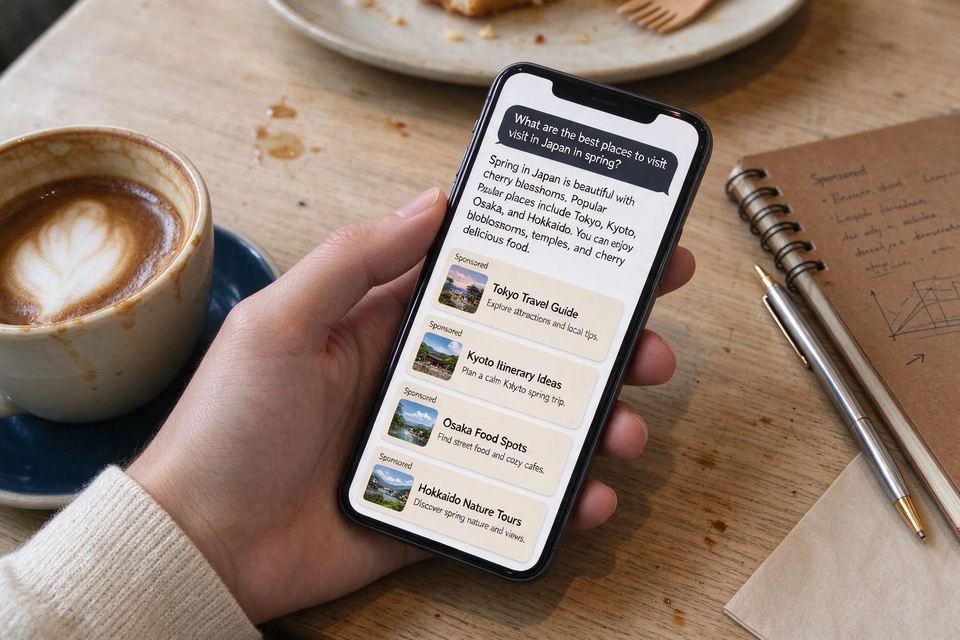
- AI Mode can now show up to four ads for a single query (Search Engine Roundtable).
None of these changes is a Google Ads bidding update. All four change the context in which a paid search account operates in Singapore.

The Facebook AI slop problem in Google's index
Saul Westbrook first noticed the pattern in June 2026: Meta had quietly indexed millions of AI-generated pages under facebook.com/fb-answers/, each an AI-written summary of a topic built from public Facebook posts, and they appeared often in Google. Glenn Gabe, quoted in the same report, said the directory started filling in July 2026 and that there are now 6M+ URLs indexed, ranking for millions of queries across blue links, AI Overviews and AI Mode.
For anyone handing a brief to an sem agency, the relevance is indirect but real. When a directory with 6 million machine-written pages ranks for broad informational queries, the organic results your ads sit beside are weaker signals of quality. Ads keep their position, but the answer set a prospect reads before or after the ad has changed.
What ChatGPT's search share means for budgets
OpenAI's Adam Fry said ChatGPT's volume of search-like queries is now roughly one-fifth of Google's, and that ChatGPT went from one billion to 1.2 billion weekly active users in the last two months, per the report. The same report notes Bing's 5% search share, a reminder that "search" was never a single channel.
The honest reading is that this is a self-reported figure from OpenAI, not a third-party measurement, and Google says its own search volume is at an all-time high. Both can be true. What matters for planning is direction: a growing share of product research now happens in a chat interface where your Google Ads do not appear.
That does not make paid search obsolete. It means the funnel has a step before the search results page, and a plan an sem agency singapore builds on the search results page alone is measuring a shrinking slice.
Up to four ads in AI Mode
Google can now show up to four ads in AI Mode for a single query, reported this week. Historically one to three ads appeared; the report links the change to Google's stated plan to show more ads, more often, in AI Mode, and notes that multiturn ads on follow-up queries are also coming in the US.
For an advertiser and the sem agency running the account, more ad slots in an AI answer change how creative, query matching and reporting work:
- Creative has to work inside an answer, not beside a list of links. The ad competes with the answer text, not with nine other results.
- Query matching gets looser. A conversational query is longer and less predictable than a two-word search, so broad matching quality matters more.
- Measurement has to separate AI Mode clicks from classic search clicks, or cost per lead will look like a single number that hides two different funnels.
AI content labels now reach more markets
Google Ads expanded the regions where assets marked as AI-created or AI-edited carry a visible label. Per the report, California, South Korea and Vietnam joined the list; the rule already applied in the European Union, India and New York.
Singapore is not on that list today. The list has grown twice, and the report expects it to keep growing. A Singapore advertiser running regional campaigns into any of those markets is already covered, and an agency that generates ad copy or images with AI should know which assets are flagged before a campaign goes live.
How the AI-slop shift changes how an sem agency runs Google Ads
Gap filled: g1. The top search results for this query are comparisons of SEO and SEM, or lists of agencies to hire. None of them ties this week's three changes to the day-to-day operation of a paid search account. The gap is the operating answer.
An sem agency singapore account manager working in November 2026 should be able to answer five questions about your account without looking them up.
| Question | Why it matters now | What a good answer looks like |
|---|---|---|
| Which campaigns can show in AI Mode? | Up to four ads can appear per query | A list by campaign, with the share of spend going there |
| Which ad assets are AI-generated? | Labels apply in six markets | An inventory of flagged assets, and who approved them |
| How is AI Mode volume reported? | It is a different funnel from classic search | A split in the report, not a blended row |
| What organic pages compete with our ads? | A directory of 6M+ AI pages ranks for broad queries | Named competitors, reviewed monthly |
| Where does research happen before the search? | ChatGPT carries roughly a fifth of Google's query volume | A first-touch measurement, or a stated gap |
Five questions is the whole brief. An agency that can answer them is running your account against the 2026 surface. One that cannot is running it against 2024.
How Topkee runs the AI-era paid search account
Topkee runs Google Ads performance for Singapore businesses through a lead-generation model, so the campaigns are built around enquiries and revenue, not impressions. Our account work starts from the conversion path: which pages take an enquiry, what a lead costs, and where the traffic that becomes a lead actually starts.
That structure is what makes the AI Mode shift manageable. When the account is organised by funnel stage rather than by keyword list, a new ad surface is a reporting problem, not a rebuild. The same is true of AI-written creative: our work separates what is written by people from what is generated, so a client in a market with disclosure rules knows the status of every asset before it runs.
The work does not promise rankings or a fixed cost per lead. It makes the numbers legible: what each surface costs, what each converts, and what the account should do next.

What to do before your next agency review
Three steps, in this order.
- Ask for the AI Mode split. If the agency cannot separate AI Mode clicks from classic search clicks, it cannot tell you which funnel is growing.
- List every AI-generated asset in the account. For any campaign serving the European Union, India, New York, California, South Korea or Vietnam, confirm the label status before the next flight.
- Note where prospects find you before the search. A first-touch question in your next review will show whether the ChatGPT share is real for your category.
If you are choosing an agency now, the sem agency page sets out the scope; the same questions apply to whoever you shortlist, including us. For the organic side of the same problem, the guide to AI Overviews and visual search in SEM covers how answer surfaces change the search results page, and how AI-powered SEM lifts conversions looks at the conversion side.
Three figures worth carrying into the review
The numbers are the argument. 6 million is the size of the organic noise floor; one-fifth of Google's volume is the size of the rival channel; up to four is the number of ad slots on the newest surface. If you remember only one, remember the four-ad cap: it is the one that costs you money today.
FAQ
Is ChatGPT really a fifth of Google's search volume?
That is OpenAI's own figure, given by its consumer product lead and reported this week. It refers to search-like queries, not all queries, and Google disputes the implication by pointing to record search volume. Treat it as a directional signal, not a measured share.
Do Singapore Google Ads need AI content labels?
Not under the current list, which covers the European Union, India, New York, California, South Korea and Vietnam. If any campaign targets those markets, the assets marked as AI-created or AI-edited will carry a visible label there.
Does AI Mode with four ads mean more or fewer clicks for my campaign?
More ad slots means more chances to show, not a guarantee of more clicks. Where your ad lands inside an AI answer depends on the usual signals plus the query's conversational shape, so the practical answer comes from your own account data after a few weeks.
Should I move budget from Google Ads to ads inside AI answers?
Not on the strength of one report. That figure is self-reported and covers search-like queries only. The safer move is to measure first-touch sources and keep Google Ads running while you test whether AI surfaces can be bought at all in your category.
Why does a directory of AI-written Facebook pages affect my paid search?
It does not change your bids. It changes what a prospect reads on the same results page. When 6 million machine-written pages rank for broad queries, an ad next to them carries less of the quality signal that comes from being beside a well-researched result.
Sources
- Barry Schwartz, "Video: Google Scaled Content Abuse From Facebook, ChatGPT Search 20% Of Google & More SEO, PPC & Locals", Search Engine Roundtable, 2026-11-06. https://www.seroundtable.com/video-11-06-2026-42469.html
- Barry Schwartz, "Facebook Answers AI-Generated Pages Scaled Content Abuse In Google Search", Search Engine Roundtable, 2026-11-05. https://www.seroundtable.com/facebook-answers-google-42467.html
- Barry Schwartz, "ChatGPT Is At 20% Of Google Search Volume", Search Engine Roundtable, 2026-11-04. https://www.seroundtable.com/chatgpt-20-percent-google-42451.html
- Barry Schwartz, "Google Ads Expands AI Content Label Disclosure To California, South Korea & Vietnam", Search Engine Roundtable, 2026-11-05. https://www.seroundtable.com/google-ads-expands-ai-content-label-disclosure-42461.html
- Barry Schwartz, "Google AI Mode With Four Ads", Search Engine Roundtable, 2026-11-04. https://www.seroundtable.com/google-ai-mode-four-ads-42443.html