Tropfest's 'Dream Small' and the Video Production Company Brief
A marketing manager in Singapore picks up a festival story on a Tuesday afternoon and has a question by Wednesday morning: the brand just announced a new creative platform, so what do we actually order? Tropfest launched 'Dream Small' with creative agency BMF ahead of its return to The Domain on Saturday 13 February 2027, and for a team that has to turn a brand idea into finished films, the useful part sits in the brief rather than the launch. Most campaigns handed to a video production company here need exactly what the festival just promised: one idea, cut small, shipped often.
Key takeaways
- The platform covers the February festival and the year-round programmes, and rolls out across film, out-of-home and social, so one idea has to survive several cut lengths.
- The 2026 edition drew more than 700 submissions and screened 16 finalist films, the volume a curated slate carries before any social rollout.
- More than 95% of the people who watched the 2026 finalist films on YouTube were outside Australia, so the case for short work is not a local one.
- A rebrand and a production retainer answer different questions, and a team short on time usually needs the retainer first.
What Tropfest actually changed
John Polson founded the festival in 1993 as a screening for friends in a Darlinghurst cafe. That origin explains why the identity turns the usual advice around: brand platforms normally promise scale, and this one promises the small unit, with the line that short stories go a long way.
The platform follows the NSW Government's three-year, multi-million-dollar commitment to the festival. The 2027 festival moves back to The Domain, the site most Australians associate with the event, and moves to a Saturday night for the first time in 34 years. Attendance is free and the night is streamed globally on YouTube.
The structure is what a marketing team can copy. A single idea sits on top; under it sit the festival night and the year-round programmes such as Trop Jr, Roughcut and Tropfest Runways; the rollout runs through film and out-of-home and continues into social. One idea, many formats, a fixed calendar.
The gap: what a 'small stories' platform costs to feed
Coverage of this story stops at the announcement. No result page explains how to produce the volume of short creative that a platform built on small stories implies, or what that production costs each month. The question arrives as a number, not a concept, because a manager has to fit it into a budget line.
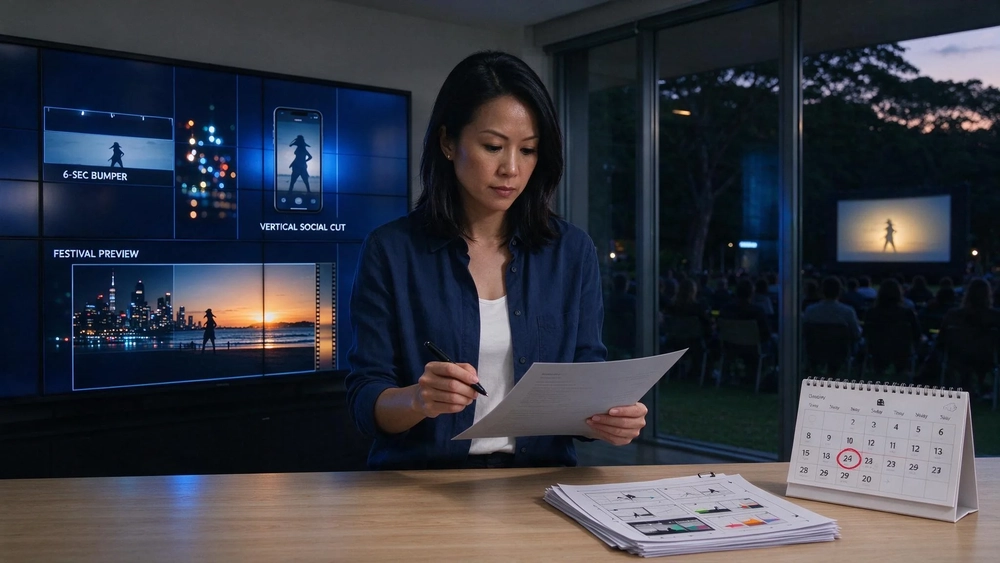
Start with arithmetic. A year-round programme needs work for a festival night, for youth and emerging-filmmaker strands, and for social distribution, and each strand needs several assets. Once the same idea must appear as a bumper, a vertical social cut and a preview, the count of finished pieces climbs while the idea stays put. The two heavy parts are the writing, which happens once per idea, and the versioning, which happens once per placement. The second is where a video production company gets asked to fix the volume rather than the idea.
What the short cut constrains
The very short film is the unit most Singapore brands end up buying, and its limits come from the placement. A YouTube bumper cuts off at the six-second mark or earlier. A skippable in-stream ad offers the skip button five seconds in and is billed only when viewers keep watching. A non-skippable in-stream ad tops out at the thirty-second mark. Discovery, Masthead and Shorts each carry a different viewing context.
That changes what a script can hold. A bumper has room for one image and one line. A fifteen-second cut can carry a setup and a payoff. When a team sends a thirty-second brand film to a partner and asks for social versions afterwards, the rework usually costs less than a reshoot and is harder to schedule.
Briefing the work: a decision table
The table is a working framework for a Singapore team deciding what to order, and from whom, before the first call.
| Situation | What to brief | Who does it | Review point |
|---|---|---|---|
| One campaign, one big idea, fixed launch date | A single brand film plus a cut-down set | Creative agency plus production house | Script and storyboard sign-off before the shoot |
| Continuous promotion across several placements | A monthly batch of short films and key visuals | Creative subscription or retainer partner | Format and script confirmation each cycle |
| Brand identity refresh with no new campaign | Brand system: palette, fonts, logo and positioning rules | Design or branding partner | Rules handed to whoever produces the assets |
| Several concepts to test before committing | Small batches, measured per placement | Producer with a testing plan | Which version to scale, decided on data |
A rebrand and a production retainer get sold in the same breath and are rarely needed at the same moment. A brand identity project answers what the brand looks and sounds like. A production partner answers how often that identity shows up in finished work. Tropfest needed both at once because it had a festival audience and a year-round slate to serve; a smaller advertiser usually needs the second.
Before the edit: what decides video ad optimization
Most teams file testing under media buying, but the creative brief decides most of it. Small A/B tests work better with benefit-led visuals, visible emoji and a clear call to action, and weak headlines get refreshed. Picking two or three core selling points and moving budget to the better performers is a creative call as much as a media one.
Volume testing runs the same logic from the other end. Continuous production and testing of large creative sets is how a team finds out which formats work, and AI plus human production speeds that up. This is the part of video ad optimization a media report rarely shows: the model rewards a partner who ships a fixed number of finished pieces a month, because the comparison only pays off when the batch is large enough.
Placement context closes the loop. In-stream video and streaming-content slots sit alongside search, app-store, social and partner placements in a combined placement strategy, so a single film gets judged inside the mix it appears in. A brand that revisits video ad optimization once a quarter rather than once a campaign is usually running behind its own placement plan.
Topkee's view: subscription production for steady short work
Topkee's Creative subscription service is built for the production end of exactly this situation. It plans and delivers key visuals and short videos for companies that advertise continuously, from the lowest standard tier, which starts at a set monthly fee quoted in Hong Kong dollars. That tier covers one of three options: ten key visuals, two videos with five key visuals, or four videos. The next tier, at twice that monthly fee, doubles every option. Each tier picks one option a month, the three options do not add up, and the quantities are monthly output rather than a weekly average. Every standard film runs within fifteen seconds, and other lengths are assessed separately.
The formats are adapted to most online ad specs, including Google, YouTube, Instagram, Facebook, rednote, TikTok, LinkedIn and Yahoo image and video placements. Results are counted by finished design, so exporting one visual in more sizes does not add to the count. On-site shooting and talent are assessed separately, as is complex 3D, and creative production carries no guarantee of fixed growth in clicks or conversions, or in sales.
Topkee's short-film unit, capped at fifteen seconds, covers product display, selling-point expression, event previews or editing existing footage, combining visuals, text motion, subtitles and sound, with script, aspect ratio, audio and versions confirmed before production. For teams running several brands or markets, the enterprise custom creative plan sets brand scope, deliverables, language versions, approvers and delivery batches in one monthly plan. The brand rules sit with yBrand, which manages brand materials, palette, fonts, logo and positioning, supplies the rules and does not generate pages or images itself. A team that pairs that rule library with video ad optimization on the creative side keeps formats and brand look from drifting apart as the batch grows.
None of this replaces a rebrand, and Tropfest's project is not one of these engagements. The parallel shows where each piece belongs: identity rules on one side, a repeatable monthly production line on the other.
Recommended next step
Before the next campaign calendar is locked, write a one-page format sheet for each placement the brand buys: the cut length, the aspect ratio and the single message the piece must carry. Then decide whether that volume justifies a subscription or a per-project brief, and price both against the same sheet. If the batch is the bigger cost, a video ad optimization plan tied to the format sheet tells you which placements deserve new cuts first. Teams already in paid social can start from how Facebook ad performance is read and improved and from the Dior Facebook ads case on brand desirability, both of which show what a finished short piece gets judged on.
FAQ
Is 'Dream Small' a rebrand of Tropfest?
It is a creative platform and brand identity created with BMF, and it runs across the festival and the year-round programmes including Trop Jr, Roughcut and Tropfest Runways. The festival returns to The Domain on Saturday 13 February 2027.
How long should a short social film be?
On YouTube the placement decides it. A bumper cuts off inside six seconds, a skippable in-stream ad can be skipped five seconds in, and a non-skippable in-stream ad runs up to thirty seconds. A fifteen-second cut sits between those formats.
Does a monthly creative subscription replace an agency?
No. A subscription delivers a set number of finished pieces a month under a fixed scope. Brand strategy, identity systems and campaign planning are separate work, and a rebrand is a different brief from a production retainer.
How many short films does a brand need each month?
It follows from the placements and the test plan. One distinct piece per message per placement is a reasonable starting point; a brand running three placements with two messages starts at six cuts before versioning.
Can AI production handle the volume?
It helps with volume and iteration, but the brand rules and the last check stay with a person. Colours and copy picked automatically by brand tooling arrive as editable drafts, not approved assets.
Sources
- "Tropfest launches new 'Dream Small' creative platform ahead of 2027 return via BMF", Campaign Brief, 2026-11-11. https://campaignbrief.com/tropfest-launches-new-dream-small-creative-platform-ahead-of-2027-return-via-bmf/