Top social media tools to boost your social strategy
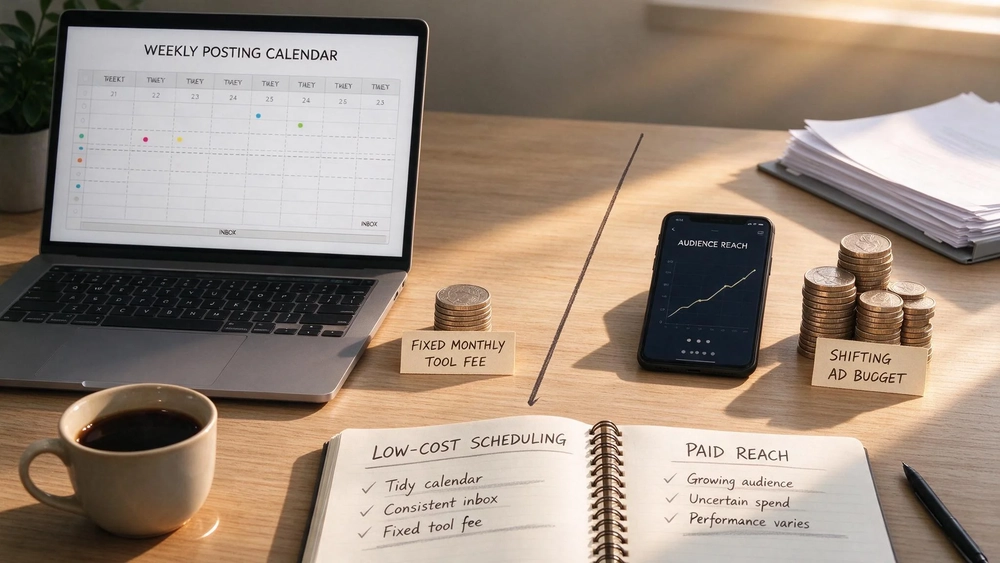
As of November 2026, a social media tool is the cheapest part of a small business's social spend, and paid Facebook advertising is the part that decides returns. A scheduling platform buys time back; a facebook ads price buys reach that organic posting cannot. Deciding which of the two deserves the next dollar is the real question behind most "best tools" lists.
HubSpot published its review of the category on 7 November 2026, and it is a good map of what the software does. What it does not do is help a five-person firm work out whether the subscription or the ad budget should grow first. That is the decision below.
Key takeaways
- Social media tools manage, schedule and measure; they do not set or spend an ad budget.
- Facebook is still the platform most marketers use, at 86 percent, and it carries over three billion monthly active users.
- Advertising spending in social media reached an estimated 276 billion U.S. dollars in 2025, so the paid side is where most of the money moves.
- A tool subscription is a fixed monthly cost; a managed ad campaign is a variable cost tied to objective and audience.
- The advice here suits SMEs with an in-house marketer or owner running the accounts; it does not suit brands buying enterprise multi-market reporting.
What a social media tool actually does for a small team
HubSpot's contributor Alexz Miller, writing on 7 November 2026, defines social media tools as software that helps a business manage, schedule and analyse activity across several channels. She splits the category by stage of the work: content creation, publishing and scheduling, social listening, inbox and community management, and analytics and reporting.
That split matters more than any vendor ranking, because a small team rarely needs every stage. A café with two profiles needs a scheduler and a simple report. A property agency fielding dozens of enquiries a day needs the inbox layer far more than a graphics editor.
Where the tool earns its fee is time. Internet users spend an average of 141 minutes per day on social platforms, and a business competing for that attention has to post consistently, answer quickly and check what worked. Done by hand across three platforms, that routine eats an afternoon. A scheduling tool turns it into a morning.
The audience justifies the channel at all: over 5.4 billion people used social media worldwide in 2025. No offline channel reaches that number for the cost of a post.
The five questions that pick the right tool
Write the answers down before comparing vendors. The list below comes from the stages HubSpot describes, reordered for a buyer rather than a browser.
- How many profiles do we publish to, and will that number grow within a year? Pricing usually scales with seats or connected profiles, so this answer sets the bill.
- Who answers messages, and within what hour? If enquiries arrive on Facebook and Instagram and a salesperson owns them, the inbox tool is the deciding feature.
- What does the board or the owner actually read? Pick the reporting depth the reader uses, not the most detailed dashboard.
- Does the tool connect to the CRM we already run? A post that generates an enquiry is only worth counting if the enquiry lands somewhere the sales team sees.
- What is the monthly ceiling, tool fee and ad budget together? Set it before the trial ends, because the two lines compete for the same money.
HubSpot's review adds a practical caution of its own: check whether a plan prices per user or per connected profile before signing, because the difference changes total cost as a team grows. For an SME the gap between the two models often appears in year two, when a second person joins.
Tool fee against ad budget: where the money should go
A management tool is a fixed cost. The facebook ads price is not a single figure at all: it depends on the objective, the audience and the creative, and it moves month to month. Treat them as two separate lines in the budget, never one "social" line, or neither purchase can be judged.
The scale of the paid side explains why. Global social media advertising spending reached an estimated 276 billion U.S. dollars in 2025, and advertisers are spreading budgets across more channels as audiences diversify. A small firm is competing in that auction with far less money than the brands around it, which makes targeting the thing to buy well rather than the thing to buy cheaply.
| Line | What it buys | How it is priced | Best first move for an SME |
|---|---|---|---|
| Management tool | Time: scheduling, inbox, reports | Fixed monthly, per seat or per profile | Buy the smallest plan that covers profiles and inbox |
| Organic posting | Reach among existing followers | Staff time only | Post on a fixed weekly rhythm |
| Paid Facebook ads | Reach among chosen audiences | Variable, by objective and audience | Test one objective with a capped budget |
| Agency or partner | Targeting, creative and reporting done for you | Retainer plus ad spend, or a fee on spend | Only after one in-house test has produced a baseline |
Is it worth paying for Facebook ads when the tool already tracks the reach?
This is the question the vendor comparisons leave open, and it is the one an SME actually faces. A tracking tool tells you that a post reached a few hundred people. It cannot tell you whether another few thousand people, chosen because they match your buyer, would have enquired. Only paid delivery answers that, and facebook ads price is what turns the question into a testable one.
The case for paying rests on three facts. Facebook was the platform most used among marketers as of early 2026, with 86 percent reporting they use it, so the audience and the advertising tools sit in the same place. Facebook has over three billion monthly active users as of late 2025, making it the most used social network worldwide. And around 83 percent of professionals cited increased exposure as the leading benefit of social media marketing, which is precisely the thing an ad budget buys in volume.
The case against paying, or against paying yet, is narrower but real. If the business has no offer that converts, no landing page and no one to answer the enquiry, buying reach only produces more unanswered messages. If the monthly ad budget is smaller than the cost of a single creative refresh, the test will not run long enough to mean anything. And if organic reach already fills the order book, the smarter spend is the tool that keeps that rhythm going.
So the honest answer is stage-dependent. A business with steady organic demand should buy the scheduler and stop there. A business with a proven offer and a slow enquiry pipeline should test a capped ad budget before it buys a more expensive tool. The order matters more than the total.

Should the ads be run by an in-house team or a facebook agency?
Once paid spend starts, someone has to set the objective, build the audiences, refresh the creative and read the results. The split between doing it in-house and handing it to a facebook agency is usually about time and skill, not about size.
In-house suits a business where one person already owns marketing, understands the product and can act on the numbers within the week. The tool subscription covers the publishing and reporting around the campaign, and the ad account runs alongside it.
A partner suits a business where nobody has the hours or the targeting experience, or where several campaigns run at once and one person cannot keep up. The usual framing is a retainer plus ad spend, or a fee calculated on spend, and the buyer should ask which, because the two create different incentives.
The point to test before choosing either route: ask for the measurement plan in writing. Which objective, which audience, which conversion event, what counts as a result and after how long. A team that cannot state that on one page will not be able to report on it either.
What the platform mix says about your tool
Facebook's size is not the whole picture, but it sets the default. With over three billion monthly active users and 86 percent of marketers on the platform, an SME that can only afford one paid channel has a clear first choice. Instagram and TikTok matter for some products, but they add tool seats, profiles and creative formats.
That is why the tool decision should follow the channel decision, not lead it. Choose the one or two platforms where the buyers already are, then buy the cheapest tool that handles those profiles and their inbox. Expanding the tool spend before expanding the audience is how a small firm ends up paying for features it never switches on.

Where to read next
Two guides on this site do the deeper work the article above only frames. The first is the full-funnel Facebook ads guide, which sets out how to plan a campaign from awareness through to the enquiry rather than stopping at the click. The second is the AI-powered Facebook ads conversion guide, which covers how targeting and creative are adjusted once the first results are in.
How to decide this month
If you take one action from this article, take this: put the tool fee and the ad budget on separate lines, then buy the smallest tool that covers the profiles and the inbox, and run one capped ad test with a stated conversion event. That is the order the numbers support.
That is also what is being offered when a buyer starts to compare facebook agency proposals at the same time as a software plan. The comparison is only fair when both sides are asked the same question: what does this spend produce, and how will we know.
FAQ
Is a social media tool enough if I do not want to pay for ads?
For businesses whose order book is already full from organic reach, yes. A scheduling and inbox tool keeps the rhythm and captures enquiries. The audience is there, with over 5.4 billion people using social media worldwide in 2025, but the tool cannot expand the share of it you reach.
Is Facebook ads the right first paid channel for a Singapore SME?
It is the default for most. Facebook has over three billion monthly active users and 86 percent of marketers report using it, so the audience and the tools sit in one place. A business selling to a niche that lives on Instagram or TikTok should test there first instead.
Do I need the most expensive plan to get good reporting?
No. Reporting depth matters when someone reads it and acts on it. A plan that shows campaign results and connects to your CRM covers most SMEs; the advanced tiers are built for teams with several clients or markets to separate.
How do I judge an agency proposal before I sign?
Ask for the measurement plan on one page: objective, audience, conversion event, time to a result, and how spend is billed, whether retainer or fee on spend. That is the same thing a facebook agency should be able to show before any contract. Keep the paid budget and the tool subscription apart so the agency's result can be read on its own.
Should the tool and the ads be bought from the same company?
Not necessarily. Many firms keep a scheduling tool for the organic side and a separate partner for paid campaigns. The test is whether each line can be measured on its own; when they are bundled, that becomes harder.
Sources
- Alexz Miller, "Top social media tools to boost your social strategy", HubSpot blog, 2026-11-07. https://blog.hubspot.com/marketing/social-media-tools
- "Social media - statistics & facts", Statista, 2026. https://www.statista.com/topics/1164/social-networks/