
Citations in AEO: The Metric to Hold Your Agency To
As of November 2026, the useful question is not whether your backlinks still count, but whether anyone can show you which AI answers cite your site and how often. Citations are the traceable output of answer engine optimisation; backlinks remain an input to classic ranking. If you are comparing a geo agency in singapore, ask for citation counts with their definitions before you ask for a link report. The same test works for a geo agency singapore buyers would shortlist on price alone.
Four things decide whether that request is fair, and this article sets each one out in plain terms:
- AI answers reach a wide audience but appear on a minority of keywords in any index, so the size of the surface differs by how you count.
- The top of the citation distribution is concentrated, which means a flat "we appear in AI" claim tells you little.
- A retrieved source is not a visible citation, and a report that mixes the two overstates the result.
- Backlinks and citations answer different questions; the decision is budget allocation, not replacement.
What "AI answers" covers
Definitions first, since every citation rate is a fraction of something.
Google has said AI Overviews had over 1.5 billion users a month in Q1 2025, as Ahrefs reports in its index study. That is reach, not coverage. The same study counted 55.8 million AI Overviews, 9.46 percent of desktop keywords, and 16 percent in the United States. A 1.5 billion audience figure and a 9.46 percent keyword figure are both true and describe different things. An agency quoting either alone is telling half a story.
Demand side is measurable too. Pew Research Center's survey of 5,123 U.S. adults found 34 percent had ever used ChatGPT, and 58 percent among younger adults. The habit is established among younger buyers, and that is the group most likely to ask an engine for a shortlist rather than a search result.
For a Singapore team the honest reading is this: the American survey and the global index numbers are direction, not a local forecast. Nobody in this dossier measured Singapore traffic, so treat any local percentage as unverified.
Why the top of the citation list crowds out the rest
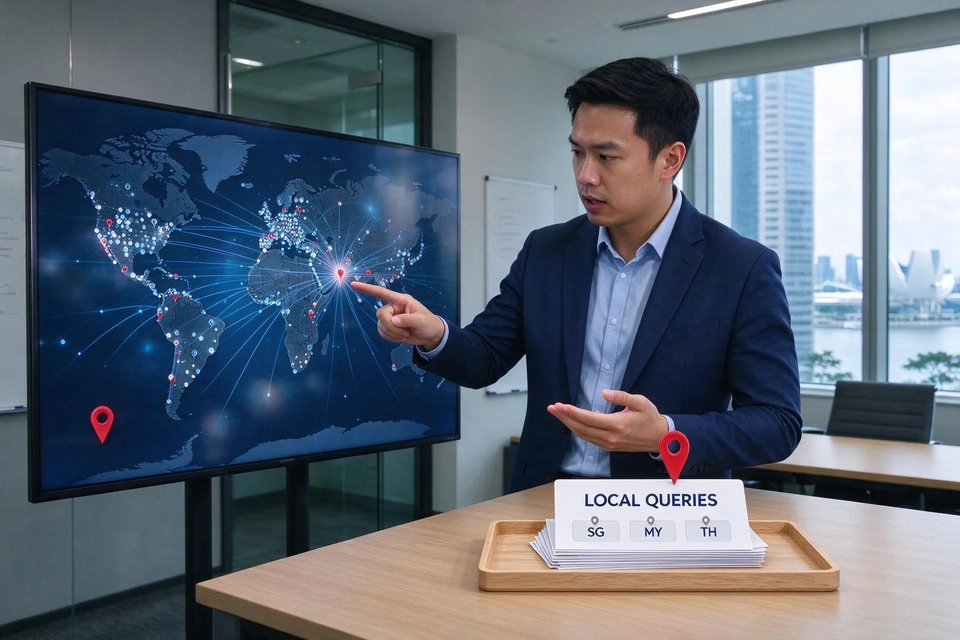
Concentration is the second thing to check. Ahrefs found the most frequently cited domains took 28.9 percent of all AI Overview mentions. Read one way, that is a ceiling nobody should expect to break. Read the accurate way, it means citations follow a long tail: just over a quarter of mentions sit with that small group, and the rest are spread widely enough that a well-structured niche page can land in them.
That tail is where the argument for citation work sits. A brand does not need to beat Wikipedia to be the source an engine picks for "who handles ANSWER ENGINE OPTIMISATION for an SME in Singapore"; it needs the page that answers that exact question better than anything else indexed.
The click side has moved the same direction. Ahrefs reports that AI Overviews reduce clicks by 34.5 percent. That figure is an aggregate across the queries studied, not a promise about your own click-through rate, and it should not be read as a per-page number. It does tell you that a ranking which gets no click has a cost, and that being named inside the answer is the substitute.
Retrieved is not cited: the measurement trap
This is the part most reports get wrong, and it is the reason a citation number can flatter an agency without anyone lying.
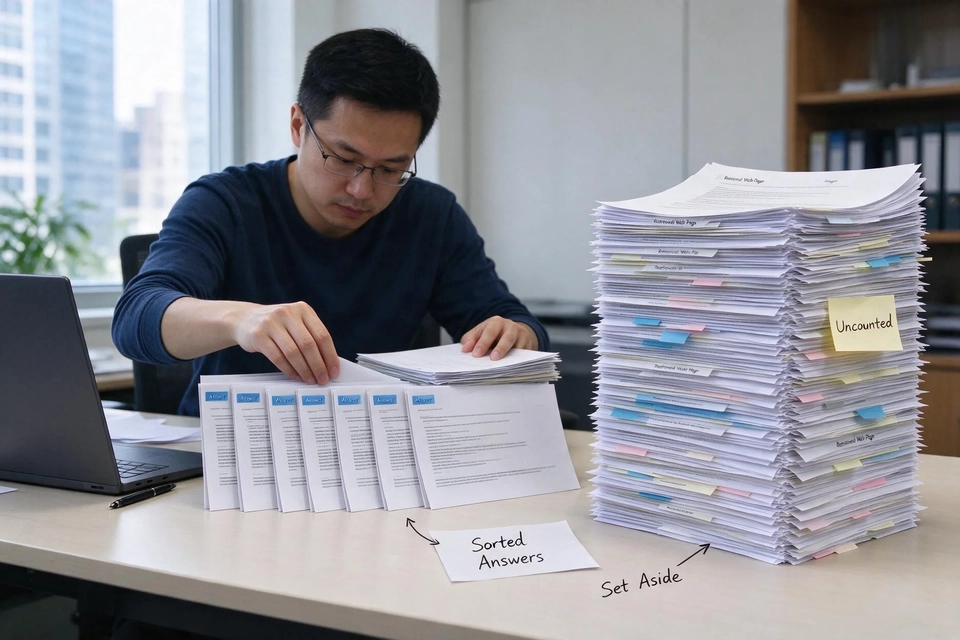
Engines retrieve far more pages than they show as sources in the answer. A tool that lists every retrieved URL under "citations" is counting retrieval, not visibility. Before anyone reports a citation rate, the definition has to be stated: which engines, which questions, how many rounds, and whether a source shown to the engine counts the same as a source a reader sees named in the answer.
HubSpot's free AI Search Grader offers one published shape for a scoring model. It scores a brand across a fixed set of dimensions into one composite, and it currently analyses GPT-5.4 mini from OpenAI, Perplexity and Gemini from Google. Sentiment carries the largest weight, so a sentiment problem will pull a composite score down even when a brand is cited frequently. A composite like that is a perception measure, not a citation count, and the two should not be swapped in a board deck.
For a brand that sells into Singapore, there is a practical wrinkle. A Singapore English buyer asking an engine for a shortlist may get answers drawn from pages published in other markets, because the engines do not index by country in the way a search console report does. That is one more reason to brief a geo agency in singapore with the exact questions your buyers type, in their phrasing. When your agency reports citations, the report has to name the questions in the phrasing your buyers use, not the phrasing that happens to favour you.
The case for backlinks, stated fairly
Backlinks still do a job that citations do not. They are an input to authority signals in classic ranking, and that ranking still decides whether a page is retrieved at all. A page that never enters the retrieval set cannot be cited.
The mistake is treating the two as rivals. A link profile earns a page its place in the candidate pool; citation quality is what gets it named once it is there. Budget allocation follows from which half is failing, and any geo agency singapore proposal should name that half explicitly. If your pages are not being retrieved for the questions you care about, the issue is visibility and structure. If they are retrieved and never named, the issue is how the answer is written and whether the page states a clear, checkable claim the engine can lift.
That distinction gives you a defensible test for any proposal, and it is the first thing to ask when a geo agency in singapore sends a renewal deck. An agency promising more citations should be able to show the retrieval set did not change and the naming did, or vice versa.
Is GEO better than SEO?
This question is common and the honest answer is that it describes a purchase structure, not a ranking of methods, so it deserves to be answered plainly here.
GEO and SEO can be bought separately. GEO covers what AI answers say about a brand and the knowledge content behind those answers; SEO covers organic ranking and on-page work. When a team runs both, shared content work is counted once and the extra page changes and technical implementation sit under SEO. The two lines share a content base, and they are measured on different outputs: ranking positions for one, citation and mention for the other.
So the question "is GEO better than SEO" is malformed. Better at what output? If your goal is a positioning improvement on named queries, SEO reports answer it. If the goal is being the source an engine names when a buyer asks for a shortlist, you need citation data, and no ranking export substitutes for it. A budget move from one to the other is a move between outputs, and it should be argued on which output feeds your pipeline.
What Topkee measures, and what it will not claim
Topkee's GEO service works as a loop. Real buyer questions become a tracked list sampled in agreed generative engines. The follow-up queries are analysed, along with the way AI describes the brand. Competitors are then compared on the same questions. Retrieval sources and cited pages are reviewed before knowledge content is delivered. Each tier sets a number of active tracked questions and a matching number of knowledge pieces per month, the four analyses are included at every tier, and the question count is a concurrent cap rather than a monthly execution total.
Its AI browsing analysis separates sources that were retrieved from citations visible in the answer, and records that existing citation summaries include retrieval sources flagged as not shown in the answer, which cannot be reported as a visible-citation rate and must be counted separately. That is the definitional discipline this article argued for, applied to the client account. Reports are split into four layers: service delivery; search and AI visibility, measured by per-keyword organic ranking, top-ranked keyword count, brand mention rate, owned-site source appearance rate and description accuracy; visits and engagement; business results.
The boundary is worth repeating because it is easy to promise past. Article completion, approval, publication, indexing, ranking and AI citation are six separately counted states, and Topkee's service does not guarantee a specified AI recommendation, fixed exposure or query volume. Backlinks stay in the SEO link building line, where they belong. If you are choosing a geo agency singapore teams can brief, the useful test of any provider is whether it draws those lines as clearly.

Recommended next action
Take your last agency report and mark every number with its definition, its date range and its engine list. Anything you cannot mark, treat as marketing until proven otherwise. If you want to see how the visibility layer is reported in this structure, read [AEO vs. search rankings: AI visibility basics](https://www.topkee.com.sg/dynamic/ai-visibility-vs-search-rankings-is-your-agency-measuring), which sets out the difference between a ranking report and an AI visibility report. The information behind that service outlines the tracked-question tiers and what each analysis covers, and how small businesses compete with big brands on Google Ads shows the paid side of the same visibility problem.
FAQ
How is a citation different from a backlink?
A backlink is another publisher linking to your page. A citation in an AI answer is an engine naming your page as a source inside or alongside the generated response. The first is usually earned and permanent until removed; the second is recomputed per question and per engine round, so it has to be sampled and reported with the questions in view.
Can I measure AI citations myself?
Partly. You can run a set of questions against the engines you care about and record which sources are named. What you should avoid is counting every retrieved URL as a citation. A usable count states the engine, the question list, the number of rounds, and whether retrieval sources are included. HubSpot's AI Search Grader gives a free one-time brand check across GPT-5.4 mini, Perplexity and Gemini, with sentiment as its largest weighted dimension, which is useful as a baseline rather than as a running citation rate.
Does a drop in clicks mean I should stop investing in SEO?
No. Ahrefs' click figure is an aggregate across the queries in its study and it does not describe what happens to any one page. Ranking still determines whether a page is retrieved by an engine, and retrieval is the precondition for citation. The case for shifting budget rests on which output feeds your pipeline, not on a single click number.
What should I put in an AI visibility report for a Singapore business?
Four things at minimum: the question list in the language buyers use; the engines sampled; the brand mention rate and owned-site source appearance rate with their definitions; and a separate line for visits or enquiries, since a citation is not a site visit. If the report merges delivery, visibility and business results into one score, ask for the underlying counts.
Sources
- Justina Thompson, "The role of citations in AEO: Why citations matter more than backlinks for AI visibility", blog.hubspot.com, 2026-11-11. https://blog.hubspot.com/marketing/citations-in-aeo
- "AI Search Grader: Free One-Time AEO Brand Check, No Account Required", HubSpot, undated (accessed 2026-11-11). https://www.hubspot.com/ai-search-grader
- Patrick Stox, "Insights From 55.8M AI Overviews Across 590M Searches—A Study by Ahrefs", Ahrefs, 2025-05-19. https://ahrefs.com/blog/insights-from-56-million-ai-overviews/
- Olivia Sidoti and Colleen McClain, "34% of U.S. adults have used ChatGPT, about double the share in 2023", Pew Research Center, 2025-06-25. https://www.pewresearch.org/short-reads/2025/06/25/34-of-us-adults-have-used-chatgpt-about-double-the-share-in-2023/