SEO tips that still catch leads when AI answers the query
A Singapore SME with a working content engine does not need another numbered list of tactics; it needs the split between the tips that still earn clicks and the tips that now only earn citations. Start with generative engine optimization singapore work on the pages you already own before you commission another twenty posts.
HubSpot's update of its SEO tips post, published on 7 November 2026, puts a number on why. HubSpot research found that 30% of marketers have seen a decrease in search traffic as users prefer conversational search in answer engines. The tips in that post are organised by impact rather than by channel, so the useful reading is to sort them by what each one still produces: a click that can convert, or a citation that keeps the brand in the conversation before the click.
As of November 2026, the split below is my reading of the HubSpot list against a lead-generation funnel. It is not a prediction of your traffic, and the measurement problem behind it is set out further down.
Key takeaways
- The HubSpot post names its own starting point: 26% of SEOs target keywords of moderate to high difficulty, and most of the remainder choose reachable terms. The lift sits in coverage and structure, not in difficulty.
- Core Web Vitals are a technical floor with published numbers: LCP under 2.5 seconds, INP under 200 milliseconds, CLS under 0.1. A page that misses them loses on both search and answer engines before content is judged.
- Intent clusters and answer-first formatting serve both channels at once; they are the only tips in the list that pay twice.
- Citation monitoring is a separate measurement from rankings, and most teams have not started it.
- For a lead-led SME, the order is: fix intent coverage, fix page experience, then earn the citations.
Which of the listed tips still pay, and at what stage
I grade a tip by where it sits in the funnel rather than by whether it is fashionable. A tip earns priority when it moves either the discovery stage or the conversion stage, and it earns caution when it mostly serves an observer inside the marketing team.
| Tip group from the HubSpot list | Stage it serves | Who does it | What it produces now |
|---|---|---|---|
| SERP analysis, intent clusters, pillar-cluster model | Discovery | Content lead | Rankings across many queries, plus material an answer engine can lift |
| On-page structure, answer-first headings, image alt text | Discovery | Writer | Extractable passages; citations in AI answers |
| Core Web Vitals, mobile, technical audit, llms.txt | Both | Developer | Pages that load and can be crawled and quoted |
| CTAs on every page | Conversion | Marketer | Leads from the traffic that does arrive |
| Link building, brand mentions, E-E-A-T | Authority | Founder or PR | Trust signals read by search and by AI systems |
| Historical optimisation, content pruning | Maintenance | Content lead | Keeps the older inventory earning |
The rows that changed meaning are the ones near the top. When an answer engine lifts a paragraph and presents it without a click, the discovery work still produced value, but the value arrives as a mention rather than a visit. The conversion rows do not change: a page that gets a visitor still has to offer a next step, and a page that gets only a citation has to be good enough to make the brand look like the safe choice.

Why keyword difficulty is a weaker choice than teams assume
The difficulty split is the more quietly useful finding in the survey. HubSpot's Web Traffic & Analytics survey found 26% of SEOs target keywords of moderate to high difficulty, and the survey's other stated group is the one aiming at low-difficulty terms. Taken together, roughly two in three listed teams are already trading head-term volume for reachable terms.
That matters for a generative engine optimization singapore plan because it tells you where the fight is not, and the share that opted for easier terms is the larger group. Most of your competitors are aiming at terms you can also reach, so difficulty alone will not separate you. What separates teams is how completely each cluster is covered: whether the page answers the follow-up question, the comparison, and the exception, or stops at the definition.
There is a caveat I would put in front of any client reading this. The survey reports what SEOs say they target, not what they achieve, and it sits on a self-selected panel. Treat them as a description of intent among the respondents, not as a market-wide benchmark you can plan a budget against.
Building intent clusters instead of single-keyword pages
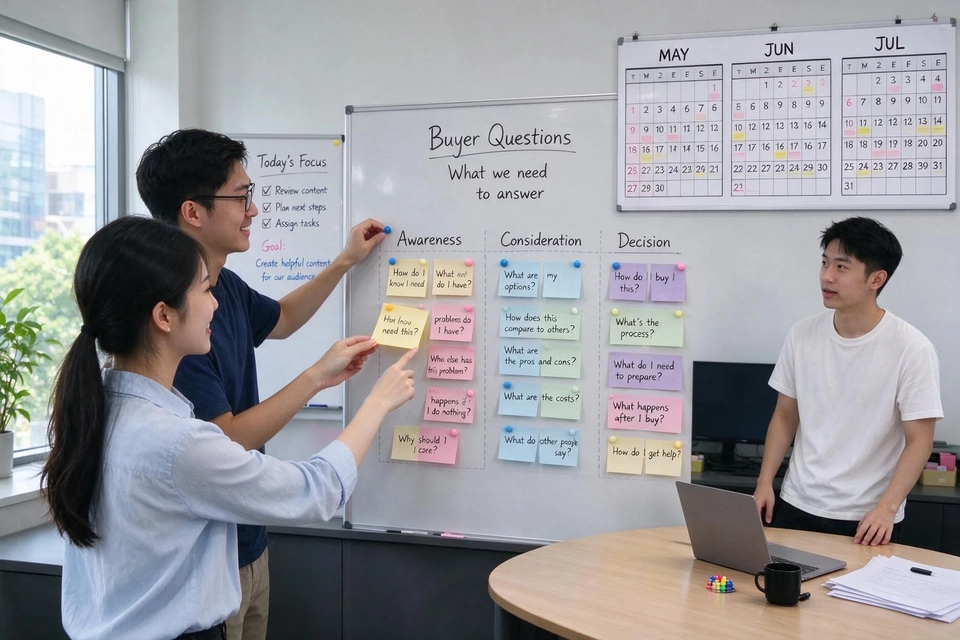
An intent cluster is a set of questions a buyer asks in sequence, answered in one place or one connected group of pages. For a Singapore consultancy selling a high-ticket service, that sequence usually runs from what the service is, to who does it well, to what it costs here, to what happens after signing.
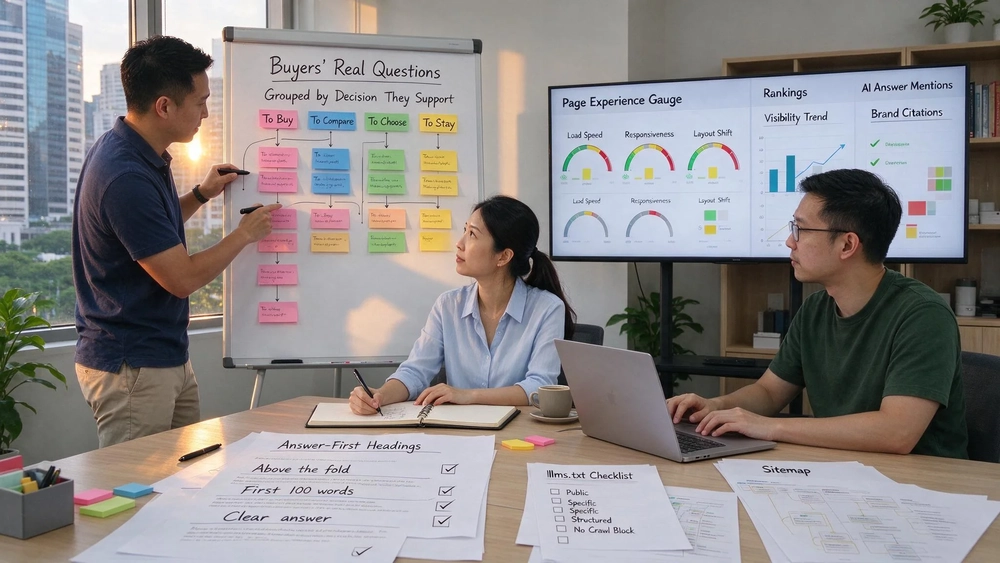
A geo agency singapore brief and an in-house sprint use the same method here, and it is short enough to try on one service this week:
- List the questions real buyers asked in the last quarter, in their words.
- Group them by the decision they support, not by the phrase they share.
- Give each group one page that answers the main question in its first hundred words, then the follow-ups as sub-sections.
- Link the group to a pillar page that explains the whole subject once.
- Retire any page that answers a question the buyer no longer asks.
Account managers already hold step one. The list of questions a buyer sent before signing is a better keyword source than any tool export, because it is filtered by someone who had to answer it. Keeping each question as a tracked item also gives you a baseline: you can check later whether an answer engine quotes you for that question, which a volume figure cannot tell you.
Technical tips that are floors, not advantages
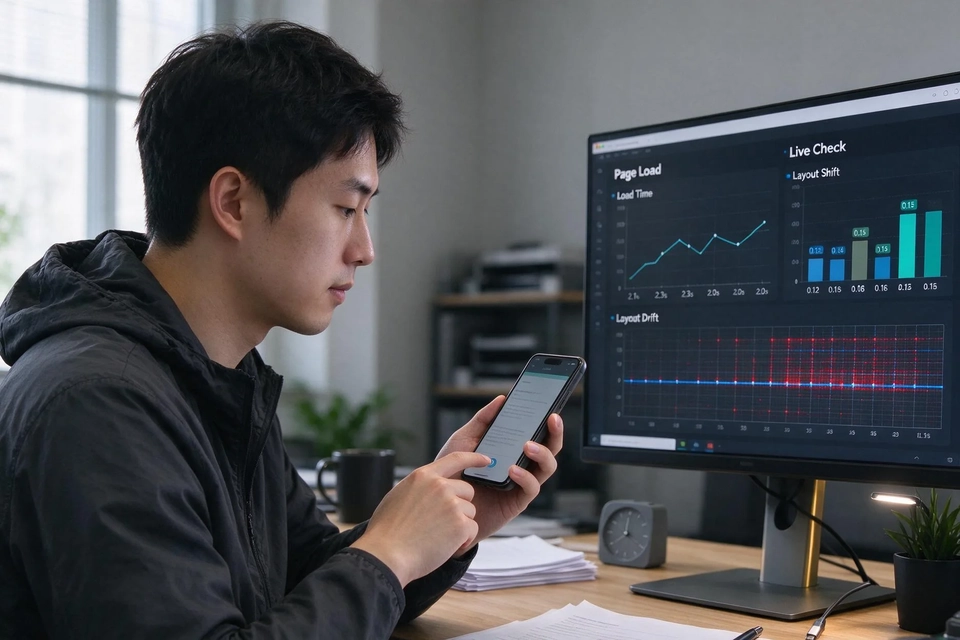
The HubSpot list puts three Core Web Vitals thresholds against Google's ranking signals: LCP under 2.5 seconds, INP under 200 milliseconds, CLS under 0.1. The LCP figure measures how quickly the main content loads. INP measures responsiveness to clicks and taps. CLS measures how much the layout shifts while the page renders.
These read as a floor for a reason. A page that fails them is judged on the failure before its content is read, and an answer engine that cannot retrieve the page quickly has nothing to quote. The fixes in the source are ordinary: compress images, cut render-blocking JavaScript, reserve space for embeds. What is not ordinary is keeping the check running, since performance drifts as plugins, tags and embeds are added.
One item on the technical list matters for any generative engine optimization singapore audit: llms.txt, a file that describes a site for AI crawlers. It is worth publishing because it costs little, but I would not present it as a switch that makes a brand visible in AI answers. No published data in this dossier shows what it delivers, and the honest position is that it belongs in the baseline alongside the sitemap rather than in the plan that turns the quarter.
The measurement gap between rankings and citations
This is where the news item and the generative engine optimization singapore question meet, and it is the part most tip lists skip. Rankings and citations are two different counts taken from two different systems, and a team that reports only the first is reporting half of its discovery performance.
The HubSpot post is explicit that search visibility now spans rankings, clicks and AI citations, and that a growing number of queries end without a click. It also says that content structured with answers under descriptive headings is more likely to be extracted for an AI answer. Two consequences follow for a Singapore team.
The first is that the reporting line has to change. A weekly rank check shows whether a page is on page one; it does not show whether the brand appeared in the answer above the page. Keep a small set of buyer questions, ask them in the engines your buyers use, and record three counts per question: brand mentioned, brand's page cited, neither. That table is small enough to keep by hand and it is the only way to see the channel you have lost traffic to.
The second is that the owner of a citation cannot be inferred from size. A global brand's content set was not written against the questions a local audience asks, and an engine answering a local question needs the material to exist somewhere it can retrieve. An answer engine optimisation plan built on global templates will miss that local question, even when the brand is well known.
What Topkee's GEO service does about it
Topkee's GEO service is built around the gap this article describes: a brand that is known to its clients but not to the answer engine their clients now ask. Its method is easier to judge than a package name.
Topkee monitors and analyses the questions buyers put to AI engines, identifies the sub-queries an engine returns for each one, and records which brand knowledge is missing before a buyer can compare and choose. The work links monitoring and analysis to content delivery, so a gap found in an answer becomes a page or a section to write rather than a slide in a report. Competitor comparison runs the same question set against the brand and its rivals and records which sources the answers cite, which is how a gap is identified per question instead of being inferred from advertiser size. Prompt monitoring keeps the period, question version, engine, sample size and failure count alongside the answers, and the service states that it does not guarantee an AI recommendation or a fixed level of exposure. Any geo agency singapore brief is worth reading against that scope: if a proposal promises a ranking position in an answer, it is promising something the engine controls.
A three-month order for a lead-led team
The sequencing matters more than the individual tips, because each step makes the next one cheaper. A quarter spent in the wrong order produces reports nobody acts on.
| Month | Focus | Output you can check |
|---|---|---|
| One | Intent coverage on the two pages closest to a sale | One page per cluster, follow-up questions answered under headings |
| Two | Page experience and retrieval | Core Web Vitals inside the three thresholds, sitemap and llms.txt confirmed |
| Three | Citation tracking and reinforcement | Three counts per buyer question, material written for the gaps found |
By the end of the quarter the team holds two things it did not have at the start: a cluster that answers real questions and a table showing where the brand appears in answers. Both are decisions a budget owner can act on, and neither depends on a promised ranking.
Recommended next step
Before the next content sprint, pick ten questions your buyers have asked in the past quarter and run the three-count table on them. Where the count is zero across all three, that question is the next piece to write, and it is the highest-return page you can publish this month. For the measurement side of the same work, read [AEO vs. Search Rankings: AI Visibility Basics](https://www.topkee.com.sg/dynamic/ai-visibility-vs-search-rankings-is-your-agency-measuring) and compare it with how Topkee runs Google and Meta campaigns for Singapore lead generation, since the same attribution discipline applies to both channels.
FAQ
Do the classic SEO tips still work in 2026?
Most of them do, but they now pay in two currencies. On-page structure, intent coverage and page experience still earn rankings and clicks, and the same work makes a page quotable in an AI answer. What has stopped working is treating rankings as the only output to report.
How many SEO tips should a small team act on?
Fewer than the list offers. A team with one writer and limited developer time should pick the tips that serve the decision closest to a sale, usually intent coverage and page experience, and leave link-building and historical optimisation for the following quarters.
What is the difference between SEO and AEO?
SEO aims to get a page ranked and clicked in a results page. AEO aims to get the brand selected and quoted inside an answer that an engine writes. The content work overlaps, but the measurement does not: AEO has to count mentions and citations, not positions.
How do we know whether an AI engine cites us?
Keep a short list of buyer questions, ask them in the engine your buyers use, and record per question whether the brand appears, whether your page is cited, and whether neither happens. Repeat on a fixed schedule with the same wording, because a reworded question is a different question.
Is llms.txt worth publishing?
It is cheap enough to be worth adding to the baseline, and it belongs next to the sitemap in the technical checklist. It is not a lever you can plan a quarter around: the evidence in this source set says nothing about what it delivers, so treat it as hygiene rather than strategy.
Sources
- Rebecca Riserbato, "SEO tips to help your content catch leads [expert advice]", HubSpot Blog, 2026-11-07. https://blog.hubspot.com/marketing/seo-tips