Scrunch vs Ahrefs: AEO tools in Singapore
Should your team buy a specialist tool for AI search, or let the SEO platform you already pay for handle it? That is the question behind most Scrunch versus Ahrefs conversations, and the answer depends on whether you need someone to change your site for AI crawlers or to measure AI answers. A third option sits beside both: a geo agency singapore team that runs the programme end to end. As of November 2026, every route here starts under a thousand dollars a month.
Key takeaways
- Ahrefs Brand Radar works from 406M+ monthly search-backed prompts and covers 7 AI platforms on every tier.
- Scrunch tracks four LLMs on Core and nine on Enterprise, and also rewrites pages for AI crawlers at the edge.
- Ahrefs Lite starts at $129/month and Scrunch Core costs roughly twice as much, though the two count prompts in different units.
- Google AI summaries now change how often people click, which is the practical reason to track AI answers at all.
- Test both vendors against the same prompts and your own manual answers before you commit to a year.
What each tool actually measures
HubSpot published the comparison on 6 November 2026 and framed it as a specialist purchase against an existing platform. The two products sit on different layers of the same problem.
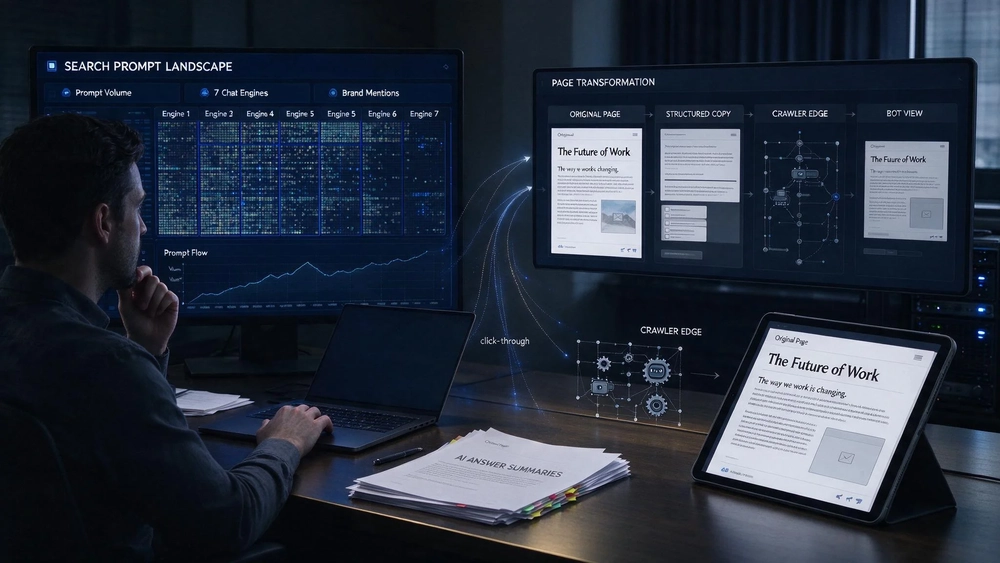
Scrunch is an Agent Experience Platform (AXP) from Sitecore. At the edge it recognises AI agents such as ChatGPT or Perplexity, then hands them a lean, structured copy of each page while human visitors still see the full site. Ahrefs Brand Radar lives inside the Ahrefs account, so brand and citation data sit beside the SEO reports the team already opens.
So Scrunch measures AI answers and then edits what bots receive. Ahrefs measures AI answers and passes the insight back into SEO workflows. A team rarely needs only one of those jobs done.
| Question | Scrunch | Ahrefs Brand Radar |
|---|---|---|
| Prompt source | AI Search Trends estimates, fan-out analysis, custom prompts | 406M+ search-backed prompts, plus custom prompts |
| Engines | Four on Core, nine on Enterprise | Seven on all tiers |
| Non-LLM surfaces | Product-level AI shopping | YouTube, Reddit, TikTok in beta, Google Business Profiles |
| Bot-side delivery | Yes, through AXP edge serving | No |
| Full SEO suite | No | Yes |
How much engine coverage do you need?
Coverage is where the trade-off is easiest to see, because each vendor buys breadth in a different place.
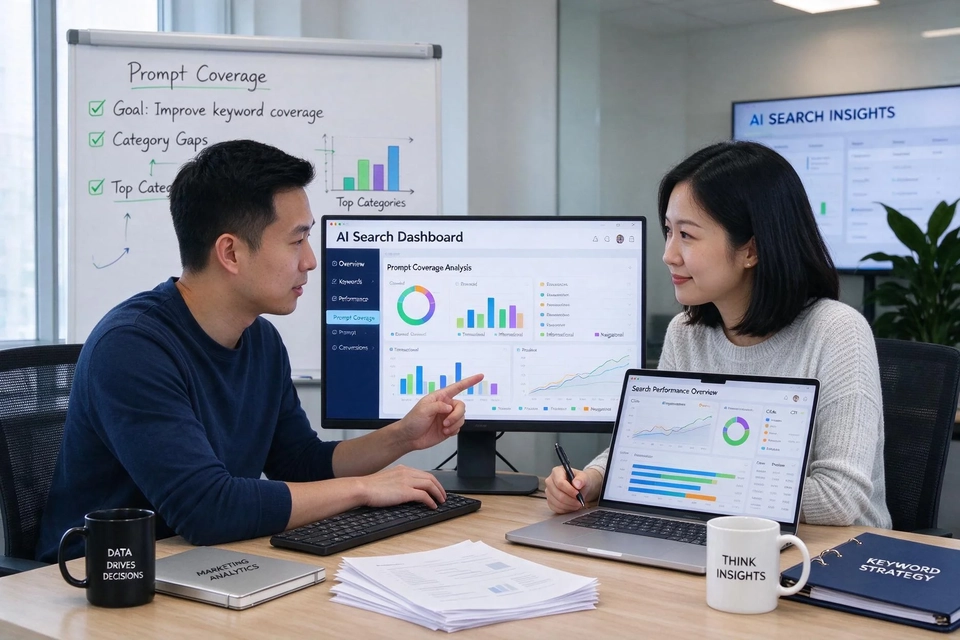
Brand Radar names seven platforms on every plan. Scrunch's Core tier names four, and Enterprise adds five more engine names to reach nine. A team that wants many engines without an enterprise agreement therefore gets more from Ahrefs out of the box. Scrunch puts its extra scope into shopping visibility, crawler-side tools and aeo delivery at the edge.
Ahrefs also reaches beyond chat engines into YouTube, Reddit, TikTok in beta and Google Business Profiles. That matters for consumer categories where buyers ask communities rather than assistants. Scrunch's product-level shopping view matters for ecommerce teams whose answers include product recommendations.
Start from the engines your buyers mention in calls and analytics referrals, then widen. Most Singapore teams building an AEO programme begin with Google's AI surfaces because of the traffic already sitting there.
Where do the prompts come from?
How a vendor builds its prompt set shapes how far you can trust a visibility score, and here the two products genuinely diverge.
Ahrefs anchors its prompt universe to real keyword demand: a proprietary base of 406M+ search-backed prompts, drawn from what people actually type rather than synthesised questions, with your own custom prompts allowed on top. Scrunch estimates prompt activity with AI Search Trends, spots emerging topics and gaps, and runs fan-out analysis to show how one query breaks into follow-up searches.
Neither sample is your market. Every tool watches a slice of prompts, and answers change with session, location and wording, so treat the numbers as direction of travel. A consistent prompt set tracked over months still tells you whether you are gaining or losing ground.
Search-backed prompts fit teams that already plan content from keyword research, which is also where most geo agency singapore engagements start. Custom-prompt tracking fits teams mapping AI-only buyer questions that keyword tools never see, and most aeo programmes end up needing both lists.
Why does click behaviour make tracking urgent?
The case for paying for any of this comes from outside both vendors, and it is about how people behave once an AI summary appears.
Pew Research Center studied 68,879 unique Google searches made by a panel of U.S. adults in a single month of 2025. Among visits where a summary appeared, readers clicked a conventional result in 8% of visits; without a summary the figure was 15%. Clicks on links inside the summary itself happened in 1% of those visits. Sessions ended on 26% of pages carrying a summary, a higher share than the pages without one.
The effect grows with research-heavy queries. Across that month 18% of searches returned a summary, rising to 53% for searches of ten words or more and 60% for queries opening with a question word. The median summary ran 67 words, and 88% of them cited three or more sources.
Read together, those figures explain the market: answers now absorb a large share of research, and the sources named inside them send few visitors. Being the source an engine names has become its own channel, separate from holding a ranking.

How much do the plans cost?
Compare whole scenarios, not entry prices, because the two vendors count in different units. Where a figure is not published, the table says so. The rest come from the vendor documentation the news comparison draws on, dated to its October snapshot, and can change.
| Plan | Monthly price | Prompts | What else |
|---|---|---|---|
| Scrunch Core | the entry rate the source lists | the published prompt cap | four LLMs, five audits, five licences |
| Scrunch Agency Core | $500/month | a larger prompt cap | three brand and three pitch workspaces |
| Ahrefs Lite (bundled) | $129/month | checks for five prompts | full SEO suite |
| Ahrefs All Platforms | $699/month | the full-database allowance | full prompt database |
| Ahrefs Lite billed annually | $108/month | checks for five prompts | billed yearly |
Two things change the arithmetic. Scrunch counts unique prompts while Ahrefs counts prompt checks, one per run, and the bundled Ahrefs plans divide down to roughly thirty runs per tracked prompt each month. On top of that, the Ahrefs bundles carry the whole SEO suite, including Keywords Explorer with 28.7B keywords, so the true cost of its AI layer depends on whether you would buy Ahrefs anyway.
Agency Core on the Scrunch side adds unlimited licences, Looker Studio connectors and MCP access on top of the Core allowances of five site audits and five user licences per month.
Who should pick which?
The right pick usually follows where your team already works, not the feature matrix.
A team that lives in Ahrefs should begin with Brand Radar, the usual first stop for AI visibility tracking. No new vendor, no second login, no separate reporting layer, and AI findings sit beside the SEO data the team already trusts. Bring in Scrunch when the real gap turns out to be crawler access or product-level shopping visibility, and consider a geo agency singapore partner when nobody in-house can run either.
A team starting an AEO programme on a tight budget should buy the smallest plan that answers its questions. Ahrefs Lite at $129/month is the least expensive way to watch AI answers, though it carries only five tracked prompts. Scrunch Core buys more unique prompts, but on fewer engines.
Before you buy either, check whether the aeo work can be run in-house at all. This advice does not fit everyone. Brands selling mainly offline, or without a content team to act on recommendations, get little from either tool. Businesses whose buyers never consult AI before purchasing should watch the market rather than buy into it.
How should you trial them?
Demos show you a curated view. Your own prompts show you the market you sell into, so run one test across both tools.
- Choose 15 to 25 prompts that match real buyer questions at awareness, comparison and purchase stage.
- Run each prompt yourself in the engines that matter and save the answers.
- Check whether each tool reports the same brands and the same cited sources you saw.
- List any engine you need that the plan leaves out.
- Ask for citation data on your prompts, exported, since a claim without a named page leaves nothing to fix.
Scrunch gives entry tiers a 7-day free trial, so the test costs nothing there. Ahrefs runs no free trial or discount on Brand Radar, so ask the sales team about a pilot before you sign.
The Topkee view: measurement joined to delivery
Tracking is half the job. Topkee's GEO service joins the monitoring to the delivery that follows: real buyer questions and sampled prompts come first, query fan-out shows how one question spreads into related searches, and sentiment and description analysis show how engines characterise a brand beside its competitors. From the same dataset it reads AI browsing and cited sources so the team knows which pages and third-party sites the answers lean on. Engagements carry a band of active tracked questions and a published entry rate.
That model fits teams that want analysis and delivery handled by one party. Teams with a capable in-house content unit may only need the measurement layer, and either vendor above supplies it.
What if nobody in-house can run the programme?
For some Singapore teams the real constraint is capacity, not tool choice: nobody can read the dashboards, brief writers and chase citations each month. Then the question shifts from which product to which partner, and the tool becomes one input among several.
A quick screen is whether a partner can name, in the first meeting, the questions your buyers ask and the third-party sources the answers favour. A pitch that opens with a dashboard tour rather than your buyers has skipped the part that decides results.
If this primer is your first step, our explainer on [AEO vs. Search Rankings: AI Visibility Basics](https://www.topkee.com.sg/dynamic/ai-visibility-vs-search-rankings-is-your-agency-measuring) sets out how AI answers differ from rankings, and AI answer ad counts: what apparel and electronics show shows how much ad space AI results already carry in two categories.
FAQ
Is Brand Radar included in a normal Ahrefs plan?
It comes bundled with the Lite and Standard suites, with tracked prompts capped well below what Enterprise allows, and also sells alone at $699/month for All Platforms with the full prompt database.
Can I start with Scrunch without an enterprise deal?
Yes. Scrunch Core is the entry tier, with four LLMs and its published prompt cap, on a 7-day free trial.
Which tool shows who AI cites, not just whether I appear?
Both report on citations, but the depth varies by plan and the vendor documentation does not describe it evenly. Ask for citation-level exports on your own prompts while trialling.
Do I still need regular SEO if I buy an AI visibility tool?
Yes. AI answers cite pages that compete on conventional SEO signals too, and in Pew's study the summaries sat above the traditional results rather than replacing them.
How many prompts should a small team track?
Begin with the questions closest to purchase, then add awareness prompts. A small team does better with a short prompt list it acts on than a long one it never reads.
Sources
- HubSpot Staff, "Scrunch vs. Ahrefs: AI visibility tracking comparison", HubSpot Blog, 2026-11-06. https://blog.hubspot.com/marketing/scrunch-vs-ahrefs
- HubSpot, "AEO Tools to Track & Improve Your AI Visibility", HubSpot, 2026-11-09. https://www.hubspot.com/products/aeo
- Athena Chapekis and Anna Lieb, "Do people click on links in Google AI summaries?", Pew Research Center, 2025-07-22. https://www.pewresearch.org/short-reads/2025/07/22/google-users-are-less-likely-to-click-on-links-when-an-ai-summary-appears-in-the-results/