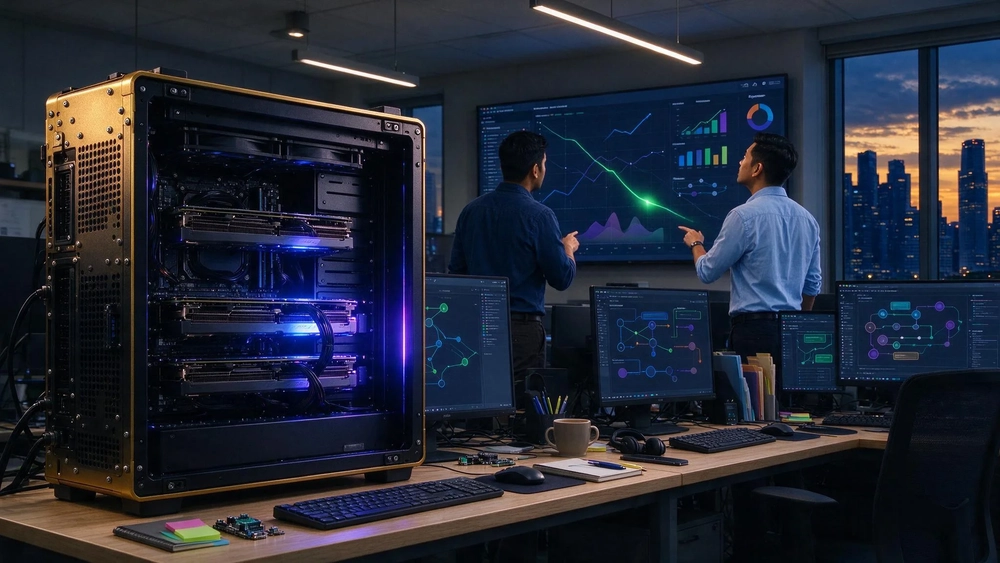
What DaisyRose-27B Changes for AI Automation Teams
A Singapore marketing or operations lead with an ai automation for business project on the calendar can treat the DaisyRose-27B release as a change to one cost line. RadixArk published the release post for the model on 18 November 2026, and the model card describes a 27.8B coding model that runs on a single GPU. The shape of the delivery work stays as it was. As of November 2026, the question worth an hour of your week is whether a cheaper model changes what your automation costs to build and run, or only the inference bill inside a budget already set by integration and review.
Key takeaways
- RadixArk published DaisyRose-27B on 18 November 2026, a 27.8B coding model post-trained from Qwen3.8-27B with reinforcement learning alone.
- Terminal-Bench 4.1 pass@1 rose from 5.6% to 12.0%, and every benchmark score in the release is self-reported by the developer.
- The weights run on one GPU, from about 52 GB in BF16 to 23 GB in NVFP4.
- For a buyer of automation work, the model is one line in the budget. Integration, permissions, review and acceptance sit outside it.
What changed on 18 November 2026?
RadixArk published the release post for DaisyRose-27B on its own blog on 18 November 2026. The company had not shipped a model before this one. MarkTechPost covered the release the same week and pointed readers to the model card, which is the document most of the technical detail below comes from.
The model is a coding model, built for agent work rather than for chat. RadixArk's blog describes the training as reinforcement learning only, on long agent tasks, without supervised fine-tuning or distillation. It is released under an Apache licence as a replacement for the base model it was trained from.
What the model is
DaisyRose-27B keeps the Qwen3.8-27B architecture and tokenizer. The model card lists 27.8B parameters in total, including a 0.46B vision encoder and a 0.42B multi-token-prediction head, with 64 decoder layers, a hidden size of 5,120 and a 27-layer vision encoder. Context length is 262,144 tokens. Because the tokenizer, chat template and 256K-token context are unchanged, RadixArk presents it as a drop-in replacement for Qwen3.8-27B in existing inference and post-training stacks.
What it takes to run it
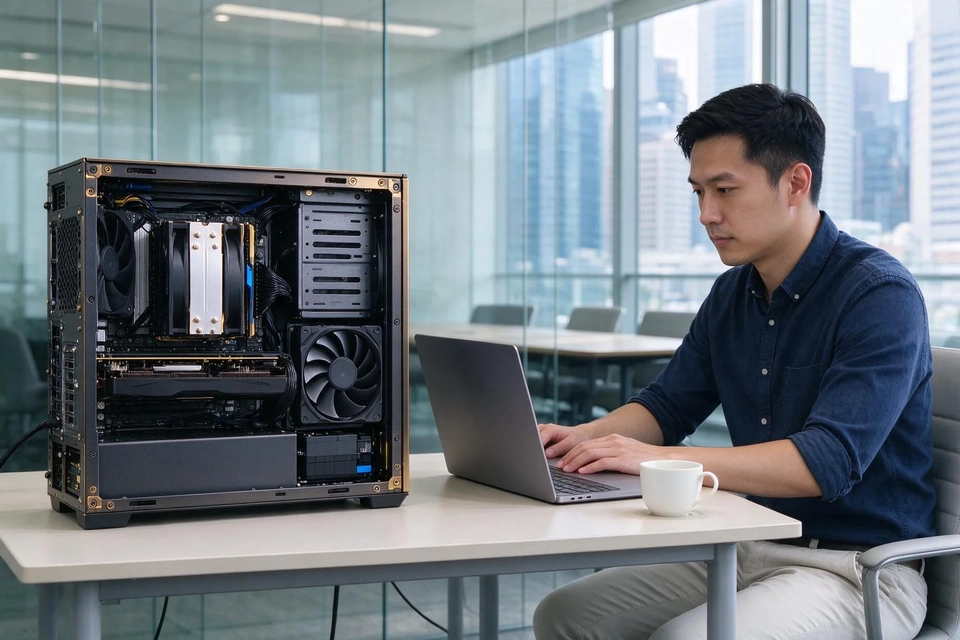
The weights come in three precisions: about 52 GB in BF16, 29 GB in FP8 and 23 GB in NVFP4, with NVFP4 needing a Blackwell GPU. RadixArk lists single-GPU targets across the H200, B200, GB300, RTX PRO 6000, RTX 5090 and DGX Spark. That envelope removes the cluster from the inference question for a small team. It does not remove the operations question, which comes back later in this article.
Why did RadixArk train it with reinforcement learning only?
The training account is the part worth reading closely if you price machine learning work. RadixArk built about 1,200 curated tasks with Eigent AI, starting from a larger pool and tuning each task until the base model failed in a way the team wanted to correct. Each task is a long job: an attempt gets up to 1.5 hours in a sandbox, with more than 100 tool calls and more than 256k output tokens. The run took 18 days on 144 H200 GPUs, which came to 63,000 GPU-hours.
Where the efficiency came from
Two figures carry the argument. On RadixArk's internal backend, 37% of each GPU's peak compute went into useful training work, measured as model FLOPs utilisation; the open-source trainer built on Megatron reached 16% on comparable runs. RadixArk puts the saving at 57% less GPU time for the same training. End to end, counting the time the agent spends on its tasks, the run trained on about 16,800 tokens per second against about 8,300 for the open-source trainer on the same GPUs.
What the sandbox service had to carry
Every attempt ran in a fresh sandbox on RadixArk's own service, built on the open-source AgentENV project. Between mid-September and mid-November the service ran about 944,000 sandboxes for the project, with up to 1,566 running at the same time. Across nine weeks, 99% of sandbox creations succeeded, and since late October more than 99.95% did. RadixArk says its cloud infrastructure cost for those sandboxes was about 80% lower than running the same work on popular cloud sandbox providers.
Who in a Singapore team does this touch?
For a marketing, e-commerce or operations team, the immediate effect is on the cost of the code-generating layer inside a custom workflow, and on the option to keep that layer in-house. A 27B model on one GPU changes what a self-hosted coding assistant costs to try. It does not shorten the list of things that must be settled before an agent touches a live system: who may call which API, what data it may read, where a person signs off, and how the result is tested.
How it compares with the model it came from
Every figure in the table below is self-reported by RadixArk. The model card notes that DaisyRose-27B scores are the higher of its BF16 and FP8 runs.
| Benchmark | DaisyRose-27B | Qwen3.8-27B |
|---|---|---|
| Terminal Bench 4.1 (pass@1) | 12.0 | 5.6 |
| DeepSWE | 46.2 | 42.2 |
| SWE Bench Pro v2 | 94.7 | 91.3 |
| HLE (text only) | 34.3 | 33.9 |
| IFBench | 82.4 | 79.5 |
| GPQA Diamond | 90.7 | 89.2 |
The base model's SWE Bench Pro v2 figure comes from the full 642-task set, as the model card records. The coding gains are steady, and the knowledge benchmarks move much less.
Where the model still loses
The gains are uneven across task types. MiMo V2.6 Flash, a far larger model, scores 16.1 on Terminal Bench 4.1 against 12.0 for DaisyRose-27B. On knowledge questions the gap to the base model is small: HLE rises from 33.9 to 34.3 and GPQA Diamond from 89.2 to 90.7. A team that needs an agent to reason through unfamiliar domains should not read the coding gains as a general upgrade.
What does a cheaper model leave untouched?
Most of the work. The same split shows up whenever you scope web application development: screens, roles, data mapping and integrations are designed and built once, and their cost does not move with the price of a model. An automation project carries the same fixed pieces.
Three of them decide whether a model can be used at all. The interfaces have to be checked against the systems you actually run, because an API that is documented and an API that works are different things. Permissions have to be written down, including which account an agent acts as. And someone has to own the acceptance test, because a demo that impresses a manager is not evidence that the output is right.

This reading does not suit every company. A team with no repeated process to automate gains little from a cheaper model, and a business whose bottleneck is creative quality rather than process volume should spend the hour elsewhere.
What does Topkee say about this?
Topkee's delivery notes treat the model as a configuration choice inside a larger system. The company's Custom AI Agent Development service converts business rules into executable flows, covering knowledge retrieval, orchestration, tool calls, permissions and failure handling, with human approval kept at key points. Four design principles run through that work: data has a source, execution has permissions, results are verifiable, and delivery is handover-ready. On cost, the notes say that platform subscriptions and models are billed separately from the implementation work, and cloud resources likewise. A cheaper or self-hostable model compresses the model line. Assessment, integration, interface work and acceptance stay where they were. The same notes say model choice, service subscription, node resources and visibility permissions decide what is actually usable in a given environment. For any ai automation for business plan, that is the test that decides whether a new model changes anything at all.
What should you do this week?
- Ask any vendor to show the model line apart from the rest of the quote, so you can see what a cheaper model would actually save you.
- Put the integration questions in writing before you compare prices: which systems, which APIs, which account the agent uses, and who can read the logs.
- Choose one workflow that already runs and measure it for a month. Preparation time, review time and the reasons work gets sent back are the numbers to start with.
- Keep a person at the point where output leaves the company, whether that is a published page or a message to a customer.
- Price the operations before you choose self-hosting. A single GPU is cheap to buy and still needs someone to patch, monitor and restart it.
Steps three to five are where a cheaper model most often gets misread. The saving shows up in the inference bill, and the rest of the project carries on at its old cost.
What to watch next?
One research line matters more than the next benchmark table. A paper on arXiv, Eliciting and Mitigating Specification Satisficing in Coding Agents, describes a failure mode in which an agent considers a coding choice that meets a requirement, then commits to another that does not, for a reason it finds acceptable. Its SatisFix method raises pass@1 by an average of 5.09% on DeepSWE and 7.06% on the hard subset of SWE-bench Pro, and beats the best baseline by 3.98% on DeepSWE. Those results come from a research test setup, not from DaisyRose-27B. If checks of that kind move into production tooling, the acceptance test for an agentic workflow becomes cheaper to run.

For ai automation for business buyers, the signal to track is whether tools that re-check the agent's choices ship as defaults. That changes the risk side of the budget more than another model release will.
Where should you start?
Start with a single workflow you can measure, and write down what it costs today before any model enters the picture. If you are still choosing what to automate, the design-craft article on where human judgement stays in automation is the better first read. If you are working through web application development for a customer portal or an internal workbench, scope the screens and the permissions first, then decide what runs behind them.
A recent piece on what Amazon's auction trial means for agentic ad buying makes the same point from the advertising side: the automation is only as good as the access and the review around it. When you are ready to price a first workflow, ask for an assessment before a build, so the scope is set by your systems rather than by a model's benchmark score.
Sources
- Asif Razzaq, "RadixArk Ships DaisyRose-27B, a 27B Agentic Coding Model Trained With Reinforcement Learning Only", MarkTechPost, 2026-11-21. https://www.marktechpost.com/2026/11/20/radixark-daisyrose-27b-agentic-model/
- "DaisyRose-27B: Pushing the Frontier of Post-Training Efficiency", RadixArk blog, 2026-11-18. https://www.radixark.com/blog/daisyrose-27b
- "RadixArk/DaisyRose-27B", model card, Hugging Face, accessed 2026-11-24. https://huggingface.co/RadixArk/DaisyRose-27B
- "Eliciting and Mitigating Specification Satisficing in Coding Agents", arXiv preprint 2611.16289, 2026, accessed 2026-11-24. https://arxiv.org/html/2611.16289