
PLG Funnel vs Flywheel: Which Gets More Leads?
A product-led growth funnel and a product-led growth flywheel pull growth from different places. The funnel moves a wide audience toward a purchase in stages and keeps a record of each stage it converts. The flywheel keeps working on users after they sign up and asks them to bring the next cohort in. For a software team in Singapore trying to get more leads for my business, the workable answer usually mixes the two: run the funnel wherever a person still has to close a deal, run the flywheel wherever the product can carry the deal by itself, and keep one ledger that shows what happens after conversion.
- A funnel fits when a person still closes the deal or the product needs explaining.
- A flywheel fits when users reach value without a rep and can invite others.
- Both models hide the same blind spot: acquisition counted, everything after sign-up unmeasured.
- Test on one segment and one quarter of your own data before reorganising the team.

The two options, and who is asking
A product-led growth funnel moves a broad audience through touchpoints toward a sale. Clearbit's grouping, as Contentsquare's guide reports it, splits PLG funnels into four types by user and company goal: self-serve, where a buyer completes the purchase alone; sales-assisted, where the buyer gets most of the way and a rep closes; bottom-up, where sales widens use inside an account; and top-down, where a large account gets white-glove attention. In its simplest form the funnel has three stages: free trial sign-up, product usage and conversion.
A product-led growth flywheel works from the same product experience but spends its effort after sign-up. The model comes from Appcues, whose team interviewed nearly 100 SaaS companies to build and validate it. The inner ring holds four user segments mapped onto marketing phases from awareness to evangelism: evaluators, beginners, regulars and champions. The outer ring names the actions that move a user forward: activate, adopt, adore and advocate. Advocates bring new evaluators, and the cycle repeats.
The question arrives when trial signups rise while revenue stays flat, or when every signed deal needed a rep on the final call.
The criteria that matter in Singapore
Both models are judged on the same six criteria, the ones a Singapore buyer applies to any best lead generation proposal.
Who closes the deal
One of Clearbit's four types is fully self-serve; others end with a rep closing inside the product or working an account upward. A flywheel assumes the user can finish the journey alone and needs a nudge from the product rather than a call.
Singapore makes this criterion sharper than it looks. SME buyers often decide quickly, but procurement at larger firms involves more than one approver, and a trial can stall while they compare options. A rep who answers a security or billing question keeps that deal alive, and a flywheel has no designated place for that conversation.
How long value takes
Time to first value decides the work. If a user reaches a useful result in the first session, the funnel's usage stage is where to watch. If value arrives after setup or an import, the flywheel's beginner segment carries the retention risk.
Which segments you sell to
A single model rarely fits a mixed book. SMB buyers accept a card and a self-serve plan; enterprise buyers expect a scoping call, a security review and a named contact. Contentsquare's guidance agrees: companies serving both ends run the funnel where sales stays necessary and the flywheel after sign-up.
What your data can see
The funnel is easier to instrument when touchpoints are visible: page visits, form fills, chat starts, calls. The flywheel asks for something harder, product usage data joined back to the marketing record. ProductLed's guide to a PLG marketing stack puts the customer data platform and the data warehouse at the centre for this reason: signup and usage events have to reach the tools where campaigns run and leads are graded.
Who owns the customer after sign-up
A funnel handed to sales ends at the signed deal. A flywheel continues into onboarding, habit and advocacy, which puts product and customer success in the lead. If nobody owns the period between sign-up and first renewal, no team will do that work.
Budget and team shape
The funnel suits a small team with a clear conversion target, because every stage has an owner and a number. The flywheel needs people who can change onboarding, in-product messaging and support, which means product and customer success time. A team that funds acquisition only keeps a flywheel running at the speed of its slowest handoff.

Side by side on the same criteria
| Criterion | Product-led growth funnel | Product-led growth flywheel |
|---|---|---|
| Who closes | Self-serve, sales-assisted, bottom-up or top-down; a rep can close | The product carries the journey; advocacy brings the next user |
| Stage that gets attention | Free trial sign-up, usage, conversion | Sign-up onward: activate, adopt, adore, advocate |
| Fit with a mixed book | Strong, because each funnel type carries one segment | Weaker alone; best after a funnel has produced the signup |
| Data it needs | Touchpoint, form and chat data, plus deal records | Usage events joined to marketing and CRM records |
| Owner after sign-up | Sales, up to the signed deal | Product and customer success, through renewal |
| Main risk | Growth after the sale goes unmeasured | No place for a rep when a deal needs one |
Where each option wins
The funnel wins when a person still has to close
Complex products, multi-stakeholder deals and enterprise accounts keep a rep in the journey. The funnel gives that rep a defined moment to enter and gives marketing a defined moment to hand over. Lead grading works the same way: a product-led motion still uses marketing qualified, sales qualified and product qualified leads, and the product qualified lead tells a rep to call now rather than after the trial.
The funnel also wins on measurement. Contentsquare's account of The North Face shows a CTA exposure gain of over 50% after the hero banner moved above the fold, measured with heatmaps. A page-level change tied to a page-level number is the kind of evidence a funnel review produces, and the kind of proof that helps you get more leads for my business from traffic you already pay for.
The flywheel wins when the product is easy to try and easy to share
Low-cost acquisition channels, transparent self-serve pricing and a product that delivers value early give the flywheel its fuel. Contentsquare names a product experience built for growth and advocacy, plus a user base that reaches value without a sales conversation. When those hold, the flywheel works on habituation: the beginner becomes a regular, the regular a champion, and the champion brings the next evaluator.
When both run at once
A mixed book is the common Singapore case: a self-serve tier for smaller firms and a sales-assisted path for larger ones. The funnel covers the path where a rep is needed; the flywheel covers the period after sign-up for everyone. Split by account, and do not put one person in charge of both motions.
The biggest mistake in lead generation: counting acquisition only
The mistake is to treat the funnel as the whole story. Acquisition gets counted because it is easy to count: clicks, trials, enquiries, cost per lead. The post-signup period is left out because no channel report owns it. Call that gap the post-signup blind spot, and test for it before you accept any best lead generation plan.
Three questions expose it. Does your reporting follow a user from first touch to first renewal, or stop at the signed deal? Can you name what a new user does in the first week, and who acts when they do nothing? When a customer leaves after a few months, does anything in your acquisition reporting change?
A funnel that fails these questions buys the same lead twice, as acquisition and then as replacement. A flywheel that fails them is worse, because it spends the post-signup effort and cannot show what that effort returned. Either way, the work after conversion needs an owner and a review rhythm with a measure attached, and most teams skip that part when they copy a framework.
Contentsquare's list of funnel weaknesses names the same cost: a funnel does not account for growth after the sale, and current users are not an acquisition channel. The flywheel answers that and brings its own gap, leaving no designated space for sales to work a deal.
Choosing by budget, team and stage
By budget
A fixed acquisition budget with little room for product work points to the funnel, where the spend buys measurable stages. A budget that includes product and customer success time can carry a flywheel, because the work after sign-up becomes someone's job. Keep a share for the page and the handoff: a sound model on a page that hides its call to action still loses the lead.
By team
One marketer running campaigns alone gets further with a funnel and one clear conversion target. A team with product, design and customer success able to change onboarding can run a flywheel. Where marketing and product have no shared owner, the funnel's defined handover is the safer first structure.
By stage
A company easing into product-led growth, or one with a product that needs explanation, starts with the funnel. A company with strong product-led foundations, self-serve pricing and a product users already recommend can shift weight to the flywheel.
A working order:
- Sales-assisted deals with several approvers: build the funnel, keep a rep in the loop, and grade leads by product use as well as form data.
- Self-serve product with fast time to value: build the funnel to the signup, then run the flywheel from activation onward.
- Mixed book: funnel for the sales-assisted segment, flywheel after sign-up for everyone, with one shared record per account.
- Sales-led today: add a measured trial stage and watch usage before reorganising anything.
- Already product-led with weak retention: work the flywheel's beginner and regular stages, and keep the funnel's deal ledger so revenue stays visible.
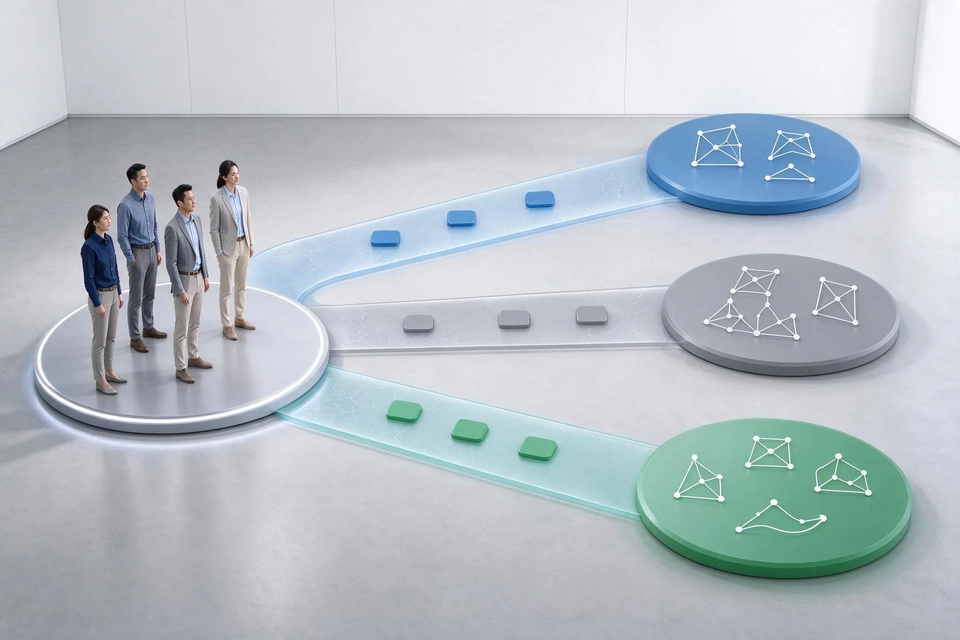
If you are still deciding which half to fund first, ask the get more leads for my business question against your own close rates.
What Topkee does with the funnel and the loop
Topkee's Growth Operating System is built as an acquisition funnel and described in the company's own material as connected funnel moments that lead to one shared customer view, with AI reports that carry next actions. The workflow runs Capture, Connect, Improve: capture the source of every click and enquiry, connect it to one customer record, then turn the data into the next action. The path runs from ad click to landing page to conversation to CRM record to quote to signed deal, and accountability sits on signed deals rather than on product usage.
The loop enters at the decision level. Every decision on the action list, whether to confirm, assign, pause or archive, is written to cross-cycle memory, and the next cycle re-tests what the previous one predicted. That is a learning loop, not a customer-to-customer flywheel: the system improves each round, and customers do not recruit each other. Retention, repeat purchase and organic traffic are scored as their own channels in the company's lead generation work, which is where the flywheel becomes literal after the deal.
Two products show how the handoff is instrumented. Leadbox keeps sales stages from prospect discovery to won, fires a stage-change event back to the platform's tag system for attribution, and returns the source campaign and ad platform when a rep enters a deal value. YME Chat Agent handles website chat, WhatsApp and Messenger, identifies intent and passes the lead into lead management, so a WhatsApp conversation becomes a record with a follow-up. A team that wants the best lead generation setup without hiring a sales team first can start from the free Campaign Intelligence Report, which checks tracking, locates leaks by layer and arrives by email with no sales call.
None of this is product-led in the strict sense. Acquisition is sales-assisted, with a self-serve front door in the audit and the reporting, and the metric that matters is the signed deal. A software company running a flywheel should read this setup as the funnel half of the picture, instrumented well enough for the post-signup period to be scored.
Your next step
Start with the deal data you already have. Take the last ten opportunities, mark whether each needed a rep before signature, and mark which came from an existing user's recommendation. The pattern usually points at one model for the near term and one to build toward. For the budget side, Keith Turco's reading of the B2B market covers how buyers are treating budget proof, and the piece on Google Ads and first-party data covers the measurement layer a flywheel needs. If your get more leads for my business question is really a handoff question, fix the handoff before you choose a model.
Sources
- "PLG Funnel vs Flywheel: Which Fuels Sustainable Growth?", Contentsquare, 2026-11-20. https://contentsquare.com/guides/product-led-growth/funnel-vs-flywheel/
- "The Growth Flywheel: A Proven PLG Framework", ProductLed, undated. https://productled.com/blog/product-led-growth-flywheel/
- "Building a Marketing Ops Tech Stack for Product-Led Growth", ProductLed, undated. https://productled.com/blog/marketing-tech-stack-plg/

Article Author
Pang Sir
