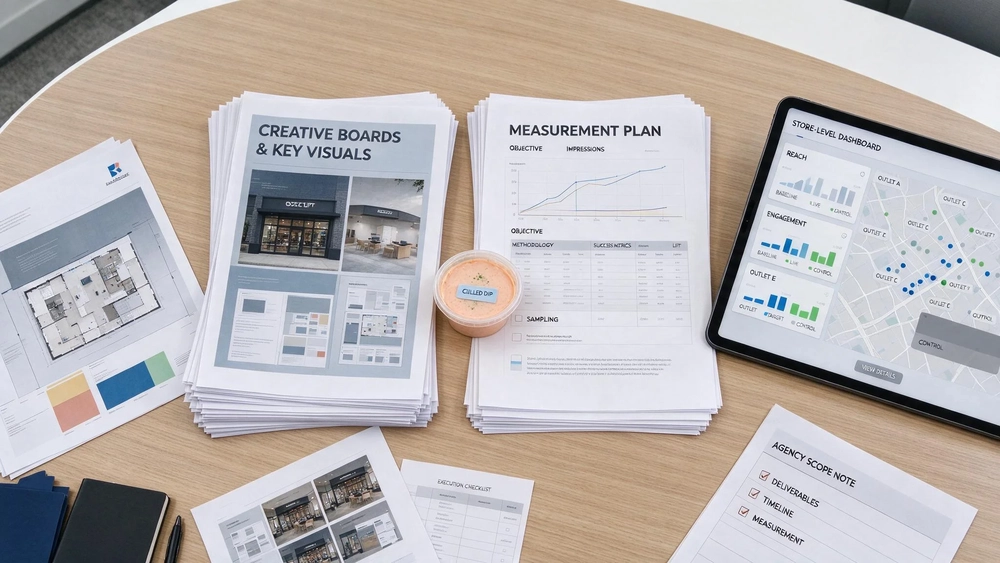
Pilpel's lead agency appointment, read as a measurement question
Campaign Brief reported on 9 November 2026 that Summit Group has appointed Banter, an independent engagement marketing agency, as lead agency for Pilpel, the Australian dip brand. The report describes Banter's remit as creative strategy and campaign development across multiple channels and consumer touchpoints. If you are drawing up a similar brief, the useful question is not whether the creative will be good. It is what the appointment makes measurable, and anyone shortlisting digital agencies should ask it before signatures.
Key takeaways:
- A creative lead-agency remit, as reported here, names strategy and campaign development, not a reporting obligation.
- The first work is expected later this month, so no performance reading exists yet; that is a scheduling fact, not a criticism.
- A lead agency can be held to one report only if the brand owns the tracking accounts and the data.
- Creative output and audience reach are measured on different clocks, and the brief should say which clock governs which review.
- Agencies serving Singapore clients, including those marketed as marketing singapore partners, should be asked which report they will hand over at the end of a campaign.
- A brand asking marketing singapore agencies to quote should expect the quote to name the report it will deliver.
What the report says, and what it does not
The report is short and factual. Banter takes over creative strategy and campaign development, brings the brand to life across channels and touchpoints, and works with Summit Group to broaden the audience. Paul Den, co-founder of Banter, is quoted saying Pilpel has already made a product people love and that Banter's task is to give more Australians a reason to discover it.
Nothing in the report names a media budget, a measurement framework, a reporting cadence or a definition of success. That absence is the substance worth writing about: the report sets a creative direction and leaves the denominator against which anyone will later be judged undefined.
This matters for the reader because the phrase "lead agency" carries different weight in different markets. In some briefs it means the brand's strategic centre of gravity, with media, PR and shopper agencies reporting through it. In others it means the shop that holds the creative idea while every other partner keeps its own contract. The report does not settle which one applies to Pilpel, and a brand drafting its own version should settle it in writing.
Defining lead agency before the brief leaves the room
Before scoping deliverables, write the definition of the term into the brief. Start with the role the agency plays in decisions, then attach the paperwork to it. I use three fields, each with a time range, because without them the same word supports two different expectations.
Field one is decision rights. Who signs off the campaign platform, who signs off the channel plan, and who holds the last word when the two disagree? A lead agency with creative sign-off but no channel sign-off will produce work that media partners are not obliged to follow.
Field two is the reporting surface. Name the system of record before the first campaign, not after. If the agency reports from its own dashboards, the brand cannot audit the numbers without rebuilding them.
Field three is the review clock. Set the calendar for creative review separately from the calendar for performance review. A campaign platform is judged over months. A paid campaign is judged over the attribution window printed in the report. Mixing the two produces arguments nobody can resolve.
When those three fields are filled, "lead agency" stops being an honour and becomes a job description. Brands comparing digital agencies can use the same three fields as a screening sheet: an agency that cannot answer them has not thought about the end of the contract.

Gap filled: what does a digital marketing agency actually do?
The g1 question is the one readers type most often, and the short answer that agency lister pages give is a service list: strategy, creative, media, social, analytics. It is accurate and useless, because every agency claims all of it.
A better answer, for appointment purposes, splits the work by what the brand can check afterwards. A creative agency delivers artefacts: a platform, key visuals, films, copy, a channel toolkit. You can count them. A media agency delivers placement and reports on spend, impressions and clicks by channel. You can reconcile those against the ad accounts. A growth or performance agency delivers a change in an outcome the brand defines, usually leads, sales or revenue, and reports it against a stated denominator.
Most lead-agency appointments blur the three. The brief says "integrated", the agency says "full service", and the review at the end of the quarter compares a count of deliverables with a revenue target. The two numbers cannot be compared. The g1 answer that helps a brand is therefore not a list of services but a mapping from each service to the measure it produces and the person who owns that measure.
Correlation, causation and the launch-month reading
A consumer brand typically sees three things move at once after a creative platform launches: branded search volume, organic reach, and paid media efficiency. It is tempting to attribute all three to the campaign. The temptation is worth resisting in the first review.
Branded search can rise because of retail distribution, a price promotion or a competitor's exit. Organic reach can rise because an algorithm update pushed every brand in the category. Paid efficiency can improve because the agency inherited a good account, or because a budget cut reduced exposure to expensive placements. None of these requires the creative to be bad for the number to move, and none requires the creative to be good.
The practical remedy is a control. Pick one channel or one store the campaign does not touch, and watch it for the same period. If the control moves by the same amount, the campaign is a candidate cause at best. If the control stays flat and the treated group moves, the case is stronger, though still not proof.
This is the part of a lead-agency review that agencies and clients most often skip, because it needs planning before launch. It costs one meeting at briefing time.
A small case: how one dataset changes the brief
I have seen this play out on a briefing spreadsheet. A brand listed nine deliverables for its lead agency and, in the same sheet, one target: a percentage lift in revenue. The agency signed. At the first review, seven of the nine deliverables were complete and reported as such, and the revenue number had moved by less than the target. Both sides were right about their own line of the sheet.
The fix was organisational rather than creative. The brand split the sheet in two. One tab held creative deliverables with their own acceptance criteria, due dates and a named reviewer. The other held outcome measures with a definition, a denominator, a time range and a statement of what counted as movement within normal variation. The agency took the first tab. The second was joint, with the brand's own analytics owner accountable for the data.
The dataset in that example was small, which is the point. A brief that can hold nine deliverables and one revenue target in the same table has not yet decided what it is buying. Test your brief against the same split before you send it.

Designing the measurement layer into the appointment
The measurement layer is not an afterthought of the media plan. It has to exist before the agency starts, because the attribution assets belong to the brand.
First, the brand keeps its own ad accounts, analytics property and customer data platform, and the agency receives access rather than ownership. Contracts that leave history inside the agency's environment make the exit expensive in a way the fee never shows.
Second, the event definitions are agreed in writing before build. Does a lead mean a form submission, a phone call or a message? Does a sale mean a paid order or a first order once refunds are stripped out? Is a conversation a chat started or a chat answered? Each choice changes the denominator, and an agency and a client can both be honest while disagreeing.
Third, consent and data retention follow the brand's policy rather than the agency's convenience. Where user-level data is joined across systems, the lawful basis and the retention period belong in writing before the first join. A measurement plan that skips this step usually fails a privacy review later, and the campaign stalls while it is rebuilt.
Fourth, the reporting template is agreed at kick-off, with the definitions printed on it. A template without definitions invites the same word to mean different things each month.
Where Topkee fits, and where it does not
Topkee is a different kind of partner from an engagement-marketing creative shop, and it is worth saying so. Founded in 2010 in Hong Kong as Topkee Media Limited, it describes itself as a full-stack marketing partner covering search, paid media, content, data and creative production, with offices in Hong Kong, Singapore and Los Angeles. The knowledge base holds no case on a consumer food brand or on any Australian appointment, so nothing here should be read as a claim about how Banter's appointment will perform.
What the company does publish is a position on measurement. Its performance work is held to ROAS as a single number, with media budget paid through the client's own ad accounts and the optimisation history kept in the client's own tenant and customer data platform, so attribution assets stay with the brand when a contract ends. For creative supply, its Topkee Media subscription tiers specify output formats for Google, YouTube, Instagram, Facebook, rednote, TikTok, LinkedIn and Yahoo placements, with a version log and reusable brand assets.
That combination is the structural difference from a creative-only lead agency. A creative platform delivered as assets can be measured by completion; a creative platform delivered into a measurement layer can be measured by what happened after exposure. For brands reading the Pilpel appointment, the question is which of the two the brief actually commissions. Singapore marketers weighing digital agencies will meet both models, and this guide to Singapore agency selection sets out how to test them.

Recommended next action
Take your current lead-agency brief and add one page: the definition of success, its denominator, its time range, and the system of record it will be read from. If the agency cannot sign that page, the brief is still about deliverables, and you should know that before the first campaign. The revenue tracking setup is a useful reference for what a closed-loop report looks like at the account level.
FAQ
Does a lead agency appointment have to include media buying?
No. In many briefs the lead agency holds creative and strategy while media sits with a separate partner. What matters is that the reporting surface is shared, so the two partners' numbers can be reconciled without the brand acting as referee.
How early should the measurement plan be agreed?
Before the first campaign build. Event definitions, the system of record and the attribution window all affect what can be reported later, and changing them mid-campaign invalidates any comparison with what came before.
Is a creative platform measurable at all?
Yes, but on its own terms. Deliverable completion, brand-asset usage and channel availability can be counted. Whether the platform changed buyer behaviour needs a separate test with a control, and it needs to be planned before launch.
Who should own the data in the contract?
The brand. Accounts, event history and the customer data platform should sit in the brand's own environment, with the agency granted access. This one clause determines how expensive it is to change agency later, and how much of the history survives the change.
What is the most common scoping error?
Comparing a deliverable count with a revenue target in the same review. The two measures answer different questions and cannot be traded against each other; splitting them into two review tracks removes the argument without removing accountability.
Should the agency own the reporting dashboard?
No, though it can operate it. A dashboard held inside the agency's own environment is a record of its own work, not an independent source. Brands shortlisting digital agencies should ask for read-only access to the ad accounts and the raw event data before signing, so the numbers can be rebuilt if the relationship changes.
Sources
- Ricki Green, "Pilpel appoints Banter as lead agency", Campaign Brief, 2026-11-09. https://campaignbrief.com/pilpel-appoints-banter-as-lead-agency/
- "The Shop – Portfolio And Reel", Portfolio And Reel. https://www.portfolioandreel.com/shop