
Marketing automation obstacles and how to fix them [2026]
As of November 2026, most marketing automation trouble is not a tool defect: HubSpot reports that 86.4% of marketing teams use AI somewhere in their workflows, yet measuring ROI still tops their challenge list at 33%. Teams that want ai automation for business that actually pays back fix strategy, CRM data, sales alignment, tool seams, customer experience and compliance first, then let agents act inside those guardrails.
Key takeaways
- The automation platform is not usually the failure. It reproduces a missing strategy, thin data or a broken handoff at higher speed.
- Only 65% of marketers say the data they hold on their target audience is high quality, so segmentation and routing break before the workflow fires.
- HubSpot found 27.6% of marketers name sales–marketing misalignment a top challenge, and 67% of B2B buyers say inconsistent messaging from a vendor puts them off.
- ai automation works best on always-on jobs such as scoring, research, drafting and reminders, with human approval gates on anything that touches price, first contact or a live deal.
Why the obstacle is rarely the tool
A work scenario I keep running into: a professional services firm in Singapore has three nurture tracks, a lead scoring model and two years of workflows. The marketing manager runs a dashboard review and finds pipeline flat for six months. The platform is healthy. The problem is that every contact enters the same track regardless of lifecycle stage, nobody can say why half the workflows exist, and the campaign volume doubles while conversion does not.
Running ai automation on top of that setup only multiplies the misfires, which is why HubSpot's 2026 article makes the same point from its own data: obstacles in marketing automation are usually unclear strategy, bad data, siloed tools and weak team alignment, and the platform simply executes those problems faster and at greater scale. A tool with that much reach deserves a written strategy behind it, and a team asking for ai automation for business should ask for that document first.

<!--more-->
The seven obstacles and the fix for each
Use the table as a triage sheet. Read the symptom you recognise, then work the fix in the order the sections below give, because the data and alignment fixes free up the rest.
| Obstacle | What actually happens | First fix |
|---|---|---|
| No strategy | Every contact gets the same nurture; workflows accumulate with no owner | Define the goal, segment, entry and exit criteria, and one named owner per workflow |
| Bad data | Duplicates trigger duplicate sequences; stale titles misroute leads | Audit, then clean across accuracy, recency, completeness, standardisation and deduplication |
| Sales–marketing misalignment | Marketing nurtures accounts sales never works; leads stall at handoff | Shared MQL and SQL definitions, routing rules, a response window and a recycle loop |
| Siloed tools | Each integration seam drifts; exports and re-uploads create latency | Test the stack for speed and orchestration before buying another point tool |
| Customer experience | Emails fire at the wrong moment; tokens stand in for relevance | Automate repeatable work, keep human judgement on trust-shaping moments |
| Compliance | Journeys execute at scale without re-checking consent | Suppression and subscription checks as steps inside the workflow |
| Measurement | Campaign activity reported, revenue not traced | One yardstick and a funnel from first touch to signed deal |
Write the strategy before the workflow
HubSpot's fix starts with four questions per automation: the goal it moves, the segment it serves, who enters and what removes them, and the named owner accountable for its performance. Missing exit and suppression criteria is the usual cause of an "automation gone rogue" incident.
Personalisation is the reason to bother. The same report notes 93.2% of marketers say personalised, segmented experiences drive more leads and purchases, which is impossible on a single nurture track.
For a Singapore team, the practical output is a one-page sheet per workflow: business metric, audience definition, entry rule, exit rule, suppression list and owner, reviewed at the same meeting where the sales pipeline number is read.
Clean and govern CRM data across five dimensions
The scope of the data problem is larger than most teams admit: only 65% of marketers say they have high-quality data about their target audience, and that figure has not moved even as AI adoption climbed. Duplicate contacts fire duplicate sequences, stale job titles route leads to the wrong owner, and a missing lifecycle property enrols customers in prospect nurture.
HubSpot's sequence is audit first, then clean along five dimensions: accuracy, recency, completeness, standardisation and deduplication; then govern continuously on a recurring quality dashboard, with a human as final approver. Validation at the point of entry, required on forms and list uploads, stops the decay at the source rather than building one automation to clean up after another.
This is the step that decides whether ai automation for business has anything safe to act on. The completeness dimension now matters more: agents read fields no workflow touches, so a blank property is no longer harmless.
Agree what "qualified" means and who answers it
Misalignment usually starts two levels above the handoff. Marketing builds segments by persona and industry while sales works a named-account list, so the automation nurtures accounts sales will never prioritise. The two teams also optimise different metrics, MQL volume against pipeline.
HubSpot found that 27.6% of marketers name misalignment a top challenge, and the cost is visible to buyers: 67% of B2B buyers say inconsistent messaging from a vendor actively puts them off, according to a DemandGen report.
ai automation cannot repair a disagreement it was never told about, so the fix is a written lead lifecycle and service level agreement covering MQL criteria, SQL criteria with disqualification reasons, routing rules, the response window and a recycle loop so "not yet ready" leads keep getting nurtured. In the supply chain example HubSpot describes, pipeline moved once every sales alert carried a human owner, a response window, the qualification criteria to check and a recommended next action.
Test the stack for speed and orchestration
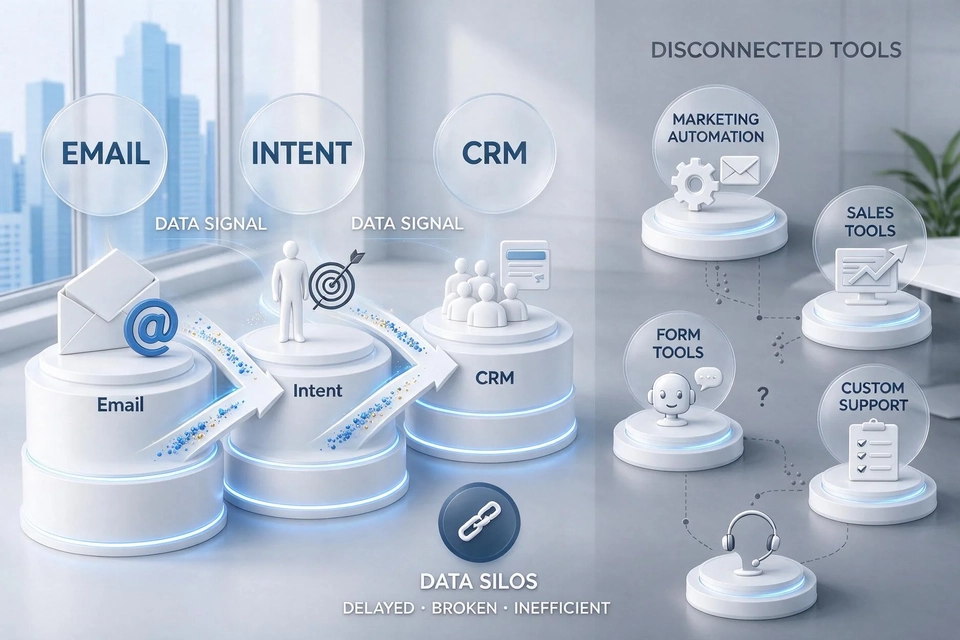
Siloed tools produce data latency, sync errors and records that disagree. Email in one platform, intent data in another and the CRM in a third means every seam is a place where records drift, and exports with re-uploads invite human error.
Before buying another point solution, run two tests HubSpot names: speed, meaning a signal should travel from detection to the CRM to routing in minutes rather than hours, and orchestration, meaning sequencing and suppression across channels work as one plan instead of each channel blasting independently.
Keep a person where trust is at stake
ai automation turns harmful once nobody is watching the moment a message lands. Over-automation shows up as emails triggered at the wrong lifecycle moment, personalisation tokens standing in for relevance, several channels firing the same message on the same day, and sequences that keep selling after a prospect said "not now".
HubSpot's split is workable: give AI the always-on jobs such as scoring, account research, signal capture and routine follow-up, and put approval gates on first-touch outreach, pricing conversations and anything mid-deal. Ground AI drafts in live signals and CRM history, and train the agent on approved messaging and banned phrases.
Put compliance checks inside the journey
An automated journey can execute at scale without asking permission twice, so consent has to be checked by the workflow itself. Subscription status, do-not-email flags and internal exclusions belong at enrolment and before every send, managed from one master suppression list that is documented in a shared source.
For Singapore teams this sits next to PDPC obligations under the PDPA and the do-not-call register; the workflow step is where those rules stop being a policy document and start being a gate.
Pick one measurement yardstick
Measuring ROI is the top challenge at 33%, and the usual cause is that reports describe activity rather than revenue. Choose one formula, publish it, and build the funnel beneath it so a number on the dashboard can be walked back to a record.
HubSpot's own sample shows the shape: one report, four ad and analytics sources, one ROAS formula of signed-deal conversion value divided by ad spend, and a funnel from impression to signed deal.
Which failures are strategy and which are tool defects
This is the angle most searches leave open: teams replace the tool when the failure is elsewhere. Walk the checklist in order, from strategy, data, alignment and tooling through experience, compliance and measurement, and stop at the first place a test fails. That is where the money goes first.
A tool defect looks different from the rest. It appears as a function that does not exist, a limit the vendor confirms, or a speed test that fails after the data, definitions and owners are already right. Everything else in this list is a decision the team made or failed to make.
What Topkee's systems do about these obstacles
Topkee Cloud and Engineered Integration is an AI full-funnel marketing and automation platform for SMEs in Singapore, Hong Kong and Los Angeles, and its stated diagnosis matches the data-silo obstacle above: budgets go to Google, Meta and TikTok but return is hard to prove because systems are isolated and the attribution chain breaks. Every lead is traceable from click through lead, conversation, opportunity and revenue, and qualified conversions are sent back offline to Google and Meta so bidding optimises revenue rather than clicks. Existing CRM, ERP, e-commerce or legacy databases are connected in days rather than months, each integration runs as a maintained engineering service, and website, TTO CDP, Leadbox, YME conversations, YIS content and Performance Ads sit under one login with data held in the client's own tenant.
Campaign Intelligence Report addresses the measurement obstacle directly: one report, four data sources (Google Ads, Yahoo Ads, Facebook Ads, GA4), one fixed yardstick of ROAS equal to signed-deal conversion value divided by ad spend, and a six-layer funnel from impression to signed deal, shipping a numbered and traceable action list rather than recommendations. Implementation runs on the client's existing ad accounts, and a read-only audit report takes about two minutes to authorise and three working days to deliver.
On the tooling side, Topkee AI Agent turns professional methods and business systems into task-executing agents through three connection points: methods written into role rules, Skills and Playbooks; business-data queries and actions inside one conversation; and outputs saved to a Library for reuse. It suits work that is relatively clear in process, with obtainable materials and verifiable results. AdOps Vanguard, a role template on that platform, reads the KPI plan, channel data and budget, runs paid-ad analysis and delivers an analysis page, task list, Library cards and approval records; tasks involving spend or publishing wait for human approval, which is the gate the customer-experience section calls for.
For the handoff obstacle, YME Chat Agent gives instant, always-on multilingual reception that reads visitor intent, guides lead capture, hands off to a human when needed and syncs with Leadbox. For automation that still needs editorial control, SEO Bot Team detects changed pages, drafts against a keyword quota and defaults to shadow mode, marking "do not publish" when a second independent source is missing. The Launch Validation and Implementation path is the adoption route: pick one high-frequency task with a clear output, connect services and approval rules, pilot on real tasks measuring completion rate, time, rework and human intervention, then reuse templates.
Topkee's AI-powered framework for non-linear consumer journeys and its AI automation work for hotel and retail marketing show how those pieces are put together for a specific market.

Recommended next action
Start with the audit, not the purchase. Pick your highest-volume workflow, write down its goal, segment, entry and exit criteria and owner on one page, then run a data audit on the fields that workflow reads. If the audit shows a split attribution chain rather than a workflow problem, the AI-powered Google Ads optimisation approach is the closer comparison.
FAQ
Why does marketing automation underperform even when the tool works?
Because the platform is executing a decision the team got wrong. No strategy produces the same nurture for every contact, bad CRM data fires duplicate sequences and misroutes leads, and misalignment means marketing nurtures accounts sales never works. Fix the foundation before adding another tool.
How many marketing teams use AI in 2026?
HubSpot's 2026 State of Marketing figure is 86.4% of marketing teams using AI somewhere in their workflows, while measuring ROI remains the top challenge at 33%.
What should the lead lifecycle and SLA contain?
MQL criteria, SQL criteria with disqualification reasons, routing rules by segment and tier, a response window the sales owner must meet, and a recycle loop that returns leads with reasons so scoring improves.
Where should a human stay in the loop once AI agents act?
On anything that shapes trust: first-touch outreach, pricing and commercial conversations, and messages mid-deal. Routine scoring, research, signal capture and follow-up can run continuously inside the guardrails you set.
How do we clean CRM data before automating?
Audit duplicates, missing critical properties and stale records, then clean along accuracy, recency, completeness, standardisation and deduplication, govern on a recurring dashboard with a human approver, and require validation at the point of entry.
Sources
- Océane Li, "Obstacles in marketing automation and how to fix them [2026]", HubSpot blog, 2026-11-06. https://blog.hubspot.com/marketing/marketing-automation-challenges
- HubSpot, "Easily Build Custom AI Agents", hubspot.com, 2026. https://www.hubspot.com/products/artificial-intelligence/ai-agents