NVIDIA's 2B Driving Model: AI Automation for Business
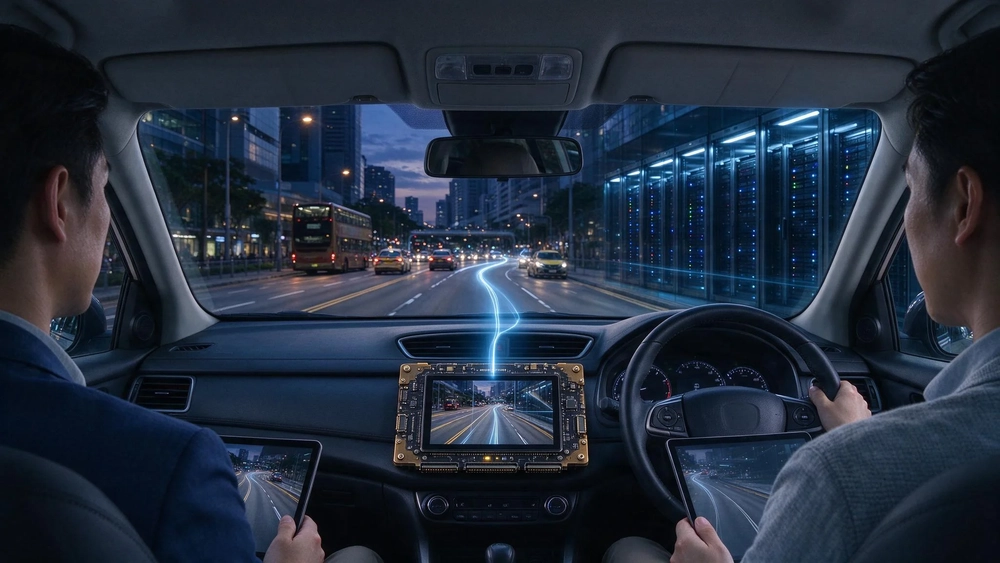
As of November 2026, a reasoning model that plans a decision and explains it can run inside a vehicle on a 2B backbone; NVIDIA published it on 10 November 2026. For a Singapore team buying ai automation for business, the direct change this week is close to zero, because Alpamayo 2 Edge drives cars and not campaigns. The change that matters sits in procurement: a vendor that quotes a large model and a large cloud bill for a task that only reads an enquiry or drafts a report now has to explain why the reasoning cannot sit in a smaller runtime near the data.
Key takeaways
- Alpamayo 2 Edge is a 2B-parameter reasoning vision-language-action model NVIDIA published for DRIVE AGX Thor, an in-car computer rather than a datacentre GPU.
- The optimised Thor pipeline returns a trajectory 160 ms to 190 ms after the camera frames arrive, and it skips a written reasoning trace when the driving is routine.
- In NVIDIA's own closed-loop test the model covered 15.15 km per at-fault incident over 875 scenarios, approximately 60× the comparison model.
- NVIDIA validated the BF16 path on one H100 and recommends 16 GB of GPU memory, so the hardware story is narrower than the parameter count suggests.
What NVIDIA released, and the date that matters
NVIDIA put Alpamayo 2 Edge on Hugging Face on 10 November 2026 with open weights and Apache-licensed code. It is a vision-language-action model. Six cameras and 22 image frames per observation go in, together with a navigation instruction and the vehicle's past motion, and two things come out: a driving trajectory of 64 waypoints over 6.4 seconds, and a Chain-of-Causation trace that states why the car chose that path. The same model answers free-form questions about the scene it sees.
The build is two networks. A 2.45B backbone (1.96B language model, 0.41B SigLIP2 vision encoder, 0.08B projector) reads the scene, and a 0.2B diffusion action expert turns that reading into acceleration and curvature. NVIDIA sells the package as 2B. The card lists fine-tuning as supported, which matters for a company that wants its own data or judgement rules inside the model. The family also holds Alpamayo 2 Super, a 34B model that acts as the teacher for the small one.
Why the model sits in the car, not the cloud
An onboard computer has a fixed compute and latency budget, and a model that misses it cannot drive. NVIDIA's account of the work is a compression problem: start from a large teacher, keep the reasoning that changes a decision, then measure the result on the target board. Distillation gives the small model reasoning labels written by the 34B Super model. Adaptive reasoning lets it emit a placeholder token instead of a written trace when the scene is ordinary, so routine driving spends less compute. Closed-loop reinforcement learning in AlpaGym then trains on the consequences of its own simulated actions.
The training set is specific: roughly 115,000 hours of multi-camera driving video and roughly 3,700,000 Chain-of-Causation traces. NVIDIA reports that the reinforcement-learning stage improved closed-loop driving performance by 128.5% over the best checkpoint trained without it. The release also includes AlpaJudge, a human-calibrated model that scores reasoning traces and supplies the reward signal.
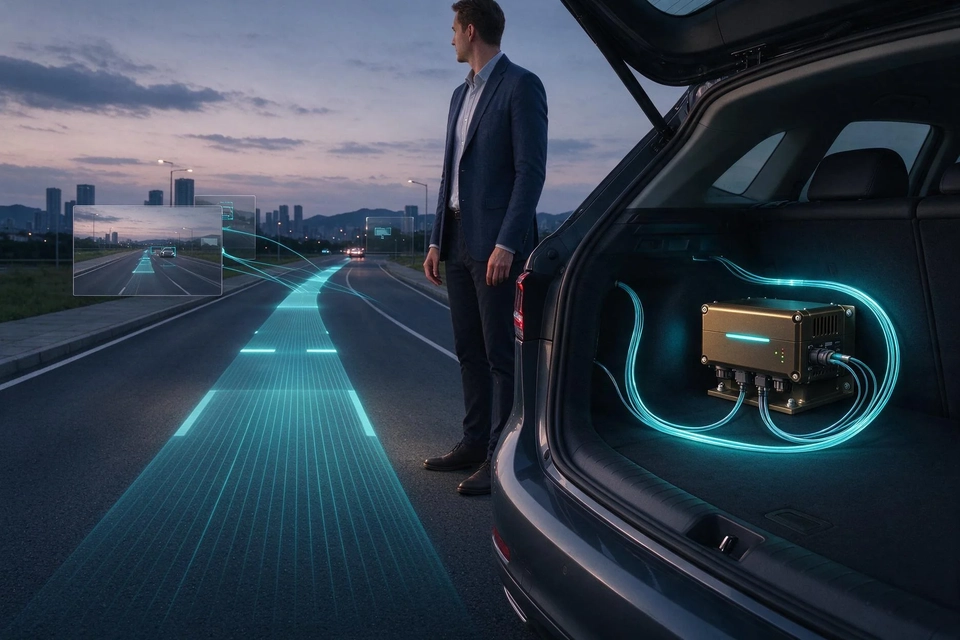
Latency is where the claim becomes checkable. The BF16 PyTorch weights run as they ship, but real-time driving on Thor needs the deployment recipe: calibrate FP8 scales, export ONNX graphs, build TensorRT engines with the Edge-LLM plugins. NVIDIA measured 160 ms to 190 ms from pixel to trajectory on the optimised pipeline, with the range set by how much the model reasons. A partner, Embedl, reported 10 Hz on AGX Thor in less than 48 hours of work. The gap between those numbers is the integration work a vendor would hide. The same test applies to ai automation for business: a published figure on reference hardware is a starting point, not a promise about yours.
The benchmark numbers, and where they stop
The headline result is closed-loop: 15.15 km driven per at-fault incident over 875 simulated scenarios, with three rollouts per scenario. The comparison model in NVIDIA's chart covered far less ground between incidents, and NVIDIA puts the Edge result at approximately 60× of it. The model card adds an open-loop error of 0.52 m at a five-second horizon.
| Measure | Result | Read it as |
|---|---|---|
| Closed-loop driving, AlpaSim | 15.15 km per at-fault incident over 875 scenarios | Distance between incidents in simulation |
| Distance against the comparison model | approximately 60× | A large gap on the publisher's own test setup |
| Open-loop minADE at five seconds | 0.52 m | Average trajectory error at that horizon |
| GPU memory, BF16 reference | 16 GB recommended | One H100 validated, other architectures untested |
All of these runs come from NVIDIA, the comparison included, so the table reads as a vendor benchmark rather than an independent audit. The reasoning score is the softest line: 75.2 on LingoQA is respectable for a 2B model, and a judge score measures agreement with a rubric rather than driving safety. Outside the core team, the release carries partner accounts rather than a silence. PORT reports lane-keeping and faster planning in closed-loop reconstructions of its own London recordings, Niulinx reports lower prediction error than the larger Super model and a further drop after fine-tuning on its own data, and Embedl reports 10 Hz on AGX Thor in less than 48 hours. Partner results on partner data are not an independent audit, and they still say the direction is real.
Who this changes for a Singapore marketing team
Nothing in a Singapore advertiser's Google or Meta account changes because a driving model shipped. What changes is the vendor conversation. A team that buys ai automation for business and has been quoted a large model with a monthly cloud bill for enquiry triage or report generation can ask a sharper question: what is the smallest model that passes our acceptance sample, and where does it run? The answer changes the cost base, and often the data-handling story with it.
That data question is worth pressing while the quote is open. A model that runs on the device or in a container near the work sends less customer data to a third-party service, though whether that helps depends on where inference runs, what leaves the system, and who reads the logs. A caution of my own, not the release's: Singapore's PDPA obligations follow the data, not the hardware, so consent, retention and access rules still apply.
The release also leaves a design pattern a marketing team can copy without touching a car. Alpamayo 2 Edge keeps a small student model and a large teacher, then measures the student with a judge. A team can use the same arrangement: the small model takes the repeatable reads while the large one handles the hard cases, and a fixed sample scores both. The article on Emails that answer: AI automation for business data shows the same idea at the inbox, where a model answers routine questions over a company's own data.

What to do now, in order
- Ask for the model, the runtime and the measured latency. A vendor should name the model size, the hardware it runs on, the latency measured on that hardware and the memory it needs. If those four facts are missing, the proposal is a brochure.
- Choose one workflow with a clear output. Scope a single process, agree the acceptance sample, the scoring rule and the pass threshold before development starts. A pilot that cannot fail is a demo. If the workflow needs a front end, custom web application development is where the agent meets the team in a workbench or a client portal, behind role permissions and approval flows.
- Fix the permission and approval rules in the contract. Any external send, or a change to a budget or an order, should need a named approval or a pre-authorisation, and delivery should include a permission list and an operation record of what ran.
- Measure process time, not output volume. Track preparation time, review time, completion rate and error rate against a baseline taken before the pilot. Volume tells you the tool is used; those measures tell you whether the work got better.
- Put a review date on the decision. Compare the pilot with the baseline on that date and extend the pilot if the sample is small. A model release is a reason to renegotiate scope, not to sign a longer contract.
What to watch next
The next NVIDIA step is likely more small students distilled from the 34B Super teacher and scored by AlpaJudge, which would make the 2B class a normal starting point rather than a headline. The other item is hardware coverage: the card validates one GPU architecture, and the real-time claim rests on a specific recipe. A vendor that publishes latency on the hardware you own, next to an acceptance sample, gives you something you can check.
For a Singapore team, the useful watch item is the contract language: whether a proposal names the model, the runtime and the evaluation set, and whether it separates process measures from revenue claims. The briefing on what Amazon's auction trial means for AI automation makes the same point about vendor claims in ad tech. If a next release drops the price of a passing pilot, the team with an acceptance sample in hand can move first.
Where Topkee fits: assessment before automation
Topkee builds custom agents around one workflow that already exists, and its public notes describe the work in the order this article recommends. The first step is an assessment of the scenario and the systems it touches; it can be booked on its own and is credited against the project. The entry package automates a single existing workflow, with business rules, company knowledge, task steps and tools arranged into a runnable process, and named people approve the points that matter. Delivery includes acceptance samples, test records, a permission list and an operation record, and the indicators are processing time, review time, completion rate and error rate. Its custom web application development work puts an agent inside a workbench, a client portal or a mobile app, with role permissions and approval flows behind it.
The notes hold nothing on NVIDIA, autonomous driving or on-device inference, and Topkee is not a partner in this release. What carries across is the delivery method: scope one process, fix the acceptance rule, keep a person at the approval point, and record what the agent did.
FAQ
What is Alpamayo 2 Edge?
A 2B-parameter reasoning vision-language-action model from NVIDIA for in-car planning on DRIVE AGX Thor. It takes camera images plus a navigation instruction and the vehicle's past motion, then returns a trajectory and a written explanation. NVIDIA published it on 10 November 2026 with open weights.
Does this change the price of AI automation for a Singapore business?
Not by itself. It changes what a vendor can credibly claim about small models and where they run. Use it to ask for the smallest model that passes your acceptance sample and its latency on the proposed hardware.
Can it run on a normal office server?
The BF16 weights need at least 16 GB of GPU memory according to the model card, and NVIDIA validated that path on one H100. Real-time use on Thor needs the FP8 and TensorRT recipe. Other GPU architectures have not been validated, so a laptop or a CPU-only server is not the target.
What should I ask a vendor before signing an AI automation project?
Ask for the model size, the runtime, the latency on that runtime, the memory footprint, the acceptance sample and the permission rules. Ask who approves external sends and budget changes, and what record the agent leaves behind. A vendor that answers all of that is worth a pilot.
Is Topkee connected to NVIDIA or Alpamayo?
No. Topkee's public notes describe custom agents, workflow automation and application development for marketing and office work, with no NVIDIA, automotive or on-device model relationship. Its relevance here is the delivery method, and nothing in this article is a product claim about the driving model.
Sources
- Asif Razzaq, "NVIDIA Releases Alpamayo 2 Edge: A 2B Reasoning VLA for DRIVE Thor", MarkTechPost, 2026-11-23. https://www.marktechpost.com/2026/11/22/nvidia-alpamayo-2-edge-2b-reasoning-vla-drive-thor/
- "Running AV Reasoning Models Within Onboard Compute and Latency Limits", NVIDIA Developer Blog, 2026-11-10. https://developer.nvidia.com/blog/running-av-reasoning-models-within-onboard-compute-and-latency-limits/
- "nvidia/Alpamayo2-Edge: model card", Hugging Face (NVIDIA), 2026-11-10. https://huggingface.co/nvidia/Alpamayo2-Edge
- "Open Models for Robotaxis and Autonomous Vehicles (NVIDIA Alpamayo)", NVIDIA, n.d. https://www.nvidia.com/en-us/solutions/autonomous-vehicles/alpamayo/