Jon Miller on AI and the Future of Marketing Automation: What to Audit Before Your Renewal
As of November 2026, the practical answer is still no: replacing a legacy marketing automation platform should never be a rush decision. But the renewal date is the moment to test it, and Jon Miller, who co-founded Marketo, argues the test has changed. His advice to anyone on an old platform is blunt: do not renew anything for more than a year, and start the evaluation early enough to walk away if the answers disappoint. That guidance, and the audit behind it, is the subject of this guide to ai automation for business.
Miller set out the case on Search Engine Journal's podcast with Heather Campbell, published on 10 November 2026. The questions below follow the order a marketing leader actually asks them: what is broken, what AI changes, what to keep, and how to run the decision before the contract renews.
Key takeaways
- Rules still belong in the system where a condition must be true, such as consent before an email goes to someone in Germany; AI reasoning belongs where the decision needs judgement.
- The cost of a legacy platform is often visible in delay and add-on tools long before it shows in a report a board will read.
- A renewal can only be tested properly if the evaluation starts months ahead; the lead time varies with how large the organisation is.
- Human approval has to stay in the loop for spend and account changes, so any replacement is judged on its controls as much as its features.
- A replacement should be scoped as a small number of connected workflows with named approval points, not as one big migration.
Is your platform the bottleneck, or is it your team?
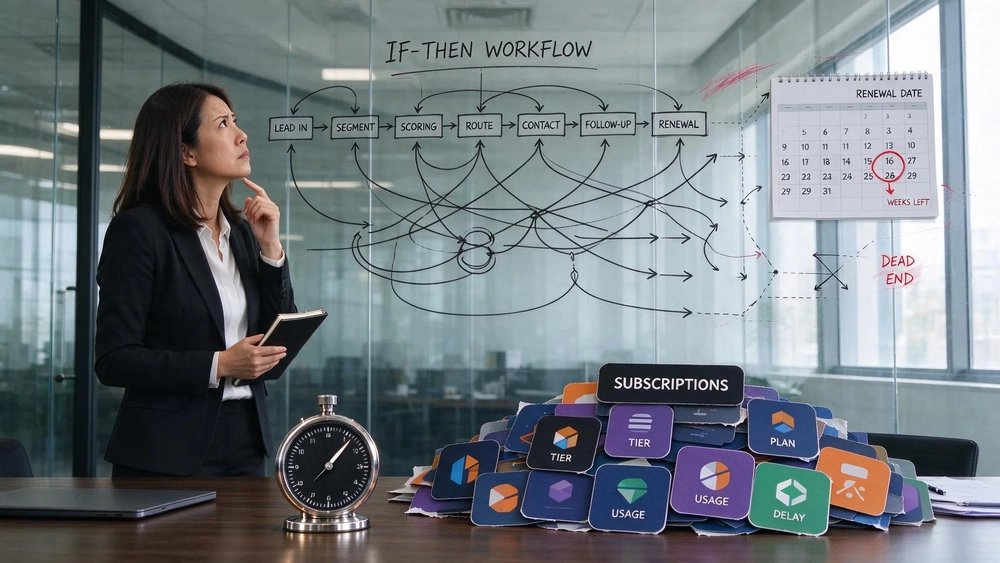
Start with the signal that does not require talking about AI at all. Miller describes CMOs frustrated by the time between an idea and a live campaign. The brief is written quickly, often with AI assistance, then handed to marketing operations, which puts it into a ticket queue until someone eventually builds the campaign in Marketo two weeks later. It then returns to the demand generation person, and you lose another two weeks on back-and-forth.
That sequence is worth timing in your own team before you blame headcount. If the delay sits in queuing and rebuilding, more people will not fix it, because the queue is the design. Miller calls the state of accepting this "marketing automation Stockholm syndrome": teams learn the platform's quirks and stop asking whether the quirks are necessary.
The second signal is stack sprawl. Lead routing, matching leads to accounts, deduplication, buying-group tracking, post-sale marketing and social buying signals each get solved by buying another tool. A new subscription is an answer to a gap in the core platform, so the count of tools is a rough measure of the gap. If your team can point at three or more tools that exist only to patch the automation platform, the platform is the subject of the review.
The advice does not suit every company. A small firm running a handful of campaigns a year, with a marketing operations team of one, may be working exactly as intended, and moving platforms would add risk without adding reach. The test is the ratio of queued work to completed work, not the age of the contract.

What is the difference between AI that builds automation and AI that is the automation?
This is the distinction Miller says a buyer must understand before signing anything. AI that builds automation still builds an if-then workflow. If you try to account for more factors, scenarios and nuance, you get more conditions and branches, and the workflow becomes brittle and hard to manage. Having AI write it for you is a quick way to build something more complex rather than something better. In his phrase, you are paving the cow path: making the old way faster. ai automation bolted onto an old platform as a feature rarely changes anything, because the branches still carry the decisions.
AI that is the automation is a different claim. The decision itself is made by reasoning over the account, the person and the stage, instead of being read off a rule. Miller frames that work as a list of judgement calls: what this person's score should be, whether they are sales-ready, which segment they belong in, which representative to route them to, and what action next moves the buying group toward the objective.
A simple way to tell which product you are being sold is to ask what happens when a scenario has no rule. If the answer is "operations adds a branch", the platform is still rules-based. If the answer is that the system reasons about the case and shows its rationale for a person to approve, the product is claiming the second category. Miller's own analogy is software engineering: a copilot that suggests while the engineer codes is the first kind, and a setup where the engineer states the outcome and the system produces it is the second.
For a buyer, the second category carries a larger promise and a larger governance burden. A reasoning agent that can act needs permissions, an approval route and a record of what it did.
Why do buying groups break the lead-and-account model?
Miller's second complaint about legacy systems is the unit of measurement. Leads are too narrow and accounts are too broad, because both miss the group of people who actually make a B2B purchase. A buying group has roles and levels, each with its own relevant message, and it has a position in its own journey with you.
The failure he describes is specific. If an account has bought one product, a traditional account-based approach may call it a customer and market to everyone inside as though they were. The people in that account who are buying a different product, or are at an earlier stage, then receive the wrong message. The fix is to treat the buying group, not the account, as the object that moves.
His own history explains why he rates this so highly. He founded Engagio in 2015 as an account-based marketing platform, which Demandbase acquired in 2020, and he ran Demandbase's marketing through 2023. The earlier Marketo business went on to a $4.7 billion sale to Adobe. He has built both models commercially, which is a fair reason to weigh the argument, though his newest company Phave competes in this market and his advice is not disinterested.
What does this mean for a team evaluating a replacement? It means the data model matters more than the workflow editor, and it is the first thing to test in any ai automation for business brief. A platform that can hold person-level identity and company-level fields still needs a way to group people by the deal they are in. Ask to see how the platform represents a purchase that involves people from several departments, and what happens when one of them leaves.
How long does it take to evaluate a replacement before renewal?
Longer than most teams allow. Miller puts the proper evaluation and implementation of another solution at two months or six months, depending on the size of the organisation, and says the first move is to know when your renewal is up and get ahead of it.
A timetable that turns that into a plan:
- Map the renewal date and the notice period, then subtract the evaluation window from it. That calendar position is the real deadline, not the renewal date itself.
- Measure the queue for one month: idea received, campaign live, first change after launch. This is the baseline the new platform has to beat.
- Count the add-on tools and the reasons they were bought. Each reason is a requirement in the replacement brief.
- Test two or three candidates on the same three workflows, using your data and your approval rules, not a demo dataset.
- Decide before the notice period closes, and if the answer is not clear, sign for the shortest term the vendor will offer.
Before that, one more signal: if your team can list the tools it would need to replace the platform's missing features, that list is the cost of staying, and it belongs in the ai automation for business business case.
Miller adds a warning against multi-year commitments by comparing them to locking into a two- or three-year phone contract a month before the market changed. The world is moving too fast, in his words, to lock yourself into a multi-year contract. For a Singapore team renewing in a tight market, that argues for keeping the contract short even when you stay on the current platform.
This is the part of the article the general "best tools" lists do not answer: they explain what exists, not how a team exits. Miller's contribution is the order of operations, and the order is calendar first, audit second, demo third.

What must a replacement prove about data, spend and approval?
A reasoning system that acts on accounts needs a control model you can describe to a risk committee, not just a feature list. Split what to demand into three questions.
Data. Ask where the record lives, who owns it and what leaves the tenant. A platform that holds your leads inside its own reporting layer makes an exit expensive, so get the export format and the notice period in writing.
Spend. What can the system change without a person, and what is capped? Ask for the list of actions that can run automatically, the ceiling on each one, and who authorised it.
Approval. Who approves, on what evidence, and is the rationale shown before the action, not after? A system that acts first and explains later is a system that owns your account for you.
Tools that stitch systems together add a fourth question, about the surface you have to maintain. The integration counts on offer are large: n8n supports over 600 integrations, and Zapier connects over 8,000 applications, according to the AI Frontdesk comparison of small-business automation platforms. Each connection is a maintained dependency, so a bigger number is also a bigger support surface. Vendor-published lists also tend to favour the vendor, and AI Frontdesk is selling its own platform alongside the comparison.
What would Topkee argue a buyer should keep?
The point of view from Topkee's own product notes is that the move from rules to agents does not remove the need for governance; it makes governance the product. Topkee AI Agent is described as the automation layer above existing systems: it reads a natural-language task, matches skills and tools, connects authorised business services, and delivers outputs that stay editable in a workspace. Its three connection points are professional method written into job rules, system operations pulled into one conversation to reduce tool-switching, and outputs stored in a library for reuse in the next task.
On the control question, Topkee's notes describe every action prescription as starting at pending confirmation, with the user choosing per item to authorise automatic execution, assign it to the team, keep observing or archive it. Before authorisation, the system only ranks the to-do list and writes its rationale; it does not touch ad accounts. Anyone comparing ai automation products should ask to see that approval screen, not just the feature list. That is a concrete answer to the "AI that acts on my account" worry, and it is the one a buyer should test against any replacement.
On the exit-cost question, Topkee's integration notes say existing CRM, ERP, ecommerce systems and legacy databases are connected into the marketing loop in days rather than months, with data staying in the client's own tenant and TTO CDP. Each integration runs as a maintained service rather than a do-it-yourself glue layer. Miller's demand for a short contract and a clean exit is easier to meet when the integration is rebuilt quickly and the data does not move.
One limit is worth stating. Miller's buying-group argument needs a data model that groups people by deal. Topkee's notes hold individual lead identity and CRM company fields, and they document lost conversions that arrive after official attribution windows, but they hold no account-based marketing product. A Singapore B2B team that needs buying-group logic should treat that as a separate requirement in the brief, not assume it comes with an agent.

What should a marketing manager do next?
If your renewal is within the next six months, put the three workflows you run most often into a short brief this week, with the queue times you measured and the add-on tools you want to retire. Then compare candidates on those three, and judge each on the control questions above before the feature list.
For a team that wants to start with one workflow rather than a migration, the place to begin is ai automation for business scoped to a single workflow, where the scope is agreed before anything is built. Two readings are useful alongside it: how AI and automation change hotel and retail marketing in practice, and how AI-driven Google Ads automation handles the spend side when an agent is allowed to act.
The next ai automation decision is not which vendor to pick. It is which single workflow to prove first.
FAQ
Is Jon Miller against rules in marketing automation?
No. In his interview he says rules have a place and are good at things that must be true, such as not emailing someone in Germany without double opt-in consent. His argument is that rules cannot handle ambiguity and judgement, and that B2B buying is full of both.
How long does a marketing team need to evaluate a new platform?
Miller puts a proper evaluation and implementation at two months or six months, depending on the size of the organisation. The practical step is to work backwards from the renewal notice date so the calendar allows for that window.
What does "AI that is the automation" mean?
It means the reasoning layer makes the decision, rather than an AI assistant writing a longer if-then workflow. The difference shows in edge cases: a rules-based system needs a new branch, while a reasoning system handles the case and shows its rationale for approval.
Is a multi-year marketing platform contract a mistake now?
Miller advises against renewing anything for more than a year, because the market is changing quickly. A shorter term costs less flexibility in price and more in negotiation, which is a trade a team can make deliberately rather than by default.
Can a small marketing team skip this review?
Sometimes. A firm running a handful of campaigns a year with one operations person may be well served by its current setup, and a migration would add risk without reach. The review is worth running when queued work and add-on tools clearly exceed the team's capacity.
Sources
- Jon Miller On AI And The Future Of Marketing Automation, Search Engine Journal, 2026-11-10. https://www.searchenginejournal.com/jon-miller-ai-marketing-automation/596446/
- Discover the Best AI Platform for Small Business Automation in 2026, AI Frontdesk, 2026-03-20. https://www.myaifrontdesk.com/blogs/discover-the-best-ai-platform-for-small-business-automation-in-2026