
Integrate MCP and the distance problem in B2B lead data
Getting more MQLs depends on joining your ad, CRM and website lead data under the same permissions, not on rebuilding another export. As of November 2026, the connection that most teams treat as the foundation of best lead generation is not the data itself but the distance between the question and the answer, and Integrate's new MCP connection is an attempt to shorten that distance without building another dashboard.
A demand-gen manager in Singapore opens the monthly review with one question: which partner sent the MQLs that closed in Q3? The answer exists, spread across a CRM, a marketing automation platform and an ad account, and the manager reaches it by guessing at report names and filters for a day or two.
The pitch is narrow and worth reading closely. On 2026-11-04, Integrate announced MCP availability in most AI tools that connect through the Model Context Protocol, letting users ask a question in plain business language inside a tool they already open every day. The answer comes from governed Integrate data, under the permissions the user already holds. Nothing in the announcement promises more leads. It promises a shorter path to the numbers that tell you where leads come from.

What Integrate MCP actually connects
The connection is part of Integrate's headless initiative, a move to make the platform operable outside its own interface. Integrate MCP is built on Model Context Protocol, described in the announcement as the open standard for connecting AI tools to business systems. In practice the user types a question into an AI assistant, and the assistant queries Integrate rather than a static export.
Integrate remains the system of record and enforces the same permissions, data controls and approval requirements already in place. That sentence matters more than the feature list. A marketing ops lead who could not see a partner's contract list yesterday still cannot see it today, because the access rule travels with the question instead of being rebuilt in a new tool.
The features named in the launch cover three jobs a demand-gen team does repeatedly: following the ABM funnel from Target to Closed/Won with tied opportunities, measuring MQL and SQL conversion by partner, channel, quarter or contract list, and querying report data directly instead of rebuilding a saved report.
Why Integrate calls it a distance problem
Integrate's CEO, Mehul Nagrani, framed the issue in the announcement: marketers have a distance problem, not a data problem, because the answer sits in the platform but reaching it means finding the right report, building the right filter, then logging back in to act. That is a fair description of what actually consumes a week in most B2B marketing teams.
The work is not analysis. It is retrieval. Someone remembers a report name, guesses at a filter, exports to a spreadsheet, and by the time the chart is ready the campaign has moved on. Multiply that by every weekly review and every partner conversation, and the cost sits in salary hours rather than in licence fees.
A tool that shortens retrieval changes what the person doing it has to check, not who is accountable. The analyst stops being a report assembler and becomes the person who frames the question and checks the answer, and the review now happens on the answer itself: is this MQL count against the definition sales signed off, does it include the partner records that still carry stale consent, and does the contract list behind it match the one the partner signed. Those are checks an exported spreadsheet sends back to the person who built it, sometimes days later; a query answers in the same conversation, so the reviewer can ask the follow-up before the wrong number reaches a slide.
A table: saved report versus direct query
| Job | Saved report workflow | Direct query through MCP |
|---|---|---|
| Which partner drove MQLs closing in the latest quarter | Rebuild the filter each quarter, export, reconcile | Ask the question in the AI tool, answer cited back to Integrate |
| ABM progress on a named account list | Manually match target accounts to opportunities | Funnel tracked from Target to Closed/Won with tied opportunities |
| Access to confidential contract lists | Access often copied into a shared file | Same permissions and approval requirements enforced |
| Speed to answer | Hours to days | Minutes, before the review starts |
| Risk | Stale exports re-used after rules change | Answer follows the current rule set |
The table is a comparison of mechanisms, not a promise of outcomes. The last row is the one to watch, because a faster answer from a governed system can still be the wrong answer if the source record is wrong.
Where a person still has to check
Handing retrieval to an AI assistant does not remove the judgement layer. The review points below stay with a human, and naming them before the pilot avoids the usual disappointment.
The definition of an MQL is a policy decision, not a query result. If sales and marketing disagree on score thresholds, the tool will return a confident number for a definition nobody agreed on. The first review point is a written definition signed off by both sides.
The second is the record quality behind the answer. Integrate's own position is that consent rules and validation are enforced at the point of lead ingestion, supporting GDPR and CCPA while keeping consistent standards across lead sources. That protection is only as good as the intake rules configured for each channel, so a quarterly audit of those rules stays on the calendar.
Last is the action taken after the answer arrives. A faster read of the funnel shortens the gap between insight and response, and also shortens the time in which a wrong read can do damage. Someone has to own the decision to reallocate budget, and that person is not the assistant.
The onboarding clock and the numbers behind the pitch
Integrate states that most teams are onboarded and live within 3-4 weeks from the first kick-off call, using pre-built integrations and configurable workflows. That figure is the one worth putting against your own implementation history, because a connection layer that takes a quarter to switch on will not survive a budget cycle.
The vendor's published customer results give a sense of the scale it sells against: Trend Micro reported a 6x boost in revenue pipeline, and Iron Mountain reported 267 more MQLs. These are vendor-published case figures, not an independent benchmark, and a Singapore SME should read them as an illustration of the mechanism rather than a forecast.
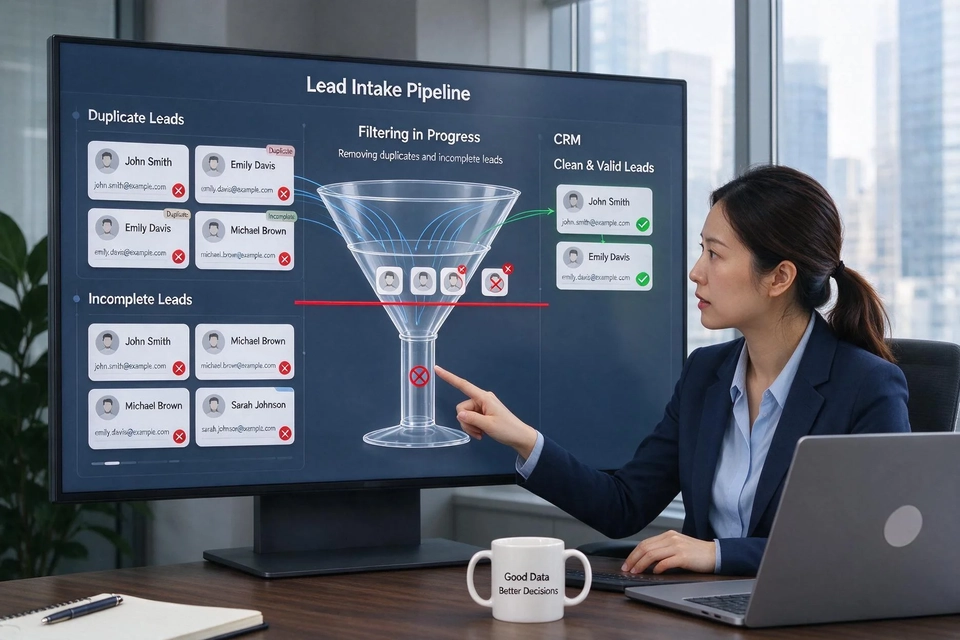
The mechanism is the point. If dirty, duplicate or non-compliant leads are stopped before they reach the CRM, the conversion rate between MQL and SQL improves without any change in ad spend. That is arithmetic, not magic: the denominator of a funnel shrinks while the numerator holds.
What the dossier actually holds is a governance claim, not a conversion lift. Integrate states that consent, validation and governance rules are enforced at the point of lead ingestion, supporting GDPR and CCPA while keeping consistent standards across lead sources, and its own site describes junk, duplicate and non-compliant leads as being stopped and fixed at ingestion before they hit the MAP or CRM. The case figures above sit beside that statement as illustrations of the vendor's own customers, not as a measured effect of ingestion-time filtering on MQL to SQL rates. My judgement, not the sources': if a fixed share of records that currently reach the CRM would never have qualified, removing them lowers the denominator and can lift the ratio at no extra spend, but the size of that effect depends on how dirty the intake actually was, and neither source measures it for a Singapore stack.
How this compares with the stack a Singapore SME runs
Most SMEs in Singapore do not run an enterprise ABM platform. They run a CRM, one or two ad accounts, a website with forms, and a WhatsApp number that sales actually answers. The distance problem shows up there in a more local form: the ad platform reports a lead, the CRM reports a contact, the WhatsApp thread holds the conversation, and nobody can join the three without a spreadsheet.
MCP as a standard is useful because it removes the guesswork from the connection. The AI tool asks for a capability, the platform answers with its schema, and the developer does not write a custom endpoint per client. For a mid-sized business, the practical effect is that connectors become cheaper to build and easier to maintain.
The limit is governance. A standard describes how tools talk, not who may read what, which is why best lead generation work in a small team ends up back at the intake rules. Every MCP deployment still needs the access model, the consent record and the audit trail to sit on the data side.
The analysis none of the ranking pages runs: who owns the intake rule
The pages that rank for MQL growth all treat the MQL definition as something you retrieve. None of them asks who owns the rule that decides which records are joined as MQLs before any assistant reads them, and that ownership is what the numbers on the dashboard are made of.
Take a small Singapore team that runs one CRM, two ad accounts and a website form. The person who configures intake decides, record by record, whether a duplicate form fill from the same mobile number becomes one lead or two, whether a lead captured without a consent checkbox is rejected at ingestion or fixed later, and whether a Facebook Lead Ads record and the matching CRM contact land under the same identity. If those rules belong to a marketing ops person and the MQL definition belongs to a sales director, the assistant is joining data under a rule nobody signed off. Integrate's own position separates the two layers: the platform stays the system of record and enforces the permissions and approval requirements already in place, and the conversion view sorts MQL and SQL by partner, channel, quarter or contract list. That gives the reviewer a comparison, not a verdict: run the same quarter's MQL to SQL conversion once with the current intake rules and once with duplicates and the missing MQLs left in, and the gap between the two figures is the part of the number the intake owner controls. Iron Mountain's reported 267 more MQLs and Trend Micro's 6x revenue pipeline are vendor-published results of a governed intake in place, so they tell you the direction the rule moves the number, not the size it would move yours.
What Topkee's data stack does about the same gap
The problem Integrate names is familiar to anyone running lead generation for SMEs in Singapore and Hong Kong, and the Topkee stack approaches it from the data layer rather than the assistant layer. TTO CDP carries landing-page, event-tracking and lead data and acts as the single source of truth for identity and event data inside the client's own tenant, with an integration catalogue that lists connectors across server, website, ecommerce, livechat, raw data, CRM and advertising groups, including HTTP API, Leadbox Webhook, Zoho Webhook, Facebook Lead Ads, Google Ads Lead Forms and LinkedIn Lead Forms.
Where the news is about giving an AI tool the same permissions as the platform, TTO CDP keeps the data in the client's tenant and scopes access through a PKCE and service-JWT single sign-on gateway, with an APISIX gateway validating each request, injecting tenant identity and enforcing per-tenant IP allowlists. The catalogue is connector and webhook based; the published notes do not document an MCP server, so the honest framing is that the governance model exists while the MCP door is not yet on the shelf.
On top of that sits Topkee Cloud, which frames the same isolation problem from the attribution side: ad, CRM, website and ecommerce systems are separate, so the attribution chain breaks. It traces every lead from ad click to lead to conversation to deal to revenue, and feeds qualified conversions back to Google and Meta as offline conversions so bidding optimises revenue rather than clicks. CRM, ERP, ecommerce or legacy databases are connected in days, not months.
The sales side is Leadbox, which consolidates leads from Weber and third-party sites, WhatsApp, Messenger and call-tracking tools into one live list, runs default stages from lead discovery to won deal, and returns the buyer's tag, ad-topic source and platform person tag on closing so performance can be compared by ad topic and by ad platform. Topkee Media, a Hong Kong digital marketing business and a Google Premier Partner, sells this stack.

A short pilot you can run next quarter
Pick one question that currently costs a meeting to answer, and route it through whatever assistant your team already uses. If you want to know where your get more leads for my business effort actually converts, start with partner-level MQL to SQL conversion for one quarter.
Set the definition with sales in writing before the first query. Run the query and compare its answer against the saved report you would have used. Where they differ, the difference is an intake rule or a naming convention, and that finding is worth more than the report.
Then decide the second question, and only the second. Teams that open five workflows at once usually end up trusting none of them.
Recommended next step
If the distance problem is really a data-plumbing problem at your scale, the useful first move is to look at how the lead data is joined before you look at which assistant reads it. Read the full-funnel Facebook Ads optimisation breakdown for how campaign structure feeds attribution, and the Google Ads AI lead generation notes for how qualified conversions come back to the platform.
If you would rather keep improving the top of the funnel while the plumbing is fixed, the get more leads for my business page sets out the service side, and the best lead generation overview for Singapore campaigns shows where tracking data is verified before spend scales.
FAQ
Does Integrate MCP replace our CRM?
No. Integrate remains the system of record and enforces the same permissions, data controls and approval requirements already in place. The connection changes how a person asks a question, not where the record lives.
Can an AI assistant show data a user is not allowed to see?
The access rule travels with the request. Because the platform enforces the existing permissions and approval requirements, a user who could not open a contract list before the connection still cannot open it after.
How long does the integration take?
Integrate puts onboarding at a few weeks from the first kick-off call. The practical variable is how clean and consistent the intake rules are at the start.
Is this the same as adding a chatbot to our platform?
The announcement draws a deliberate line: it connects the AI tool a team already uses rather than adding a separate assistant inside the platform. The value sits in the governed data behind the answer, not in a new conversation window.
What should a Singapore SME measure first?
Partner or channel level MQL and SQL conversion for one quarter, compared against the saved report the team uses today. A difference between the two is a data definition worth fixing before any wider rollout.
Sources
- Integrate MCP Targets the 'Distance Problem' Between B2B Marketers and Their Data, demandgenreport.com, 2026-11-04. https://www.demandgenreport.com/industry-news/news-brief/integrate-mcp-targets-the-distance-problem-between-b2b-marketers-and-their-data/55096/
- Lead Management & Data Governance Solution, Integrate, undated. https://www.integrate.com/