
How Content Marketing Works With AEO in 2026
As of November 2026, the answer is a re-cut, not a rebuild. HubSpot's content marketing guide, in its 5 November 2026 revision, defines AEO as the marketing practice of optimising content to raise how often a brand appears in AI-generated answers across ChatGPT, Gemini, Perplexity and other answer engines. That points at what most teams already own: pages, videos and assets restructured so an engine can lift a direct answer out of them. Treat it as aeo work with a budget line, and the decision narrows to which formats to fund first and which ratio proves the work landed.
It is written for a marketing lead at a Singapore B2B or SME brand with a running content programme, paid media taking budget already, and a board asking why organic enquiries flattened. Every number below comes from the source named where it is used.
Key takeaways
- AEO is narrower than GEO: it optimises for being quoted inside an AI answer, while GEO covers description accuracy and cited sources too.
- Short-form video is the format teams rate highest for reach and return, at 60.1% and 48.6%, and it is not what feeds most AI citations.
- Production should be organised per buyer question, so one question yields a written answer and the video cut that repeats it.
- A mention rate and a source appearance rate, measured on a fixed prompt set, are what a board can act on.
- Buyers evaluating generative engine optimization singapore vendors will also price the internal option, so the plan has to state what it will not promise.
Table of contents
- What AEO means: AEO 是什麼意思 <!-- lang: allow -->
- Why content marketing still carries the budget
- Which content formats to fund first: the mix by popularity and return
- Why video leads and what it does not do for AI answers
- Turning one buyer question into three assets
- Measuring AEO: the two ratios that survive a board review
- What Topkee does about AI answers
- Your next step
- FAQ
What AEO means: AEO 是什麼意思 <!-- lang: allow -->
The three terms get used interchangeably in vendor decks and they are not the same job. The HubSpot guide's definition is the cleanest start: AEO is a marketing practice that improves how often a brand appears in AI-generated answers, and it applies to video, graphics and podcasts as well as written content. Go one layer down and the boundaries become useful.
SEO asks an engine to rank a page against a query; the engine returns a list and the reader chooses. AEO asks an engine to compose an answer containing the brand, so the unit of competition is a sentence the model writes. GEO (Generative Engine Optimization) is broader: whether the brand is mentioned at all, whether the description is accurate, and which sources the engine cites.
| Question the buyer asks | SEO answers it by | AEO answers it by |
|---|---|---|
| Can I be found for this phrase? | Ranking a page against the query | Getting a passage lifted into the answer |
| Is the brand named in a recommendation? | Indirectly, through position and title | Directly, through brand mentions in the answer text |
| Is the description correct? | Not its job | Not its job either; that is the GEO layer |
| Which sources does the engine trust? | Backlinks, partly | Cited pages and retrieval, the GEO layer |
For a Singapore brand the confusion costs money. A large share of local results for the acronym concern the Authorized Economic Operator customs scheme. A team that buys an "AEO" package without agreeing on the meaning cannot read the report it gets back, so write the term out in full on first use and put the definition in the vendor contract.
The guide is also explicit that AEO can optimise videos, graphics and podcasts, not only written pages. That matters below, because the format with the best return rating and the format that makes the cleanest answer passage are rarely the same asset.
Why content marketing still carries the budget
Content marketing is a strategy that uses written or visual content to attract and engage a target audience, and the guide's 2026 framing is that it goes well beyond a blog: video, graphics and AEO now work together. The reason is not sentiment. Paid channels are losing reach to avoidance, and content survives that avoidance.
B2B marketers surveyed by the Content Marketing Institute, as cited in the guide, report that content marketing creates brand awareness for 84%, generates demand and leads for 76%, and nurtures subscribers and leads for 63%. Those are separate jobs with separate scorecards, and lumping them into one "content performance" number is how a programme gets cut.
The avoidance explains the urgency. Backlinko's latest global statistics put ad-blocker use at 29.5% of internet users worldwide, an estimated 1.77 billion people, with national rates ranging from 40.1% in Indonesia to 32.5% in the United States and 28.5% in the United Kingdom. If three in ten of the people you pay to reach have switched ads off, and the guide's read of consumer surveys puts skipping and muting on top of that at 93%, the budget argument for owned content writes itself.
Social does not replace it. There are 5.79 billion social media users worldwide, and brands split their presence almost evenly between organic and paid social, at 40.3% and 39.4%. That near-even split means a large share of brands pay for the feed position their competitors hold organically.
Which content formats to fund first: the mix by popularity and return
Most plans guess here, and the guide's 2026 data separates what peers do from what peers say works.
Short-form video is the most popular content marketing format at 60.1%, followed by long-form video at 38.2%, blog posts at 37.8% and live streaming at 36.9%. That is a peer count, so read it as the default your competitors run.
When marketers rated which formats produced the best return in 2025, video took the top three places: short-form video at 48.6%, long-form video at 28.6% and live streaming at 25.1%. Put the two lists side by side.
| Format | Share of teams using it | Share rating it best for return |
|---|---|---|
| Short-form video | 60.1% | 48.6% |
| Long-form video | 38.2% | 28.6% |
| Live streaming | 36.9% | 25.1% |
| Blog posts | 37.8% | not in the top three |
Read the columns against each other and one pattern holds in every video format: fewer marketers rate the return as best than are running the asset. That is the normal shape of a maturing channel, where the early return has been competed away. Blog posts sit at 37.8% adoption without a top-three return rating, which is the opposite problem: under-rated by the people who measure content on traffic alone.
The budget decision that follows is video for reach and recall, written pages for the answer, and no format without a named job. A Singapore SME with a team of two can fund short-form video as a weekly reach asset and written answer pages as the citation asset, and leave live streaming to brands with a community to serve.
Why video leads and what it does not do for AI answers
Video's return rating is not a mystery: motion and a face are what a feed rewards, and it is the format a buyer finishes. The guide's funnel framing puts short-form video and social posts at awareness, alongside blog posts, podcasts, infographics and checklists, with longer-form video, white papers and case studies in consideration.
What video does not do is hand an engine a passage it can quote. Not every engine processes a transcript equally, and an asset with no readable text underneath gives a retrieval system less to work with than a page with a clear heading and a direct answer. AEO covers video and podcasts at the strategy level; it becomes operational when the video has a written layer such as a transcript and a titled page.
Short-form video earns the reach at a 48.6% return rating; the written page beneath it earns the citation. A brand funding one without the other pays for the part of the funnel that never gets recorded.
Turning one buyer question into three assets
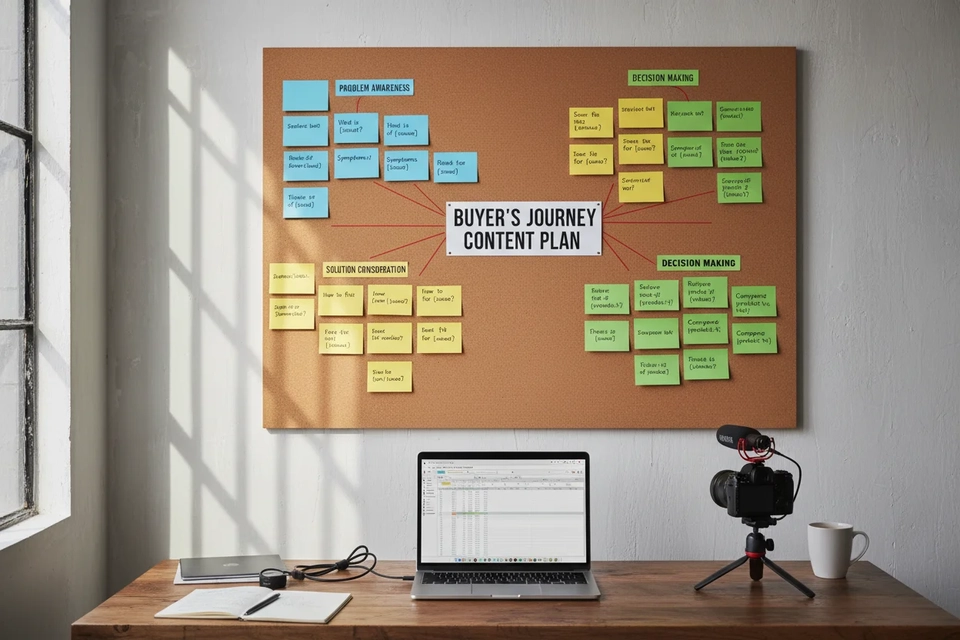
The unit of production is what makes AEO affordable. Most content calendars are organised by output type, which produces a backlog of one-format assets that no one can reuse. Organise by buyer question instead, so each entry turns one research effort into a written answer and the cuts that repeat it. The guide's funnel structure supports this: awareness content handles broad pain points, consideration educates on the solution, decision content handles objections.
The calendar runs on four steps.
- Write the question list. Take the questions sales hears on calls and the ones search data shows, then write each in the buyer's own words rather than the brand's. A question framed as "what does a company like mine need before it buys" produces a different asset from "why choose us".
- Answer the highest-intent question first. For each entry, write one paragraph that answers it directly in the first two sentences, then add the context a reader needs and the facts that can be checked. The direct answer is the part an engine lifts.
- Cut the video and the social post from that answer. The script is the answer paragraph, the visual is the context, and the social cut takes the single strongest number.
- Publish the page before the video. The page is the record the engine can retrieve; the video sends people to it.
A calendar built this way does more with the same headcount and makes the coverage metric honest. Counting articles measures how busy the team was; counting answered buyer questions measures how much of the decision the brand now appears in.
A Singapore accounting firm sees the same handful of questions in its enquiry forms every month. Under the old calendar that becomes five blog posts, each written once and read once. Under a question calendar it becomes five answered pages, each with a short video cut from its strongest paragraph and a social post behind it, all tracing back to facts the firm has already verified. Research is shared, so production costs fall, and every page ends in a direct answer, which is the part aeo rewards.
This is also where content programmes quietly fail the AI test. A team that has answered 84% awareness-level questions and no comparison questions has built reach without building the shortlist. Under a question calendar that omission is visible in the list itself.
Measuring AEO: the two ratios that survive a board review
Traffic is a poor scorecard for this work because an AI answer can send no click at all and still put a brand in front of a buyer. The guide's KPI framing keeps site traffic, engagement and conversion in view, which is right for a programme, and it leaves the AI layer unmeasured unless you add it yourself.
Two ratios carry the decision.
Mention rate is the number of valid answers containing a brand mention, divided by the number of valid answers collected under identical conditions. Source appearance rate is the number of valid answers where the brand's own site appears as a cited source, divided by the same set. Both need the question version, the engine, the language, the market and the sampling cadence fixed before any comparison, because an unfixed sample confuses a measurement change with a market change.
The denominators are where first attempts go wrong. Take one fixed question and its valid answers: a brand mentioned in most scores well on mention rate, while a source appearance rate that lags means the brand's own pages are missing from the evidence. High mention with low source appearance says other people describe you and your pages do not, which is a page and structure problem rather than a volume problem.
The reading is a quarterly decision. Set the baseline, deliver content for a quarter, then compare. The 2026 State of Marketing Report explains the patience: 61% of marketers call AI marketing's biggest disruption in two decades, and 80% already use AI for content creation, with 75% using it for media production. When most competitors produce more with the same tools, the advantage sits in which pages earn the citation.
Two limits are worth stating plainly. First, a mention in an answer is not a lead, and the ratios do not tell you what the mention is worth; only the enquiry and pipeline data do. Second, the prompt samples come from an agreed API environment, so they will not reproduce exactly what a consumer sees inside a chat app. Treat the ratio as a trend measure with a fixed method, not as an audit of the public interface.
What Topkee does about AI answers
Topkee approaches this problem through GEO rather than under an AEO label, and the distinction is worth being precise about. Its GEO service monitors how AI engines mention a brand, which sources they cite and how accurately the brand is described, then closes the gaps with knowledge content. The work runs on an ASK, UNDERSTAND, IMPROVE loop across six workstreams: prompt tracking, query fan-out analysis, sentiment and brand description accuracy, competitor comparison on the same questions, AI browsing and citation analysis, and monthly human-edited knowledge content.
generative engine optimization singapore therefore describes a service a Singapore marketing lead can buy against the content plan above, with scope fixed as one brand, one main website, one market and one content language. Scope is set per brand rather than per page, and the fees are quoted in tiers by the number of concurrently tracked buyer questions and the number of knowledge-content pieces delivered each month. Each knowledge piece carries a direct answer, necessary context and checkable facts, is human-edited, and includes one consolidated revision round.
The measurement is the part that lines up with the section above. Topkee reports mention rate and source appearance rate as its two visibility ratios, separates delivery from search and AI visibility, then from visits and business outcomes, and states plainly what it does not commit to: it does not guarantee AI recommendations, fixed exposure or any amount of query volume. That is the honest scope for a practice nobody can guarantee, and it is the right question to put to any vendor quoting a coverage figure.
Topkee's content marketing service runs the other half of the same plan: social content operations, SEO web content, blog marketing and ad creative production, with a documented method that keeps content and brand image consistent, platform-specific and keyword-led, tested continuously and reviewed on a long cycle. For budgeting the separation matters: SEO content builds the pages an engine retrieves, GEO work measures and repairs how they surface, and shared content is created once.

Your next step
Before the next budget cycle, write the buyer questions your sales team hears most, in the buyer's own words. Pick the five with the highest enquiry value, rewrite the pages answering them so each opens with a direct answer, then run those questions on two engines with the method fixed and record mention rate and source appearance rate.
Topkee's GEO service page sets out the scope, tiers and sampling method for aeo measurement. If you build it in-house, use the same steps under generative engine optimization singapore benchmarks you set yourself; the method matters more than the supplier.
FAQ
What does AEO stand for in marketing?
AEO stands for Answer Engine Optimization. HubSpot's 5 November 2026 guide defines it as the marketing practice of optimising content to raise how often a brand appears in AI-generated answers across ChatGPT, Gemini, Perplexity and similar engines, covering written pages as well as video, graphics and podcasts. The acronym is also used in shipping for Authorized Economic Operator, so write it out in full in any brief.
What is the difference between AEO and GEO?
AEO is the narrower job of shaping content so it gets picked up inside an AI answer. GEO, Generative Engine Optimization, is the broader programme: whether a brand is mentioned at all, how accurately it is described, which sources an engine cites and which competitors appear on the same question. In practice AEO is one deliverable inside a GEO programme, and a brand that measures only the first misses description errors.
Is AEO different from SEO?
They share the corpus and differ in output. SEO competes for a position in a result list, while AEO competes for a sentence inside an answer the engine writes. Both need a crawlable page, clear headings and checkable facts, and AEO puts more weight on a direct answer in the opening lines and on the brand being named in the answer text.
How do you measure whether AEO is working?
Fix a set of buyer questions, an engine, a language, a market and a sampling cadence, then collect answers repeatedly. Count the share of valid answers that mention the brand, and the share that cite the brand's own site. Compare periods and competitors only on that fixed method, and connect the trend to enquiry data.
Does short-form video help AEO?
It helps reach, and reach is not citation. Short-form video is the most used format at 60.1% and is rated best for return by 48.6% of marketers, so it works as an awareness asset. To make it AEO material, publish a written answer and a transcript with it, so an engine has text to retrieve.
Can content marketing keep earning without paid media?
It can carry the brand awareness and demand work, and it will not replace paid reach on its own. Content marketing is credited with brand awareness by 84% of B2B marketers, demand and leads by 76% and lead nurturing by 63%, while 93% of consumers use some form of ad avoidance. The two are complements: paid buys the first impression, content earns the answer.
Sources
- Kristen Baker, "How to leverage content marketing, according to a content marketer", HubSpot Blog, 5 November 2026. https://blog.hubspot.com/marketing/content-marketing
- "2026 State of Marketing Report", HubSpot, 2026. https://www.hubspot.com/state-of-marketing
- "Ad Blocker Usage and Demographic Statistics in 2026", Backlinko, 19 March 2026. https://backlinko.com/ad-blockers-users