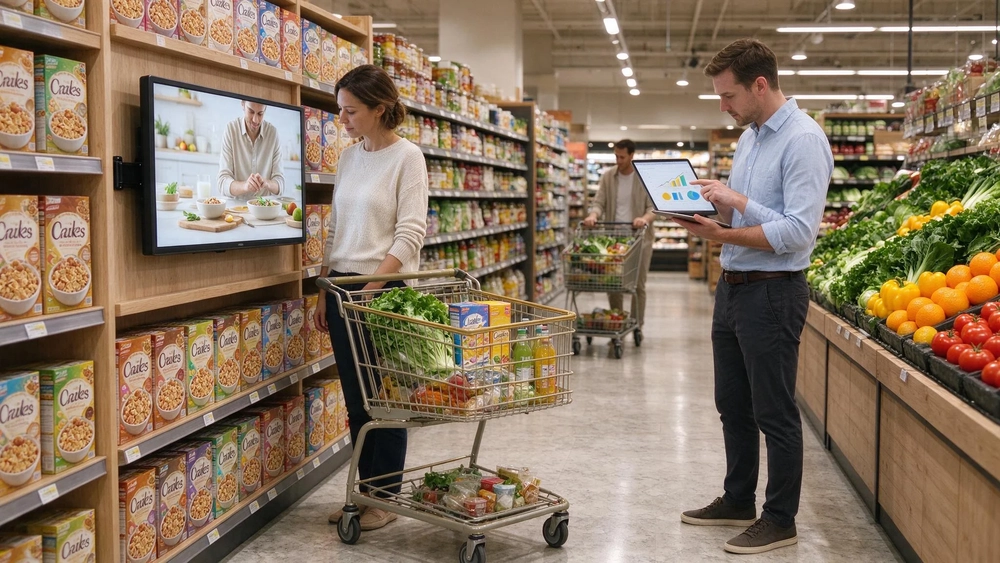
What facebook ads price buys when the store is the channel
Short answer: in-store grocery media is sold like a digital channel now. It is a network of screens inside the store, bought through one platform and measured against a control group, and that changes how you should read a facebook ads price. As of November 2026, the question a marketer should ask of any channel, paid social or a supermarket screen, is not what a click costs but what one month of spend has to buy: a measurable step in sales, some reach no other channel gave you, and a number you can defend to whoever signs off.
Digiday's explainer on the grocery store as a media channel, published on 6 November 2026, reports Grocery TV's 2026 In-Store Shopper Perception Report finding that 95% of grocery shoppers make at least half of their purchase decisions in-store, and that 55% of Gen Z consumers shop in-store at least once a week. Those two figures are the argument for the channel. They are also why budgeting for it is not the same exercise as budgeting for a news feed.
Key takeaways
- Retail media inside the store now has a standard buying path and control-group measurement, so it can be compared with Meta advertising on lift rather than impressions.
- The shopper numbers support testing a store channel; they do not say what a month of it should cost.
- A small monthly social budget can be enough, but only for one defined job, not a full campaign.
- The cheapest way to prove any channel worked is a test and control split that covers the whole campaign length.
- Managed service fees and media spend are separate lines; confusing them is the most common budget error.
Table of contents
- What the grocery store sells now
- Reading the shopper numbers without overreading them
- Laying out a monthly budget across Meta and in-store
- Is a small Facebook budget enough?
- What a control group proves about in-store spend
- Where in-store work goes wrong on measurement
- What Topkee Media does inside this budget question
- Next step: a two-week measurement audit
- FAQ
What the grocery store sells now
The shift Digiday describes is packaging. Digital media buyers had long avoided in-store because it was a retailer-by-retailer negotiation without standard metrics, and now the channel can be bought through a single platform with digital-style targeting and full-funnel measurement. Investment followed that packaging: eMarketer projects US in-store retail media spending reaching $1.15 billion by 2029.
For a media planner, the practical meaning is that the store has moved from a sponsorship line to a line in the media plan, though it still behaves differently from a feed. The unit of purchase is a screen inside a named retailer, and the value comes from where the shopper happens to stand when the screen is in view.
Two formats sit next to each other in that plan. The first is paid social on Meta, where the inventory is uniform, the auction is real time and every click is attributed; that is the auction a facebook ads price quote describes. The second is the in-store network, where the inventory belongs to a retailer, the audience is physical and the attribution runs through a control group. Both can be rational buys; they fail in different ways.
Reading the shopper numbers without overreading them
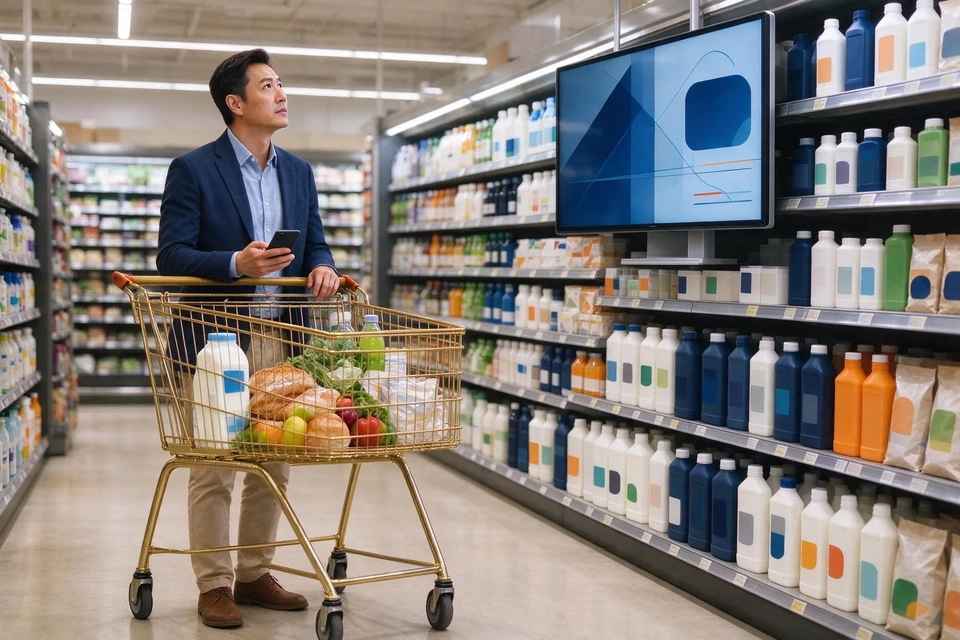
The shopper research is stronger on perception than on spend. Grocery TV's report, as reported by Digiday, also finds that 32% of shoppers enter the store without a list and 78% make at least one impulse purchase during their trip, and that 62% of shoppers have purchased something directly after seeing it on an in-store screen.
The last figure is the one a budget holder will quote. It is also a self-reported recall statistic, and it should be read as an indication that the format is noticed, not as an incremental-sales figure. The measurement that does support a spend decision is the control-group study discussed further down.
There is a second data point worth carrying into any plan. Digital display formats saw an average 10-percentage-point increase in positive customer experience ratings between the 2023 study and the 2026 one, and zones where shoppers naturally dwell were rated 84% favourable. Receptivity changed; it did not arrive at a fixed level.
Laying out a monthly budget across Meta and in-store
The mistake most often made when a new channel appears is to move money before the existing channel has been measured. A cleaner sequence keeps the social programme intact for one more cycle and funds the test from the part of the budget already producing the least evidence.
| Scenario | Meta spend | In-store test | What a month buys | What it proves |
|---|---|---|---|---|
| Small retail brand | Kept as is | None yet | Reach and conversions on a uniform auction | Cost per result, nothing about the store |
| Retail brand with a launch | Kept as is | One retailer network, matched stores | Exposure plus a test and control split | Whether the screen moved sales |
| Advertiser with weak digital | Trimmed | A defined in-store test | Reach no other channel delivered | Whether incremental reach was real |
The third row needs a reason before it gets a budget, and the fee structure is part of that reason: a facebook ads price holds only once the media spend and the managed fee are counted separately. On this, Chelsea Monaco of Digitas North America told Digiday that some cases justify taking budget out of underperforming digital and moving it in-store. The qualifier is underperforming: a channel that has been measured and failed, not one that feels tired.
What the store adds on top of the plan is reach the plan would otherwise miss. A study by Grocery TV and MFour, cited in the same explainer, found in-store media delivers an average of 49% incremental reach beyond existing media plans. For an advertiser already close to saturation on Meta, that is the number that decides the test.
Is a small Facebook budget enough?
No search result answers this directly because a monthly figure means nothing without a job attached to it. The same small sum can be sufficient or wasteful depending on what it is asked to do in one month.
A small monthly budget works under three conditions:
- One objective for the month, so the optimiser is not split across conversions, traffic and reach.
- One audience narrow enough to exit the learning phase quickly, usually a retargeting list or a single lookalike built from converters.
- One conversion event wired to the real outcome: a lead in the CRM, an order or a store visit, never a page view standing in for a sale.
A small budget fails when the same money has to launch a new audience, test several creatives and prove incrementality at once. Each of those tasks needs its own volume, and divided three ways none of them reaches a conclusion. The test-and-learn logic used for in-store applies here too: one hypothesis per cycle, a fixed window, a result you can read.
How much a managed programme costs on top is a separate line. An agency fee and the media budget are different numbers, and a quote that blends them tells you nothing about either. Ask the facebook agency for the split before comparing two providers.
What a control group proves about in-store spend
The clearest evidence in the Digiday piece is a matched-store study. For Frito-Lay, Hy-Vee's RedMedia and Grocery TV compared test and control stores across 103 stores over a month, and the campaign generated a 15% sales lift and a $7.94 return on ad spend. Grocery TV's own case study page puts the sales lift at 15.2%, with 13.2 million total impressions for the 'Do Us a Flavor' launch.
The mechanics matter more than the numbers. A matched-store test assigns stores to test and control, runs the campaign in the test group for a fixed period, then compares sales between groups. Because the comparison is between stores rather than between people, the effect of the ad is isolated from seasonality, price changes and promotions that hit every store.
Brand-lift studies use a lighter version of the same idea. A Grocery TV campaign for a financial health app measured impact against a control group and found an 82% lift in brand rating and accompanying rises in recommendation and brand awareness. A telecom campaign aimed at stores that over-index for Hispanic shoppers drove a 27% lift in consideration for the brand when shopping for a wireless plan.
When you commission any of these, three details decide whether the result is usable: the size of the test and control groups, the length of the window, and which outcome was fixed before the campaign ran. The explainer notes that in the 2026 Grocery TV and IAB study, 75% of marketers who said they fully leverage in-store media measured post-purchase outcomes such as loyalty and repeat purchase, a far higher share than among those who said they underutilise it.
Where in-store work goes wrong on measurement
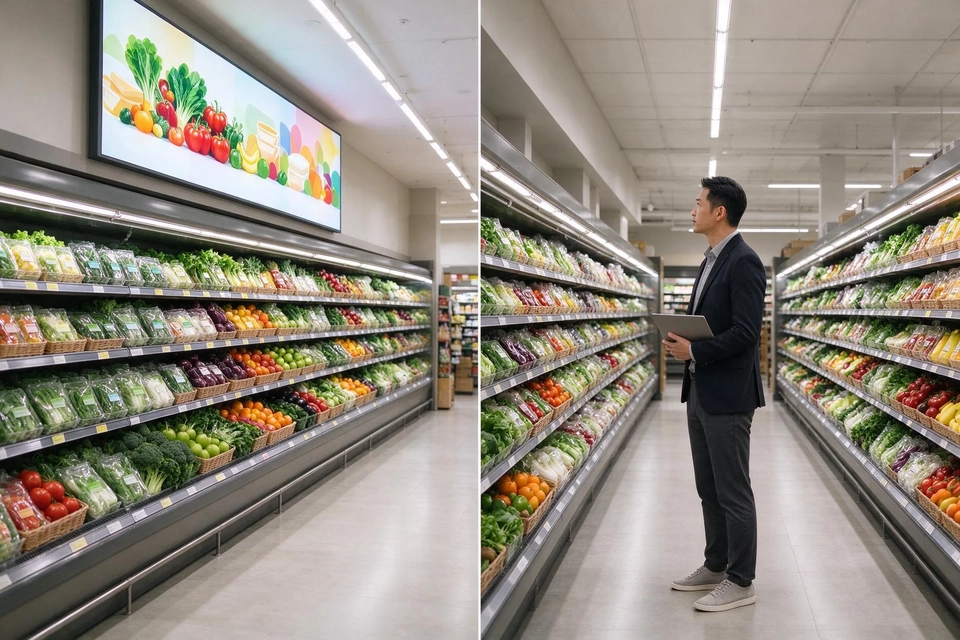
Three failures recur in the way in-store campaigns are planned.
The first is measuring the middle of the funnel and calling it sales. Awareness and consideration are legitimate objectives, and a brand-lift study is the right tool for them; presenting one as a sales result is not.
The second is letting the shopper-marketing team own the channel without the media team in the room. The explainer reports that ownership still sits largely with shopper marketing teams, while the marketers getting the most from the channel involve national media and brand teams and measure beyond immediate sales.
The third is skipping the incremental-reach question. If a store campaign reaches the same people a social campaign already reached, the lift it produces is partly a duplicate. The 49% incremental reach figure is the reason the channel can claim a budget line of its own, and it is the first thing to check in a proposed plan.
What Topkee Media does inside this budget question
Topkee Media is a Hong Kong digital marketing and website company, operating since 2010 and a Google Premier Partner, that runs Google and Meta paid advertising and tracks the results through a single conversion funnel. Its Performance Meta Ads Service builds audience lists from owned data such as site visitors, page fans and customer lists, and carries the same audience data across ad platforms, refines targeting from the profiles of customers who already converted, and reruns a dedicated offer to people who viewed a page or clicked an ad without enquiring.
That matters to the store question at one specific point: connecting an in-store or offline sale back to the ad that produced it. The company's Offline Conversion Tracking gives every lead a unique identifier carrying UTM parameters, so when sales update that lead's stage in the CRM the event returns through the tracking layer to Google Analytics, Facebook Pixel, Google Ads Conversions and Bing UET, and the platforms use their own models to find similar audiences. A retail brand that takes payment in a shop or over the phone can therefore feed that outcome into the same attribution it uses for online conversions.
The coverage here is worth stating plainly. The knowledge base holds no in-store screen network, no CTV or out-of-home inventory and no grocery case study, so this is not a claim to run a store media buy. What it does cover is the part that usually decides whether a store test gets funded: the measurement link between a sale and the campaign behind it. It also runs Weber O2O Shop, an online-to-offline platform whose inventory, membership and order data sync in real time and whose promotion tools aim at converting online traffic into physical-store footfall. For a marketer considering both an in-store test and a store-visit objective, those two systems sit on the same measurement question.
Next step: a two-week measurement audit
Before funding a store test, run an audit of what the current social programme can already prove. Export the last quarter of conversions, check that each one carries a value and a source, and confirm the CRM stages fire back to the ad platforms. If a sale in a shop or on the phone cannot be matched to the campaign that created it, the in-store test will produce lift without attribution, and the next budget conversation will rest on a figure no one can defend.
Two of the site's worked examples cover the adjacent ground: how Facebook ads strategies lifted offline fashion sales, and how Facebook ads perform in a large retail market.

FAQ
Is a small monthly budget enough for Facebook ads?
It can be, if the month has one objective, one audience and one conversion event wired to a real outcome. It stops being enough when the same budget has to launch an audience, test several creatives and prove incrementality at once.
Is in-store grocery media worth the budget?
It is worth testing when the existing media plan is close to saturation and needs reach it does not have. The 49% incremental reach figure is the test case; a matched-store study over a fixed window is the way to check whether it holds for a given brand.
How is in-store media measured, given there are no clicks?
Through the same lift studies used for brand campaigns: matched-store sales tests, brand-lift studies against a control group, and foot-traffic studies. The Frito-Lay study compared test and control stores across 103 stores over a month.
Should an in-store test replace part of the Facebook budget?
Only if the social spend has been measured and found weak. The clearer pattern is to keep the social programme intact and fund a store test from the part of the budget producing the least evidence, then compare both on lift.
How does an agency fee differ from the ad budget?
They are separate lines. The media budget is what the platforms or retailer networks receive; the agency fee is what the managed service costs. Ask any facebook agency for the split, because a blended quote hides which number moves when results change.
Sources
- "How TF is the grocery store a media channel?" — Digiday (sponsored by Grocery TV), 2026-11-06. https://digiday.com/sponsored/in-store-grocery-media/
- "Frito-Lay In-Store Retail Media Case Study" — Grocery TV, undated. https://grocerytv.com/case-study/cpg/frito-lay/
- "Grocery TV: The Leading In-Store Retail Media Platform for Grocery" — Grocery TV, undated. https://grocerytv.com/

Article Author
Pang Sir
