Google Expands & Clarifies Sexual Content Advertising Policy
Google added new prohibited and allowed examples to its sexual content policy for Google Ads on November 16, 2026, and said the update does not change enforcement. If you buy media through a sem agency in Singapore, the question this week is narrower than the headline: which live assets now sit inside a category Google has just described more precisely, and who re-checks them before the next disapproval costs impressions? As of November 2026, most accounts need a dated review of creative, copy and landing pages.
- Google posted the change on November 16, 2026, adding examples rather than a new ban.
- Enforcement is unchanged: a warning comes at least 7 days before a suspension, and an edited asset is re-reviewed in about 24-48 hours.
- Sexual content ads cannot run on YouTube, the Display Network or image ads, so an idea can pass the test and still have nowhere to run.
What the November 2026 Google Ads update adds: prohibited vs allowed examples across nudity, partial nudity, sexual merchandise and sexual entertainment
Google's change log entry, posted November 16, 2026, explains the edit: the article now gives advertisers "additional examples and clearer information", and the change "does not change enforcement of the policy". That is the line to cite when a client asks whether the rules became stricter: on paper they did not; they became more specific.
The policy separates strongly restricted from moderately restricted content. Strongly restricted ads serve only against sexual content search queries, then according to the user's age, SafeSearch setting and local laws; moderately restricted ads drop the search-query condition but keep the rest. Both example lists are guidance rather than a complete list, so an asset nobody mentioned is not automatically safe.
Nudity and partial nudity
Visible genitalia, visible female breasts and visible buttocks stay restricted. The allowed side now spells out simple or unrealistic sketches, such as stick figures or line drawings, and nudity in classical or historic art with a wide general audience.
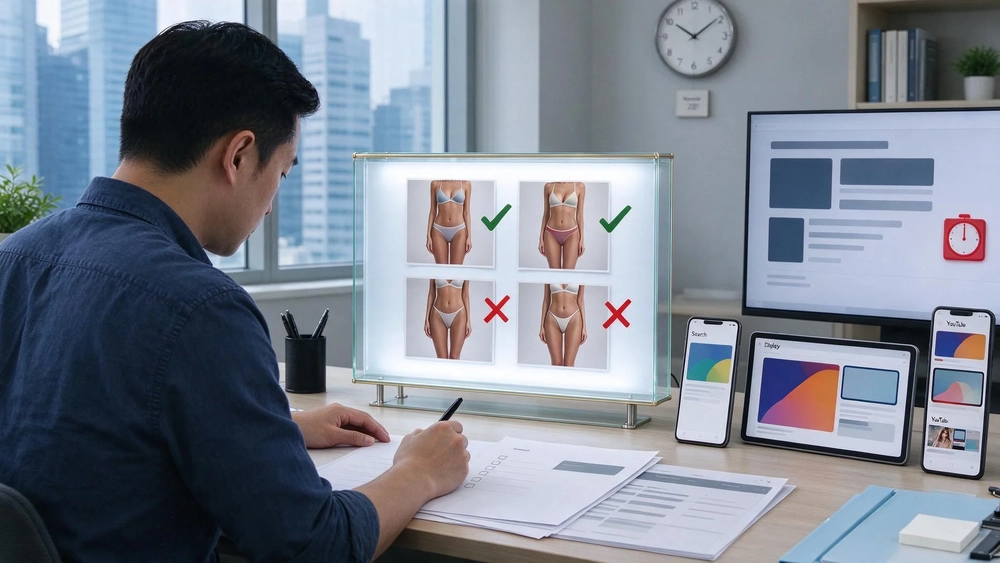
Partial nudity turns on how much is shown: the lower or side curve of an exposed breast, or buttocks mostly exposed in a thong or g-string, remain restricted. Buttocks mostly covered by bikini-cut or tanga-cut underwear are allowed, as is partial breast nudity in a breast self-exam guide or breastfeeding content. That educational example is one a clinic or a maternal health brand can now cite in a brief.
Sexual merchandise
Sex toys, devices that aid sex such as vacuum erection devices or position pillows, condoms marketed on enhanced pleasure, and fetish lingerie built for sexual experiences sit on the restricted side.
Pelvic floor muscle trainers, hormone replacement therapy with secondary sexual benefits, non-sexual genital treatments such as feminine hygiene wipes or yeast infection treatments, condoms marketed on pregnancy and STI prevention without suggestive framing, and lingerie meant to be worn under clothing are allowed. The test is marketing intent and language, so two shops can sell similar fabric and land on opposite sides.

Sexual entertainment and suggestive themes
Erotic dancing such as lap dancing, pole dancing, burlesque and striptease is restricted, as are erotica promoted in sexualised language, phone sex and webcams, suggestive role-play, adult games with sexualised narratives, and sexualised gifts. Pole-dancing classes framed as exercise or athletics are allowed, and so are books or magazines promoted without sexualised language.
The page runs wider than the four headline categories, covering suggestive language, non-graphic sex in imagery, poses, breast emphasis, foreplay and objects used as stand-ins for bodies or acts. A food image that reads as a double entendre or an emoji placed to imply a sex act has its own row, and in my experience that is the row teams miss most often: nobody in the brief thought they were making a sexual ad.
Why Google clarified the policy instead of tightening enforcement
A platform that publishes more detail and then says nothing has changed is answering a different problem. An advertiser reads the policy article to decide what to make; a reviewer applies it to decide what to approve. Without examples, both sides fill the gap with judgement, and the advertiser meets it only after a disapproval.
Examples move the judgement earlier. A designer can now point at a row and say a bikini-cut image is allowed, or that a thong image is not. An asset that was borderline under the old wording may now match a restricted example, which is the cost of clarity. For an advertiser and a sem agency reading the same page, the conversation moves from taste to a named row.
Enforcement is unchanged. The policy page states that violations do not lead to immediate account suspension without prior warning, and that Google issues a warning at least 7 days before suspending an account. That window is the period to fix the account, not a licence to keep a non-compliant asset live.
Local law sits on top: Google requires ads to comply with the laws of the regions a campaign targets, so the policy page sets the platform floor and local rules add to it.
Who in a Singapore marketing team this affects, and how
Ask who owns the asset brief, not the account: the people who feel this update first write the brief, choose the image, edit the video and approve the landing page.
Health and wellness brands are the clearest case. A clinic promoting a breast self-exam, a feminine hygiene brand, a hormone therapy provider and a pelvic floor trainer now have an allowed example to defend a campaign idea. A sexual wellness retailer selling massagers sits on the restricted side, which limits where it advertises, not whether it trades.
Beauty, apparel, lingerie and entertainment brands sit closer to the line. Underwear shown on a model needs the coverage test image by image; lingerie meant to be worn under clothing is allowed, while fetish lingerie is not. A pole-dancing studio teaching fitness classes and a club advertising a burlesque night may use similar photography and land in different categories because of the words around it.
Agencies and in-house teams share the operational problem: the policy applies to every format. Sexual content ads cannot run on YouTube, the Display Network, Gmail ads, image ads, app ads, Dynamic Display ads or TrueView video ads, though they can run on Google Search. A creative that passes the content test can still be unplaceable in the channel the media plan assumed. When an advertiser compares ppc advertising companies, the placement map is one of the answers worth asking for.

This advice does not suit a business with no health, beauty, apparel, entertainment or relationship-adjacent creative.
What to do now, in order
- Date the review. Open the policy page and the change log entry and record November 16, 2026 as the date the wording changed. Expected result: one line naming the policy version the team worked from.
- Inventory live assets by format: image ads, video, Shopping feed images, headlines, descriptions and their landing pages.
- Sort each asset against the four categories as allowed, restricted or unclear, and note the matching example row.
- Replace or rewrite the restricted assets before the next flight. A crop, a wardrobe change or one sentence removed from the headline is usually enough.
- Check the destination page. Google reviews the ad and the page behind it, so a compliant image pointing at a page with suggestive copy can still fail.
- Save the edits and let the automatic re-review run. Google says an edited asset is re-reviewed automatically, which typically takes 24-48 hours; the status shows on the Ads & assets page. Appeal anything still disapproved or remove it, since repeated violations can lead to suspension. Expected result: a status change within two working days.
- Decide who owns the check. An in-house team needs a named reviewer and a calendar slot; when a team shortlists ppc advertising companies, the check belongs in the retainer, triggered by the asset brief. Expected result: a name beside the step.
If the brief is produced at speed, the review has to catch what the brief did not. Our note on AI slop, ChatGPT Search share and the SEM brief looks at how generated copy enters a campaign and where a human check belongs.
What Topkee Media checks before an asset goes live
Topkee Media runs Google Ads as an outcome-oriented service built around revenue rather than clicks. The work covers the full funnel: search ads audit, keyword match-type refinement, long-tail expansion, negative keywords, ad-copy testing, budget and bid adjustment, landing-page and intent alignment, and enquiry handling through Leadbox lead management and YME chat. Budget is reallocated by return on ad spend, from weak ad groups to those that convert. A policy update lands inside that loop: the team that rotates creative and tests copy also reads the new examples before the next rejection.
Coverage shapes the check: Topkee Media works across Search, Display Network, Performance Max, YouTube, App and Shopping campaigns, so a creative decision is tested against each format's rules. Its ad image design produces multi-size images and GIF or animated creative from the brand manual, the promotion theme and the copy, with platform policy requirements and placement specs as a stated design constraint, informed by Leadbox behavioural data. For YouTube, the operations team tests ad content against YouTube's advertising policies before launch. Topkee Pte. Ltd. has been the Singapore entity since 2024, and the review is the kind of thing ppc advertising companies document.
Topkee Media is a Google Ads official partner and a Google Premier Partner since 2016, and that status does not exempt a client's creative from Google's review. The service tests content against the policy and fixes what fails; the approval decision stays with Google.

What to watch next
Watch the change log rather than the policy article. The article changes quietly as examples move, and a platform notice makes a dated review defensible. The examples are a living list rather than a settled one.
Watch the account signals too. A pattern of disapprovals, a sudden drop in eligible impressions, or a format that stops serving says more about enforcement than any general reading of the policy, so treat them as review triggers.
Watch placement availability as well, because the format limits decide whether a compliant idea can run at all. A sem agency that monitors the change log for clients avoids discovering the limit when a flight is paused.
For the account-level view, our article on AI-powered SEM and Google Ads ROI strategies sets out how automation, creative and budget decisions fit together once compliance is settled. The next step is concrete: open the change log, pick the format with the most exposure, and put a name and a date on the review.
Sources
- Google Expands & Clarifies Sexual Content Advertising Policy, Search Engine Roundtable, 2026-11-20. https://www.seroundtable.com/google-expands-sexual-content-advertising-policy-42548.html
- Sexual content - Advertising Policies Help, Google, accessed 2026-11-20. https://support.google.com/adspolicy/answer/6023699?hl=en
- Update to Sexual Content policy article (November 2026), Google Ads policy change log, 2026-11-16. https://support.google.com/adspolicy/answer/18952957?hl=en