
AI Automation for Business: What a 2027 Agent Needs
As of November 2026, ai automation for business has moved from drafting text to moving money and records. Google Cloud's security forecast for 2027 says every consequential autonomous action needs a complete, tamper-proof decision trace and must be 100% explainable, and the same forecast gives a supplier checklist a buyer can use today. If your agent can change a supplier record or approve a payment, budget for that control layer in the project, not after it.
Key takeaways:
- The forecast's core requirement is a decision trace that lets a reviewer rebuild what the agent did, step by step.
- Google Cloud puts a speed target on human review: a decision understood in 60 seconds and reversed in 30.
- Treat each agent as its own identity with the narrowest permissions that still let it finish the job.
- Vendors already prescribe review and permission rules, so ask for them in writing before signing.

What Google Cloud's 2027 forecast actually asks for
Chris Betz, CISO at Google Cloud, frames the year as one where agentic hacking, meaning software that finds and exploits flaws without a human at the keyboard, outpaces response teams. The forecast, published with leaders from Google, Google Cloud and Mandiant, puts three priorities in front of enterprises for 2027: protecting decision integrity, moving beyond the current Zero Trust model, and turning internal ground truth into a defender advantage. The The Keyword post summarising it puts the first priority plainly: every consequential autonomous action should be secure and 100% explainable.
The market buys this work through vendors, so the useful question is what a contract for ai automation for business should actually say. That is where the rest of this article goes: the four controls the forecast implies, what each one looks like in a business process, and the questions that separate a supplier who has built them from one who has only talked about them.
The four controls a buyer should require
A decision trace a reviewer can rebuild
Karthik Narain, chief product and customer officer at Google Cloud, sets the bar in the forecast: when an agent makes a consequential decision, you must be able to reconstruct what inputs came in, how the agent reasoned, which tools it called, what parameters it passed and why policy allowed it. AWS uses the same shape for its own governance guidance, which describes automated reasoning checks that test whether an action is consistent with the policy the business wrote.
For a Singapore SME the trace is a document request. Ask the vendor what its agent writes for each action, where that record lives, how long it is kept and who can read it. A trace that exists only inside the vendor's support ticket is not a control you own.
Transaction-level trust instead of account-level trust
Heather Adkins, vice-president of security engineering at Google, argues in the forecast for extending Zero Trust down to the transaction layer. In practice that means an agent gets its own credentials, a scope narrow enough to name the tables and endpoints it may touch, and a policy that can allow one request on Tuesday and refuse the same request on Wednesday when conditions differ.
That last point matters where erp integration services stitch CRM and ERP modules together, since a connector often runs as one shared service account with write access to several of them. Amazon's Well-Architected guidance for generative AI workloads makes the same argument from the cloud side: scope the permissions of the model and the tools it invokes, and keep the trust boundary between the agent and the systems of record explicit.
Communication between specialised agents
Betz describes a market that has moved past pilots. The forecast notes earlier expectations that a small number of organisations would use large language models and agents to find and fix vulnerabilities, then points out that this is now happening at scale across enterprises. When several agents work a single process, each should pass a structured, reviewable handoff rather than an open instruction.
A stop that works at business speed
ai automation for business without a stop button turns a faulty rule into a costly one. The forecast's clearest number is about pace: adversarial software can probe a network and move laterally in minutes. A process that needs a change request and two approvals to pause an agent will not keep up, so the pause has to sit with the process owner.
Setting a review speed your team can meet
The forecast gives human review a measurable target rather than a mood. Analysts, in the model it describes, stop working the alert queue directly and instead set doctrine and verify what the agents propose, where any defensive decision can be understood by a human in 60 seconds and reversed in 30.
Most businesses do not run a security operations centre, so the unit of measurement shifts to a single transaction: the owner of the process should be able to see why an agent acted, in a form they can read, inside that minute, and undo it inside the shorter window. Two things make that possible. The trace is written in business language rather than raw API logs, and the reversal is a supported operation in the product instead of a data restore.
If neither exists, the review window becomes a guess, and the forecast's target is a useful yardstick for judging how far the supplier is from it.

Agent sprawl and the quiet cost of shared accounts
The forecast notes that enterprises deploy thousands of custom agents across multicloud environments, and that flat trust architectures, shared human service accounts and blanket administrator tokens turn internal workflows into entry points for prompt injection and lateral movement. Each new agent that borrows a human account widens the blast radius of one bad instruction.
The cheap fix, a service account with broad rights, is the one that most often appears in quick pilots, and it is the usual way agent projects lose control after the demo. A standing access review of agent identities costs a few hours a quarter and removes the shared credentials before an agent inherits them.
Before a Unisoft AI 課程: who reviews an agent, what is logged, and when it stops
A Unisoft AI 課程 and its peers teach teams to build automations; they do not, on the whole, teach who reviews an agent's actions, what gets logged when it acts, or when it should be stopped. That is the question a buyer asks before enrolling a team or signing a supplier, and it can be answered without a course.
Put four items to any vendor in writing. First, for every agent action that changes a business record, the trace must record inputs, the tools called with their parameters, and the rule that allowed the action. Second, the agent must run as its own identity with a written scope of the systems and fields it may change. Third, every action that moves money, publishes content or edits supplier or customer records must wait in a queue until a named person approves it. Fourth, the person on that queue needs a reversal path they can run without a developer.
The forecast's two windows, 60 seconds to understand and 30 to reverse, give the vendor a target for the third and fourth items, and they are the right questions to ask before a team commits to erp integration services. A supplier who cannot show a working trace and a working pause is still selling the build phase only.
How Topkee builds agents with a review layer
The notes behind this article describe Topkee's custom AI agent development as a workflow built from business rules, with explicit triggers, inputs and outputs and human confirmation points written into the design. An agent may, within its authorisation, fetch data, generate output, save a record or submit for review; the notes state that automatic publishing outside the agreed scope is not carried out by the agent itself. That design decision lines up with what the forecast asks for at the process level.
The Topkee AI Agent platform takes a stated goal, matches it to skills and tools that run against authorised business services, and returns the resulting files, pages and business objects into a workbench. Pending steps, a payment or a publishing run for example, sit in an approvals queue where a person approves or rejects them, and the run records and evidence links show what was done and on what basis. Deployed instances use short-lived tenant JWTs with automatic refresh, which reduces the long-lived API keys sitting in runtime. A file-output guard separates deliverables from process files.
One worked model sits in the notes: the TTO Funnel Tuning Agent runs one isolated instance per campaign, marks every action as pending confirmation until the user grants automatic execution, prevents duplicate commands, keeps permanent records of timeouts and failures, and offers rollback with terminal access for human audit. The notes record unauthorised account changes at delivery as zero, and the client keeps its ad accounts and data.
Two limits deserve stating. Approvals and records depend on the matching skill being connected, so they are not automatic for every integration. The notes make no security-certification or absolute-isolation claim, and none is made here.
For companies with existing systems, the notes describe how the integration work is assessed and built, so that an agent inherits data quality and permissions already in place rather than a copy of them.
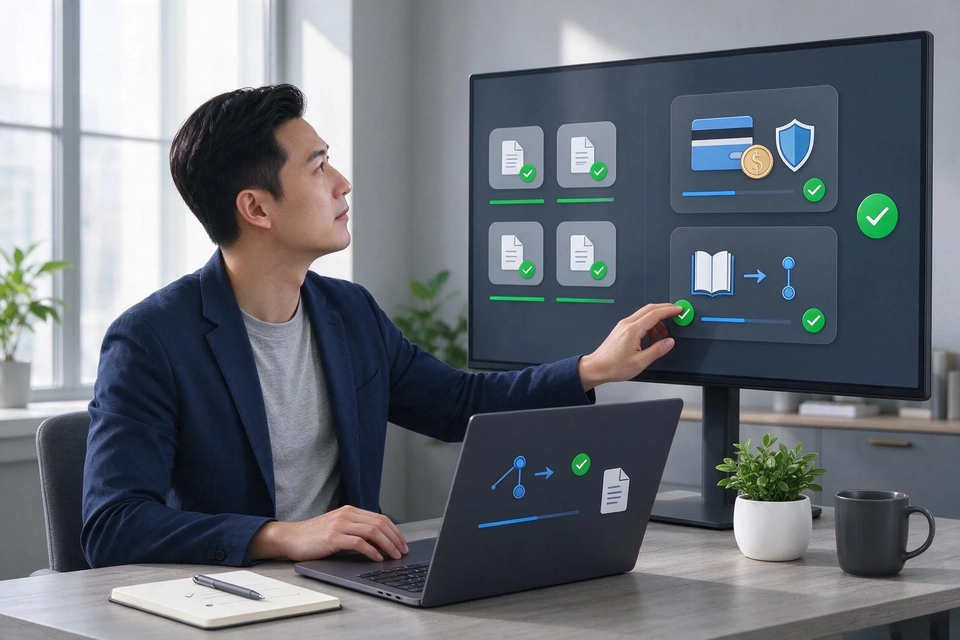
A vendor checklist for agent approvals
Use these five as acceptance items in the contract, each with a yes or no answer and a piece of evidence attached.
| Control | Question to the vendor | Evidence you should see |
|---|---|---|
| Decision trace | What is written for each action that changes a record? | A sample record showing inputs, tools, parameters and the rule applied |
| Agent identity | Does the agent run under its own account? | A permission list naming the systems and fields it can change |
| Confirmation queue | Which actions wait for a person? | The queue in a staging environment, with a named approver |
| Reversal | How is an approved action undone? | A run-through of the reversal, timed |
| Approval chain | Who can raise the agent's permissions? | A written authorisation step, separate from the build |
An agent that answers yes on every row can be tested against your own process in a sandbox before it touches live records. The same list works for ai automation for business built in house, with the team lead taking the vendor's place in the review.
The limits of the forecast for a small business
Google Cloud writes for enterprises with security operations teams, several cloud estates and a threat intelligence function. A trading firm with one operations team needs the same four controls at a smaller scale, and the forecast's numbers point at the direction rather than the budget. The 60-second and 30-second windows are a design target, and a business can set them as a target for its own process owner without buying any new security tooling.
What scales down badly is the assumption of a dedicated security team. For most SMEs the review function sits with the operations manager, which is a further argument for building the trace and the pause into the process from the start.
Recommended next step
The first action is a single sample record. Ask your supplier, or the team building in house, to show the trace and the pause for one live action, then score it against the table above. The design work that sets those rules before the build sits in the buyer's brief for ai automation for business, and that is the section of a Topkee build where the notes place the triggers and confirmation points. For a look at how one agency's reporting and publishing automations were set up around client approval, the case study on AI and inbound marketing at FamilyMart gives a worked example, and the write-up on Photoshop 2027 AI tools covers which design steps are worth handing to an agent at all.
FAQ
What is a decision trace in an AI agent?
A decision trace is the record an agent writes for each consequential action. It holds the inputs, the tools the agent called with their parameters, and the rule that allowed the action, so that a reviewer can rebuild the decision without a developer.
Does Google's forecast apply to a small business automating its back office?
The forecast is written for large enterprises, but its three priorities cover any process where an agent changes a record. A small business can adopt the decision trace, the agent's own identity and the approval queue at a scale that fits its team.
How long should an agent's action stay reversible?
The forecast sets 30 seconds to reverse a defensive decision in a security operations setting. For a business process, set a window your process owner can actually meet, and test the reversal before the agent reaches live records.
Who should approve an agent's actions?
The accountable owner of the process, not the person who built the automation. The forecast's model moves the human up the stack to set policy and verify results, which is the same split the notes behind this article describe for human confirmation points.
Can we use erp integration services and still keep agent permissions narrow?
Yes, if the connector maps the agent's scope to specific tables and fields rather than one shared administrator account. Ask for the permission list and a test that shows the agent being refused access outside it.
Sources
- Google Cloud leaders share what to expect in cybersecurity for 2027, Google Blog (The Keyword), 2026-11-12. https://blog.google/innovation-and-ai/infrastructure-and-cloud/google-cloud/cybersecurity-2027/
- Chris Betz, Cloud CISO Perspectives: Our security forecast for 2027, Google Cloud Blog, November 2026. https://cloud.google.com/blog/products/identity-security/cloud-ciso-perspectives-our-security-forecast-2027