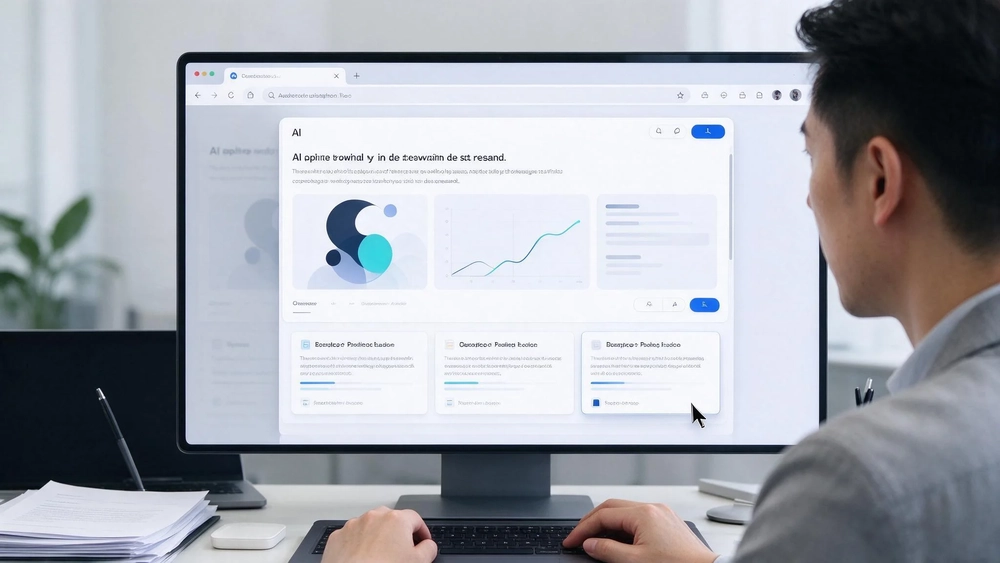
Google AI Overviews Citation Cards Lose Their Fade
As of November 2026, the citation block under a Google AI Overview on desktop shows three citations with no fade at the bottom, so the third link can be read without opening the overview. The change was reported on 18 November 2026 by Brodie Clark and spotted the same day by Sachin Patel, and it reverses a state in which Google had removed desktop citations from the overview entirely. For a team running local seo singapore work, the practical answer is narrower than the reaction suggests: nothing changed in how pages are crawled, indexed or ranked. What changed is how easily a reader can see and use the sources an answer already had.
Key takeaways
- The update is a display change: Google's default now keeps three citations visible, without the fade that used to hide the lower ones.
- Google has published no announcement of the reversal, so the report rests on observer screenshots and a dated social post.
- A Singapore site earns nothing automatically from the change; the page still has to be the one the answer retrieves and cites.
- Measurement is where most teams will go wrong: a source that was retrieved is not the same as a citation a reader can see.
What this article covers
Five questions, in the order a marketing team usually asks them: what changed, why Google would do it, who it affects in Singapore, what to do this week, and what to watch before reacting again.
What changed on 18 November 2026
The report describes a reversal in two steps. Earlier in the northern autumn, Google had taken citations off the desktop AI Overview altogether, so the answer appeared with no source list at all. On 18 November 2026, observers saw the list return in a new default: three citations, the first one clear, and no fade over the lower ones. Under the previous display, the top citation was legible and the ones beneath it faded out, which meant a reader had to open the overview to read the rest.
| Element | Before the change | Since 18 November 2026 |
|---|---|---|
| Desktop source list | Removed entirely | Three citations shown |
| Lower citations | Faded out | No fade, all legible |
| Reading the full list | Required opening the overview | No click needed |
| Google announcement | None | None |
Search Engine Roundtable also notes an expansion control labelled "Show All" being tested on some overviews; when it appears, clicking it opens the full list and a "Show less" control. The report is careful about that one: the button does not always show, so it cannot be treated as part of the default yet.
What the report does and does not establish
What it establishes is that a dated, observable display change happened on desktop, seen by at least two people working in search, with screenshots taken days apart. What it does not establish is a roll-out schedule, a mobile equivalent, or a statement of intent from Google. The observation is strongest for the desktop surface the screenshots show; treat anything wider as unverified until you see it on the queries you care about.

Why Google changed the citation block
Google has not explained the reversal, so any account of motive is inference. The mechanism is easier to describe than the motive. An AI Overview is a generated answer with a source list attached, and that list is the part a reader uses to judge whether the answer is worth trusting and where to go next. A faded list reads as decoration: the first source looks endorsed, the rest look optional. Removing the list on desktop went further, leaving a generated answer with no visible provenance at all.
There is a quality argument that fits the timing. Google's own post from 2024, written after the first wave of AI Overviews errors, describes the scale at which it tunes the feature, including a content policy violation found on less than one in every 7 million unique queries where AI Overviews appeared. A company measuring quality at that scale is also watching how the feature is perceived, and publishers had spent months arguing that a hidden or faded citation list makes the feature look like it takes content without crediting it. Restoring a visible three-citation default answers that criticism at the display layer without touching ranking or retrieval.
The honest summary for a marketer: the change is real, the motive is unclear, and neither fact changes what makes a page citable.
Who this affects in a Singapore marketing team
AI Overviews are available in Singapore, so the display change reaches local searches rather than staying a United States story. The effect differs by role.
Local businesses and service pages
The business that gains is the one already sitting in the source list. If an answer cites three suppliers and your page is the third, that citation is now readable without a click, which is a small gain in salience for a page that had earned the position anyway. If your page is not in the list, the change does nothing for you: a more visible list of other people's pages is still a list of other people's pages.
The plain statement of effect for a Singapore advertiser: expect no measurable traffic change from this alone, expect the source list to matter more in how customers judge an answer, and expect competitors named in that list to look more credible than they did last month.
Agencies and in-house teams
For anyone reporting on AI visibility, the change lands in the reporting layer. A screenshot taken before 18 November 2026 and one taken after are not comparable as evidence of performance, because the interface changed between them. An seo consultant who has been tracking AI citations for clients now has to mark the interface change on the timeline, or a client will read a display tweak as progress.
What to do now, in order
- Confirm the display on your own queries. Search logged out on desktop for the queries your business needs, note which answers show a source list, and how many sources are legible. Save dated screenshots.
- Freeze a baseline before you change anything. Record the queries, the engine, the region, the language, the device and the date in one file. Without fixed conditions, no later comparison means anything.
- Check whose pages the answers cite. For each query, list the cited domains. A competitor in the list tells you which page type Google prefers; an aggregator in the list tells you where a directory is outranking owned content.
- Strengthen the pages that already get retrieved. Make the answer paragraph explicit, keep the business name, address and service area consistent across listings, and link related pages so a crawler can see the topic cluster. This is ordinary local seo singapore work, and it compounds whatever the display does.
- Keep publishing to the same plan. The change rewards pages that are already cited; it does not reward a redesign aimed at a fade.
- Set a review date. Give the change a few weeks and check referral and impression data before drawing a conclusion.
A checklist to run today: are your three most valuable queries showing a source list; is your domain in it; does the cited page answer the query in its opening paragraph; are your listings consistent; and is the date of your baseline recorded?
How to measure citation visibility without fooling yourself
The trap in this change is a single word: retrieved. An AI answer can retrieve a page, use it, and still show no citation for it, and a display change moves entries between those two states without any change in retrieval or content quality.
The distinction matters because most citation totals mix the two. Topkee's own methodology treats them as separate stages: a source that was retrieved, a citation visible in the answer, a visit to the site, and an enquiry are reported apart, not as one number. A citation summary that includes retrieved-but-not-inline sources cannot be presented as a visible-citation rate, because the display decides what "visible" means. If Google stops fading citations out, the same set of sources can produce a higher visible count with no underlying change.
| The number says | What it does not say |
|---|---|
| A page was retrieved for the query | That a reader saw it cited |
| A citation was visible in a sampled answer | That a consumer sees the same layout |
| Impressions rose for AI answers | That the answer cited your page |
| A before-and-after count looks better | That your content improved |
Two data limits sit under that table. Sampling through an API is not the same as the interface a consumer sees, so a UI change does not automatically move a sampled count. And Google Search Console's generative AI report covers impressions for AI Overviews and AI Mode where a client's account has the data, which is not a way to inspect prompts, fan-out or conversions.
The practical rule: fix the question version, engine, language, region and cadence before any comparison, mark the interface change date on the chart, and report retrieved sources and visible citations as two rows. An seo consultant who does this will find the conversation with a client much shorter, because the chart already separates what Google's display did from what the content did.
What Topkee's AI browsing analysis reports differently
Topkee's GEO work runs as a monitoring, analysis and content loop, and the analysis stage is where this update lands. One of the six services is AI browsing analysis — AI 浏览分析, which examines the retrieval sources behind an answer, the pages actually cited, and basic site readability, and explicitly separates sources that were retrieved from citations visible in the answer. That separation is the reason a display change can be reported without being mistaken for a performance gain: the service already grades the two stages apart, so a shift in how citations are displayed shows up as a shift in the visible layer, not as a claim about the retrieval layer.
The supply side is separate. Local SEO — 本地SEO work covers local keyword research, business listings across the major directories and Google Business Profile, localised content, and rank monitoring. It makes a Singapore business checkable as an entity and its pages citable as a source; it does not control how many citations Google shows or where they sit. Topkee states no guarantee of a given AI recommendation or a fixed citation outcome, which is the right caveat here: the display decision belongs to Google, and the work that earns a citation is content and entity work.
What to watch next
Three things are worth tracking, and none of them requires daily checking.
First, whether Google documents the change. A help-page note or a Search Central post would turn an observer report into a stated policy, and that is the version worth citing to a client. Second, whether the three-citation default holds and reaches mobile and other markets; a display that changes weekly is not a planning input. Third, whether the source links produce different referral behaviour. Topkee's earlier note on citation source icons moving to the bottom covers the same measurement question from a different angle, and the reported drop in organic Google referrals at Ziff Davis is a reminder that publisher traffic and citation visibility move on different timelines.
For a team deciding whether to react this week, the test is simple: if your pages are in the cited set, the change is mildly good news and needs no action; if they are not, the change is irrelevant to you until they are.
The next step for a Singapore site
Start with the cited set, not the interface. Pull the queries that carry commercial intent, record which domains the answers cite, and compare that list with your own pages. Where a competitor is cited for a query you should own, the gap is a content and entity gap that existed before this change and will outlast it. A local seo singapore review that starts from the cited set will tell you which page to fix first; a seo consultant briefed on the display change will know to date the baseline before starting.
Sources
- "Google AI Overviews With Unfaded Citation Cards", Search Engine Roundtable, 18 November 2026, https://www.seroundtable.com/google-ai-overviews-with-unfaded-citations-42563.html
- "AI Overviews: About last week", Google, 2024, https://blog.google/products/search/ai-overviews-update-may-2024/
- "Find information in faster & easier ways with AI Overviews in Google Search", Google Search Help, undated, https://support.google.com/websearch/answer/14901683?hl=en

Article Author
Pang Sir