Google Ads 'Found on Site' Label: What Changes for SEM
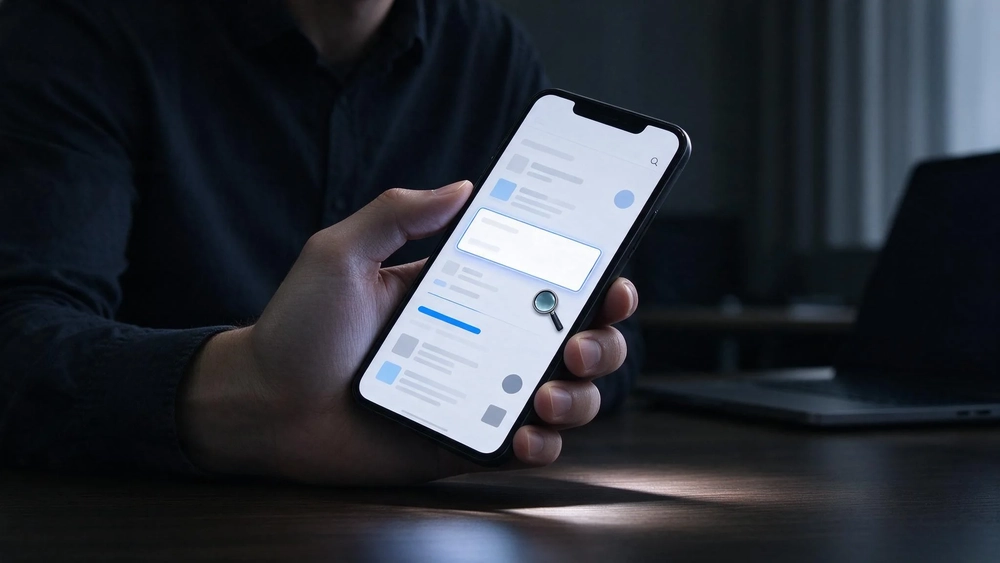
As of November 2026, Google has not published an announcement or a help page for the "Found on site" label that Search Engine Roundtable reported on 12 November 2026. What is visible is a search result layout: beneath a sponsored result, a line reading "Found on site" with a magnifying glass icon, followed by a blue hyperlink to the advertiser's site, and a separate "More pages" label on other sponsored units. Until Google documents the change, treat it as a test that changes how your ad's supporting information reads, not as a setting you can switch on. Whether the account sits in-house or with a sem agency, the work it creates is the same: your extensions, your site link destinations and the page behind them become part of the ad surface itself.
Search Engine Roundtable's item is short, and that is the honest state of the evidence. It carries a screenshot posted on Search Engine Watch by Sachin Patel, who described the label as appearing "below sponsored results," followed by a blue hyperlink. The same post shows a second label, "More pages," and the author's reading is that the element behaves like a new kind of sitelink asset.
What the 'Found on site' label actually shows
Three elements appear in the reported layout:
- A text label, "Found on site," placed under the sponsored result rather than inside the headline.
- A magnifying glass icon next to that text, the visual language of a search action rather than an ad marker.
- A blue hyperlink to a page on the advertiser's own domain, and in some results a "More pages" label.
What none of this establishes is the mechanism. Google has not said whether the link is generated automatically from the account's asset library, selected by a system that reads the landing page, or assembled from site structure. Search Engine Roundtable calls it "a new sitelink asset of sorts" without resolving which. That description is fair to the evidence, and it is also the reason to be careful: a vendor claiming to know exactly how Google picks the URL has no public source behind the claim.
Is the label a new setting you have to turn on?
No evidence points to a control you can enable. The reporting describes a SERP layout test, which sits on Google's side of the auction. Your levers are the ones that already exist:
| Layer | What it is | What the label changes |
|---|---|---|
| Ad copy | The headlines and descriptions you write | Still the signal a user reads first |
| Assets and extensions | Sitelinks, structured snippets, callouts, images | More visible: they may be the text and the link the label points at |
| Landing page | The destination behind every link | Becomes the promised answer, not just the next hop |
| Account access | Who holds the ad account | Decides who can edit assets and where they go |
Nothing new needs enabling, and several existing things need auditing. A sitelink that looks acceptable in a dropdown can look thin when it sits under a line saying the answer was found.

Why destination quality matters more under a label like this
A label that tells a searcher the answer is "found on site" makes a promise on the advertiser's behalf. If the click lands on a page that does not hold the answer, the mismatch is conspicuous at the moment of the click rather than discovered after it.
Topkee's own funnel data shows how much of a paid click is normally lost before a page can be judged. In one published campaign sample the flow ran from impressions through clicks to landing-page interactions, enquiries, quotes and signed deals, and the click-to-interaction step accounted for only a small fraction of the paid clicks: the large majority never engaged with the page at all. Those are Topkee case figures, not measurements of the new label, and should be read that way. They describe the size of the leak the label draws attention to, not a lift the label delivers.
How the site link gets chosen: what Google's own documents say
The mechanism is unclear, but the inputs are not. Google's sitelink documentation has long treated extensions as account-level assets that the system selects from, with the final display set decided by the ad system rather than the advertiser. If the "Found on site" element follows that pattern, the system chooses among pages it can read and consider useful.
That puts site structure inside the ad. A page that is hard to crawl, disallowed in robots.txt, or buried three clicks from the home page gives an automated system less reason to surface it. This is an industry-standard mechanism, not an official statement about this label, and Google may change it without notice. Even so, the preparation it implies is cheap and reversible: clean crawlability, one clear topic per page, and a sitelink asset list reviewed on a schedule.
Where Singapore advertisers should focus first
For a google ads singapore account, the label arrives in an auction where search sits above organic results and consumers begin their buying research. Three actions pay off however the test resolves:
- Review every sitelink asset and confirm its final URL still resolves, loads fast on a phone and answers the link text.
- Check that each destination page names the same service the ad names, rather than a generic brochure page standing in for a specific offer.
- Confirm the landing pages are crawlable and not blocked, since a system that selects pages cannot select the ones it cannot read.
Mobile belongs in the same list: the label adds a line of text to a sponsored result that already competes for a short screen. A layout that reads comfortably on a desktop can push the advertiser's own link below the fold on a phone. How sem agency teams read that constraint varies, and it is worth asking yours how they review mobile ad layouts today.

What this changes about how an agency should run extensions
Ad extensions are typically account-level settings rather than something an agency holds on its own account. Topkee Media, founded in Hong Kong in 2010 and entering Singapore in 2024, runs SEM for advertisers on accounts that stay with the client: sitelinks, extension work and destination choices remain in the client's account if a contract ends. That arrangement matters more when an extension has become a visible label.
Topkee operates as a Google Premier Partner, and its documented SEM work covers account set-up, keyword strategy, Google Tag Manager tracking, conversion tracking and periodic KPI reports that split impressions from click-through. Its published optimisation checklist names testing ad copy and using additional information (extensions) to raise visibility and click-through. In practice the label test shows up as a review item in the account, not a new product to buy: someone has to check which sitelinks are live, which destinations are thin, and whether the copy still matches the page. A managed Google Ads service run that way treats extension hygiene as routine maintenance rather than a redesign.
A checklist you can run this week
Work through this list in one sitting. None of it depends on Google announcing the change.
- Pull the sitelink asset report and rewrite or delete any link whose text no longer matches its destination.
- Open each destination on a phone and check that the offer is visible without scrolling past the first screen.
- Confirm robots.txt and page-level noindex rules do not exclude paid landing pages.
- Compare each ad group's copy with the page it points to and note where the wording drifts.
- Check who holds the account and what access an agency has, so edits are not blocked when a test becomes permanent.
- Repeat the review monthly, since a test reported once may be rolled out without a second announcement.
What the standing data does and does not tell you
Topkee's client results give a sense of what an account can do when the post-click side is managed. A long-term mosquito-net window installation client running a one-stop Google Ads programme averaged a return above three times the signed-deal value against its ad spend, with a peak month far higher. A private fitness coach campaign on "private fitness coach" and "one-on-one fitness coach" keywords built a three-month audience in the tens of thousands of impressions, with several hundred visitors staying more than three minutes and dozens of WhatsApp contacts. Both are individual cases, not averages, and neither measures the "Found on site" label. Their value here is narrower: they show that the destinations and follow-up behind the click are where outcomes are decided.
For a Singapore advertiser comparing an in-house setup against a sem agency, that points to a specific question in the pitch: who owns the account, and what happens to the extension library when the relationship ends.

FAQ
Does the 'Found on site' label affect my Ad Rank or my cost per click?
There is no public information on that. Google has not announced the label, so any statement about its effect on auction mechanics or cost per click would be speculation. What an advertiser controls is unchanged: how well the keyword, the ad and the landing page match each other.
Is 'Found on site' available in Singapore?
The reporting describes a test seen on Google's sponsored results without naming markets or the share of traffic involved. Singapore accounts may or may not see it. Check your own search results in a clean browser session rather than assuming either answer.
Do I need to create a new asset type for this label?
Nothing in the reporting says so. The label appears to draw on the sitelink-style assets that already exist in the account, which is why the reported description was "a new sitelink asset of sorts". Reviewing the existing sitelink list is the practical step.
What happens to my site links if I change agency?
Ad extensions live at account level, and a client holding its own account keeps them. Confirm in writing who owns the account and what access an agency receives, because the asset list is part of that asset.
Should the label change my google ads singapore budget?
Not on present evidence. No published measurement of the label exists, and a percentage without a source is a guess. Track impressions and click-through by ad group before and after the label appears in your market, and compare over a period long enough to separate a layout change from normal variation.
Should I expect a click-through rate increase?
Do not plan on one. No published measurement of this label exists. Track impressions and click-through by ad group before and after the label appears in your market, over a window long enough to separate a layout change from ordinary variation.
Where to read next
The reporting and extension mechanics above are background. For how the account's own reporting splits impressions from click-through, the Google Ads channel report definitions sets out the terms, and the SEM agency brief on AI slop and ChatGPT search share covers how the search surface and reporting have shifted. The Topkee home page lists the Singapore services in one place.
Sources
- Barry Schwartz, "Google Ads Found On Site Icon & More Pages Label", Search Engine Roundtable, 2026-11-12. https://www.seroundtable.com/google-ads-found-on-site-label-42496.html

Article Author
Pang Sir
