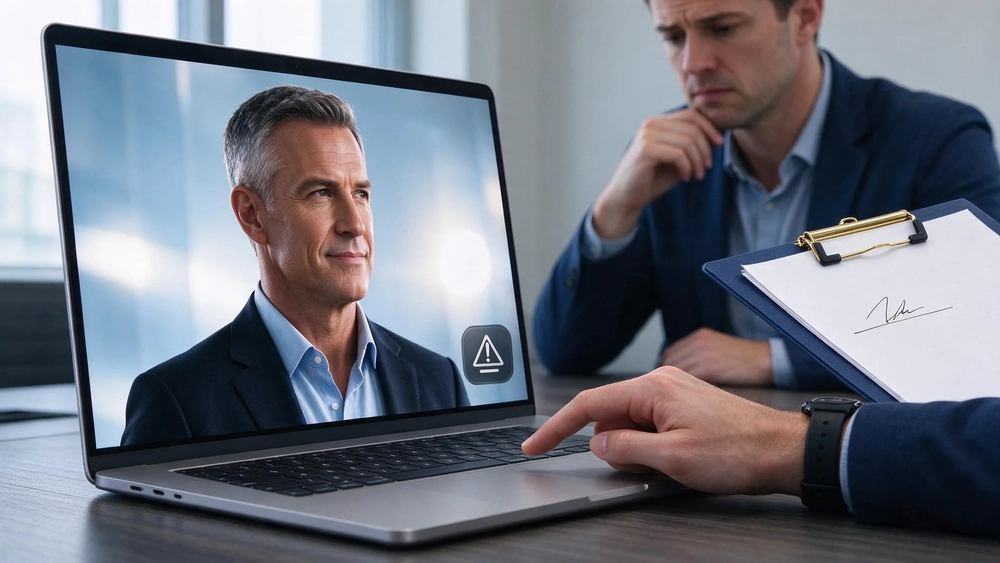
Google Ads bans AI impersonation of public figures
As of November 2026, a label saying "generated with AI" does not make an ad featuring a public figure acceptable. Google clarified on November 11, 2026, that ads impersonating public figures using AI are not allowed even when they disclose that they were generated or edited using AI, so the practical work moves before launch: prove you hold the likeness rights, or drop the creative. That is the part of the job an sem agency owns when it signs for an account's policy standing.
Key takeaways
- The clarification is a reading aid, not a new rule. Google states it does not change how the policy is enforced, which means the cost of a mistake is unchanged and immediate.
- Disclosure is not a defence. A visible note that the video or voice was AI-generated does not rescue an ad that shows a public figure without permission.
- The policy text points advertisers to documented permission as the best practice: consent that can be proved, covering name, image, video and voice used to suggest endorsement.
- The exposure sits in the account, not only the campaign. A public figure impersonation violation falls under the Misrepresentation policy, which Google treats as egregious, so the whole account can go.
What Google changed on November 11, 2026
The change is small and worth reading line by line. Google updated the Unacceptable Business Practices policy on public figure impersonation to make explicit what the AI example in the policy page already suggested: an ad that impersonates a public figure using AI is not allowed, and disclosing the AI generation or editing does not fix it.
The same update says the clarification helps advertisers understand the policy and does not change its enforcement. Both statements sit on Google's own wording, so a marketer should read the November 11, 2026 posting as a signal about how Google applies the existing rule, not as a new restriction with a grace period.
The policy page itself has listed the case for some time. Its examples include using AI-generated videos of popular YouTubers to make people think they endorse a get-rich-quick scheme, followed by the note that such ads are not allowed even with a disclosure. What changed is that the note now has an official post behind it.
Read the Search Engine Roundtable report for the trade summary. The dates matter: the policy post carried November 11, 2026, and the report followed on November 12, 2026.
Who counts as a public figure
The policy does not limit the term to celebrities. Google describes public figures as people who are famous or well known, naming government officials, entertainers, athletes, online influencers, and prominent business people such as founders or CEOs of big companies.
That list is wider than most creative briefs assume. A Singapore brand running a testimonial-style ad with a popular local creator, a well-known doctor, a founder of a listed company or a sports personality falls inside it. The question is not whether the person is an A-lister; it is whether a reasonable viewer would treat them as well known.
The policy gives examples that map onto common campaign patterns:
- Using a famous singer's name or image without permission to suggest they are a happy client of an investment service.
- Stating that a professional athlete sponsors a weight-loss product to make the results look realistic.
- Using an AI-generated video of a popular YouTuber to make a scheme look endorsed.
Each example involves the same mechanism: the public figure's identity is used to transfer trust the advertiser has not earned.
Why disclosure does not rescue the ad
Many teams hear "AI content must be disclosed" and conclude that a clear label solves the problem. This update closes that route. The label requirement and the impersonation ban are separate rules, and one does not satisfy the other.
The logic is straightforward. If a viewer sees a recognisable person in an ad, the impression of endorsement forms before the viewer reads any small print. A disclosure that the footage was AI-generated tells the viewer how the image was made; it does not tell them the person agreed to the claim being made. The policy's stated reason for the ban is that impersonation and false endorsements trick people.
For a marketer, the test becomes two questions asked in order. First, is this a public figure? If yes, second, do we hold documented permission for this use? A "no" on the second question ends the creative, whatever the caption says.
The file you need before launch
Google's best practice for this section is explicit: have documented permission, and be able to prove you have consent from any public figure before using their name, image, video or voice to suggest they have endorsed the product or service.
That sets the minimum record for any ad featuring a public figure, AI-made or not:
- A written agreement or consent reference naming the person and the campaign.
- The scope of use in that document, covering the channels you will run on and the period the consent covers.
- The specific claims the person has agreed to have associated with them, since consent to be shown is not consent to every claim in the copy.
- Where the source footage or audio came from, so an AI edit can be traced back to a licensed original.
- A named person in the team who signed the creative off, with the date.
If the person is editing or generating content themselves rather than appearing in a client ad, keep the same discipline: the licence is what counts, not celebrity. Many brands hand that review to an sem agency precisely because the paper file and the ad account sit in different places, and the gap opens exactly when a campaign is rushing to launch.

What happens when the account is hit
The practical reason to take this seriously is where the penalty lands. Public figure impersonation sits inside the Misrepresentation policy in Unacceptable Business Practices. Google describes violations of that policy as egregious, and says accounts found in violation are suspended upon detection and without prior warning.
The article notes the recovery path is narrow. The policy page says accounts are only reinstated in compelling circumstances, and the appeal route asks the advertiser to explain the relationship with the public figure and to share proof, such as contracts, written agreements or public statements confirming the partnership. An advertiser who cannot produce that file on appeal is arguing from nothing.
For an advertiser whose spend is concentrated in one Google Ads account, that is a business-level risk, not a campaign-level one. This is the author's own reading rather than a claim on either page: a single ad built on an unlicensed likeness can take down the search, Performance Max and YouTube spend that pays the month's enquiries, and the sem google ads budget you fight for in planning is exactly what a suspension puts at risk.
When to route this through an SEM agency
The decision is easier if you separate who approves creative from who owns the account. Teams running search work in-house still need a policy check on any creative that shows or references a recognisable person, and that check has to happen before the ad goes live, not after a suspension email arrives. An sem agency that signs for account qualification turns that check into a standing process instead of a favour asked mid-sprint.
The case for an external policy owner starts with volume that outruns the team's knowledge: if you generate AI creative at scale and the people producing it never read the platform rules, the failure is a matter of when. It also applies when you use influencers or licensed personalities and the agreements sit in a department that has no visibility of the ad account, so nobody knows whether the paper exists at the moment of launch. And it applies most plainly after a rejection or a warning, when you cannot say which rule the creative broke; that is a signal the account has no owner who reads policy, and it is the cheapest moment to hand that job to someone who does.
Topkee's point of view on this change is that Google's decision puts the weight on the compliance chain rather than on the AI tool. The team's SEM work starts with ad-account qualification: a dedicated person reviews the qualification material against the platform's review policies, so an advertiser holds valid credentials before spend begins. Creative then moves through a client-confirmed theme proposal before production, and AI-generated headlines, descriptions and image briefs pass a designer's review before they run, which gives a human checkpoint between output and live ads. Asset rights are checked upstream as well, with third-party images, fonts and music agreed in advance rather than assumed. This is the same Performance Google Ads approach that ties spend to the funnel from impression through to closed deal rather than to clicks; a creative that cannot clear policy never reaches the funnel at all.
The next step
Before your next AI creative briefing, run an audit of every live ad that shows or suggests a real person. For each one, record whether the person is a public figure under Google's list. Then record whether you hold a written consent covering that specific use, and who signed it off. Any ad that fails the second check should be paused, not labelled. If you want a second pair of eyes on that file before the next launch, have an sem agency review the account, and read the earlier breakdown of AI slop and the SEM brief for how AI-generated volume changes what a brief must ask for, or how AI-powered SEM affects conversions.
FAQ
Does the November 2026 update change what Google enforces?
No. Google states the clarification helps advertisers understand the policy and does not change its enforcement. The practical change is that disclosure no longer reads as a defence anyone can rely on.
Can I run an AI-generated video of a public figure with a clear AI label?
Not if the ad impersonates the person. The policy note says ads that impersonate public figures using AI are not allowed even if they disclose that they were generated or edited using AI.
What counts as permission for using a public figure?
Google's best practice is documented permission: consent from the public figure that you can prove, covering use of their name, image, video or voice to suggest they endorse your product or service.
What happens to the account if the rule is broken?
Public figure impersonation falls under Misrepresentation in Unacceptable Business Practices, which Google treats as egregious. Accounts found in violation are suspended upon detection and without prior warning.
What do I need to appeal a suspension?
Google asks for details of your relationship with the public figure and proof, such as contracts, written agreements, a credible news article about the connection, or a public statement from the person confirming the partnership. Reinstatement is only granted in compelling circumstances.
Sources
- "Google Ads Disallows Impersonate Public Figures With AI", Search Engine Roundtable, 2026-11-12. https://www.seroundtable.com/google-ads-disallows-impersonate-public-figures-ai-42512.html
- "Updates to Unacceptable Business Practices (November 2026)", Google Ads Policy Help, 2026-11-11. https://support.google.com/adspolicy/answer/18891933?hl=en
- "Unacceptable business practices", Google Ads Policy Help, undated. https://support.google.com/adspolicy/answer/15938071?hl=en