Google Ads Asset Activity: Weekly AI Cards, Read Right
Google Ads is testing a beta page called Asset activity that turns your ad assets into a short list of weekly suggestions, and the only safe way to use it is as a queued test rather than an instruction. If you manage search campaigns in Singapore and see the Beta label under Assets, treat each card as a hypothesis to check at asset-group or campaign level, not a result you can bank. This matters more when a sem agency runs your account, because the person acting on the card may not be the person who built the assets.
What the Asset activity page shows
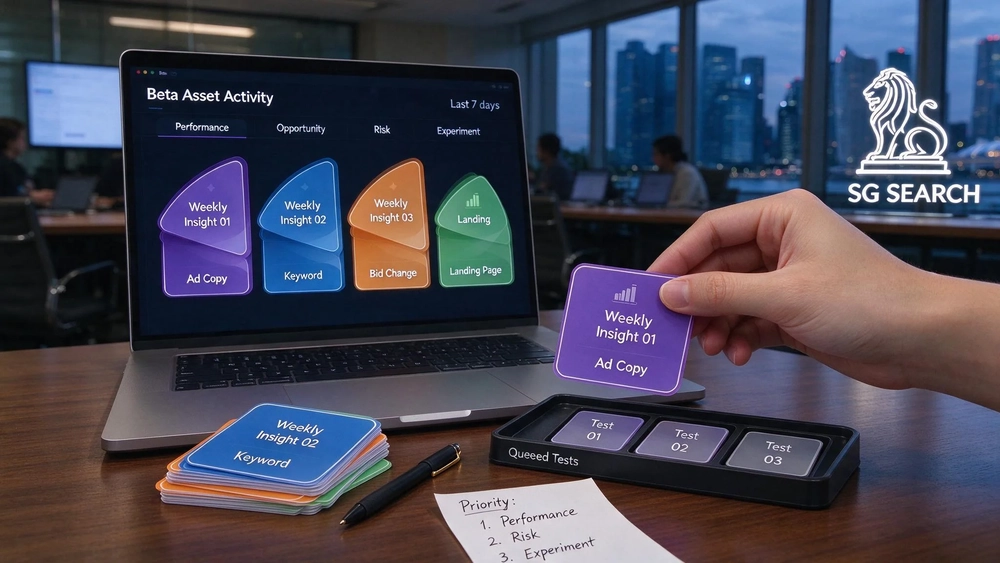
Asset activity sits in the Assets section of the Google Ads menu, between the Assets report and Videos, and carries a Beta label. The page presents insights in cards, each with a category, a date range, a headline and a View details link, plus feedback buttons so you can tell Google whether the suggestion was useful.
Google Ads search practitioner Anthony Higman posted a screenshot on LinkedIn on Nov. 6, and in that screenshot the cards filter into four categories: Featured, Asset performance, Asset diversity and Industry trends. PPC News Feed, which reported the page in November 2026, lists the same set plus competitor performance among the filter categories.
The cards update every week. Behind the cards is a Weekly activity panel that shows assets added or removed and campaigns with active assets, drawn from the past 90 days of weekly performance data. A message between the cards and the panel states that the tool uses artificial intelligence and may return inaccurate information.
Reading the four card categories
The category label tells you what kind of decision the card is asking for, and each one needs a different check before you act.
Asset performance cards point at a headline that is already working. In Higman's screenshot the card is titled "Higher clickthrough rate for top-rated headlines" and carries a Top-performing headlines section. The first metric on that card is click-through rate.
Asset diversity cards flag a theme your headline set is missing. Higman's Asset diversity card, marked Oct. 21-27, asks him to add financial recovery headlines to attract injured riders, a creative gap rather than a performance result.
Industry trends cards report a shift in what people search. In the same screenshot the card notes a rise in queries about legal consultation guidance and suggests headlines carrying simple consultation details. PPC News Feed's examples run the same way: a 12% higher clickthrough rate for repair-specific headlines, and an 89.3% increase in searches for energy-efficient home heating solutions.
Featured cards sit above those three and surface the pick Google considers most relevant that week. The distribution of cards across categories is not something Google has documented.

The asset-level metric caveat most advertisers miss
Google lists CTR, CPC, CPA and ROAS at the asset level as directional indicators only, because assets are shown together and no single headline carries its own clean audience.
That sentence changes what a performance card can prove. A headline that looks strong in the Asset performance card may be riding the combination it appears in, the audience of its asset group, or the week's auction mix. The signal is worth reading, the number is not worth quoting in a board deck as the headline's own result.
Google's own guidance on existing asset reporting says performance should be evaluated at asset group or campaign level. The screenshot of the new cards does not show how the page calculates its findings, and as of Nov. 9 there was no mention of Asset activity on Google Ads Help or the Google Ads announcements page.
A weekly loop you can run with the cards
The card is only half the loop. The other half is the change you make and the read you take afterwards.
- Filter to Asset performance and list the top-performing headlines the card names.
- Check whether each headline is already in the asset group it is being compared against, or only in another group, before you copy anything.
- Read the same asset group's CTR and conversions in the Assets report over the same week, then across the four weeks the 90-day panel covers.
- Add one headline from the card to one asset group, with the date recorded.
- Leave it for a full week, then compare at asset-group level against the group's own prior result, not against another group.
Asset diversity and Industry trends cards enter the loop at step two: they propose a theme, not a headline. Write your own copy for the theme in your brand's words before it goes near the account. That step is where most in-house teams stall, and it is the usual reason a sem agency is brought in to cover the writing and the testing together.
What the page does not answer
Asset activity reports on assets inside Google's own traffic. It does not see what your Meta spend returns for the same month, and it does not see a deal that closes after the attribution window.
Google's attribution window is shorter than a long sales cycle, so a signed deal that lands later is dropped from the algorithmic learning behind the suggestions. Smart Bidding allocates budget inside Google's inventory only. A weekly asset card therefore cannot tell you whether the next dollar belongs in search or in a different channel, and it should not be used as if it could.
It also does not resolve pacing. If your budget sits at S$3,000 to S$5,000 a month in media spend, the range one SEM provider sets from Google Ads forecasting, a single week's card is a fragment. A card that recommends adding five headlines at once asks for more test volume than a month of that budget can read cleanly.

Creative volume decides whether the page is useful
An asset card only has something to say when the account has assets to compare. A campaign running one headline and one description per group gives the page almost no raw material, and every card becomes a restatement of what you already have.
Topkee Media produces ad copy in bulk: headlines, descriptions, content-matched images and full extensions, grouped by campaign theme so each ad group's message stays specific, with an AI plus human loop for formats that need many variants for continuous testing. That supply answers the diversity side of the page directly: the Asset diversity card is asking for variants you have not written yet.
Topkee's creative fatigue monitoring watches engagement heat per creative and, when it detects decay, activates a backup creative library and expands lookalike audiences. Its creative refresh work pairs periodic copy updates with competitor insight, which maps onto the asset performance and competitor angles of the card. Where the account crosses platforms, the Creative & Audience Waste section of the Campaign Intelligence Report names wasted spend caused by fatigued creatives and audience settings cell by cell, drawing on the client's own CDP, pixel and CRM rather than the ad platform.
The boundary is worth stating plainly. Topkee Media records engagement signals; it does not attribute a change in results to a creative change on its own, and its creative work does not promise a fixed growth figure. The card is a prompt, the report is the check.
Deciding who runs the loop
The cards are cheap to read and expensive to act on badly. Before you route them into a workflow, sort by who has the hours and the asset supply.
| Situation | Sound approach | Why |
|---|---|---|
| One or two accounts, someone in-house on ads weekly | Read the cards, run one test per asset group per week | The loop is manageable in-house at this scale |
| Several accounts across markets, no dedicated buyer | A sem agency runs the tests and reports the read-out | Card review is a weekly commitment that decays when it is a side task |
| Asset diversity cards keep flagging the same theme | Fix the creative brief first, then the card | Without new variants the card repeats itself |
| Performance cards contradict your own report | Trust the report at campaign level and log the gap | Asset-level metrics are directional only |
For a Singapore business, the question is the same whichever route you pick: whether someone tests the headline the card suggests within the week it appears, and records what happened. Any sem agency singapore engagement worth the retainer should be able to answer that with a dated entry per test rather than a screenshot of the card.

What a card is worth against a quality signal
A weekly suggestion is not a replacement for the diagnostics you already have. Quality Score is a keyword-level diagnostic scored from 1 to 10, built from expected click-through rate, ad relevance and landing page experience, and Google describes it as a diagnostic rather than an auction input.
Use the two together. A performance card that names a headline is a prompt to test relevance; a low Quality Score on the keyword the headline serves tells you where the test starts. If you already pay a sem agency singapore a monthly fee (one provider's management starts from S$2,500 a month after a free first month), the card is one input in that work, not a reason to cut the review.
Start with one asset group this week
Pick the asset group with the most spend, open the Assets section, and check whether the Asset activity entry is there. If it is, read the Asset performance card, choose one headline, and run the five-step loop above for a single week before you touch the rest of the account.
To see how that loop looks when it is run against funnel and revenue rather than card counts, read how incrementality testing separates real Google Ads lift from coincidence, and how AI-assisted SEM links conversion data back to the campaign. The test that matters is the one that changes the next month's budget, not the one that fills the card list.
FAQ
What is the Asset activity page in Google Ads?
A beta page under Assets that shows weekly AI-generated insight cards about your ad assets, with cards grouped by category and drawn from the past 90 days of weekly data. PPC News Feed reported it in November 2026 and Google Ads practitioner Anthony Higman posted a screenshot on Nov. 6.
Does the Asset activity page tell me which asset performs best?
No. Google lists CTR, CPC, CPA and ROAS at the asset level as directional indicators only, because assets are shown together. Use the card to choose a headline to test, then judge the result at asset-group or campaign level.
How often do the insight cards change?
Every week. Each card carries a date range, and the Weekly activity panel behind them shows the current week (Oct. 19-25 in the screenshot Higman shared) over a 90-day history.
Should I keep every suggested headline?
No. Asset diversity and Industry trends cards propose a theme, not finished copy, and the screenshot does not show how the page calculates its findings. Write the headline in your own words, add it to one asset group, and keep it only if the group's own numbers support it.
Is the Asset activity page available to every account?
Not as far as anyone has documented. As of Nov. 9 there was no mention of Asset activity on Google Ads Help or the Google Ads announcements page, so which accounts or campaign types receive it is still unexplained.
What should a small account do with a weekly card?
Run one test a week in the asset group that spends the most, and record the change date. At a monthly media budget of S$3,000 to S$5,000, one clean test at a time is what the budget can read.
Sources
- "Google Ads Asset Activity Section", Search Engine Roundtable, 9 November 2026. https://www.seroundtable.com/google-ads-asset-activity-section-42481.html
- "'Asset Activity' Page Launched in Google Ads", PPC News Feed, November 2026. https://ppcnewsfeed.com/ppc-news/2026-11/google-tests-asset-activity-page/
- "Google Ads Tests Asset Activity Page With Weekly AI Insights", Search Engine Journal, 10 November 2026. https://www.searchenginejournal.com/google-ads-tests-asset-activity-page-with-weekly-ai-insights/596442/
- "SEM Services: Google Ads, First Month Free | Aemorph", Aemorph, 31 October 2026. https://aemorph.com/sem/