What a 100-Hour Branded Video Says About Production
As of November 2026, the number that should reset your expectations of a video production company is not the camera, the edit or the shoot day. It is 100 hours: the average time Digiday reported creator Grace Wells spends producing one branded video, across two to three branded videos per month.
Key takeaways
- One creator now takes about 100 hours per branded video, with roughly 30 hours spent on pre-production alone and about 20 hours on post.
- Revisions run to three to four rounds of small changes, which is what a heavy pre-production stage is meant to buy.
- A monthly subscription model prices output by volume and cadence, not by the hours inside each film; both can be right for different campaigns.
- Across the market her work sits alongside an ad spend of $44 billion expected with US creators this year, per the IAB, and a disclosure problem that audiences notice.
Why one creator's process is a buying benchmark
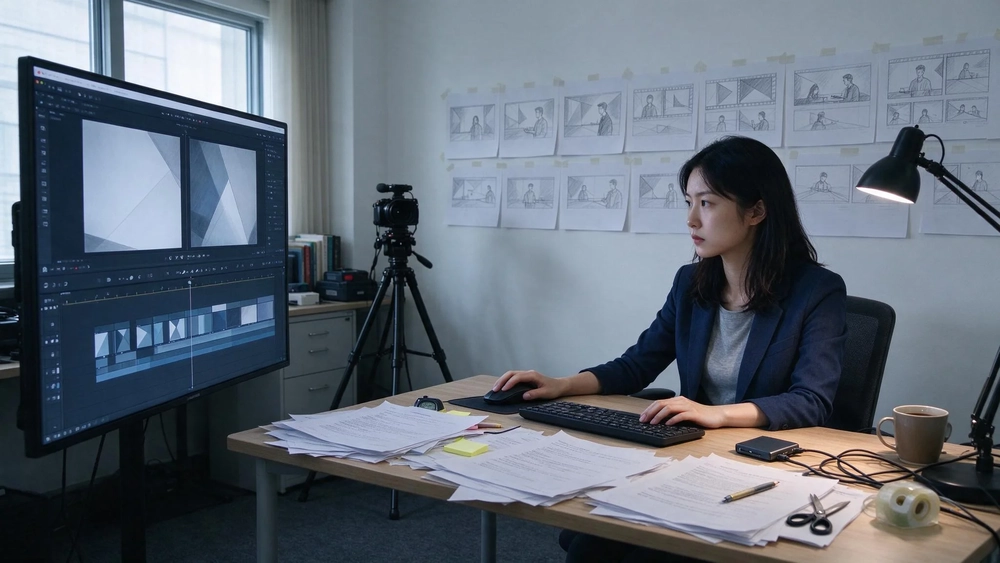
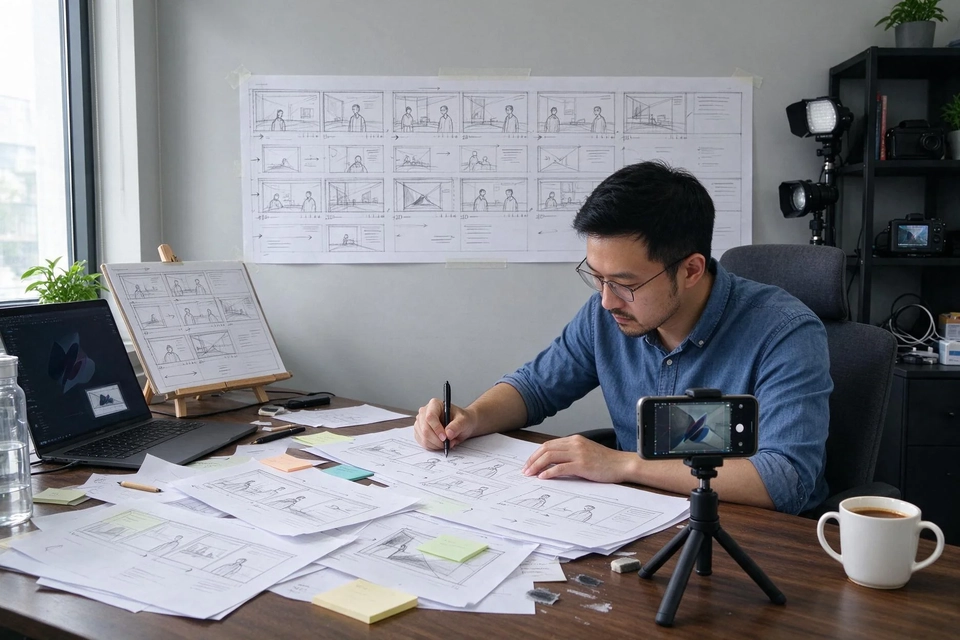
Wells is not a studio. Digiday reported in November 2026 that she joins a briefing call with the brand before anything else, asking about the objective, the target audience and whether the video is meant to sit inside a larger campaign. Only then does she move into pre-production, which can take roughly 30 hours and centres on a storyboard for every shot.
The reason is structural. She is one person with two hands, and the bulk of her time goes to filming, and to two films at once, because each branded video includes both the product film and the behind-the-scenes footage of her making it. A reshoot would break an already saturated calendar, so the storyboard is cheaper than the second day of filming.
That order, decide on paper and shoot once, is the closest thing this account offers to a process rule. It is also what a buyer can put into a brief tomorrow.
What the 100 hours actually contain
The stages do not consume time evenly, and the split tells you where the risk sits.
| Stage | Reported time | What it buys | What happens when it is cut |
|---|---|---|---|
| Briefing call | Part of pre-production | Objective, audience, campaign context, existing brand assets | The film is judged on how it looks, not what it is for |
| Pre-production | Roughly 30 hours | Shot-by-shot storyboard, music chosen early | Reshoots, or an edit that cannot be rescued |
| Filming | The bulk of the 100 hours | Product film plus behind-the-scenes in one session | Fewer usable angles per hour on set |
| Post-production | Around 20 hours | Assembly against a paper edit | Late structural changes with no time left |
Post-production being the shortest stage is the part worth sitting with. A storyboard that already fixes the perspective of each shot, its duration and where voiceover, sound effects or text callouts land turns the edit into an assembly job. Wells described choosing music before storyboarding at all, so the timing decisions are settled long before the timeline opens.
The same logic explains the revisions. What comes back is three to four rounds of small changes: wording on a text card, a tighter punch-in on a detail. Not a new structure. Pre-production spends hours so revisions do not have to spend days.
The gap: what is a video production company for?
Search results for the term rarely answer this directly. The pages that rank for it usually explain what a production house sells or what to prepare before you approach one, and leave implicit who a brand is actually hiring and what it should demand.
The honest answer is a division of labour. A video production company exists to carry the parts a single creator cannot: parallel angles, a second camera, talent and set crew, colour grading, versioning, and a paper trail of what was approved. Wells's own numbers show the ceiling of the solo route. Her flexibility to shoot for as long as she wants and to edit as she films is real, but it comes with one pair of hands.
In Hong Kong, agencies present that capability in different forms. Filmages, a Hong Kong-based agency serving international clients in Asia-Pacific, states that 98% of its portfolio was entirely produced in-house and that in 10 years it has delivered over 300 projects. Both figures are the agency's own claims, and both point at the same thing: a buyer should ask how much of the promised craft is inside the house, and how much is subcontracted.
A useful test before you sign with any video production company: ask for one finished film and the storyboard that preceded it. If the two look unrelated, the pre-production stage is a formality, and the shoot is carrying decisions that should have been made on paper.
When a subscription model beats a bespoke film
Not every campaign needs 100 hours. A launch film does; a month of product ads does not. The decision is about how many distinct ideas you need per month and how quickly they have to refresh.
| Situation | Better fit | Why |
|---|---|---|
| One flagship brand film, long shelf life | Bespoke project | Time on planning buys fewer, deeper decisions |
| Ongoing promo across several channels | Monthly creative plan | Fixed scope and cadence, repeatable approvals, and each cut is read on its own numbers |
| Testing angles for paid social | Batch of short cuts | Many variants, each judged on its own numbers |
| Multi-market launch | Enterprise plan with numbered versions | Scope, owners and delivery batches fixed first |
A video production company selling a monthly plan is trading depth for frequency. The trade is straightforward: a bespoke film concentrates budget into one asset, while a monthly plan spreads it across many smaller ones and accepts a shorter default length. Neither is cheaper in principle; they buy different things.
What Topkee Media does about this
Topkee Media is a Hong Kong digital marketing and martech brand that positions itself as a full-stack marketing partner, with in-house creative, copywriting and video production teams. Its answer to the question above is not to match a 100-hour hero film, but to make the same quality bar repeatable.
The Creative Subscription plans monthly output in fixed combinations chosen one per month: ten key visuals, or two videos plus five key visuals, or four videos at the lower tier; the higher tier doubles those quantities. The quantities do not stack, every standard film is fifteen seconds or less by default, and size, language, revision rounds and schedule are agreed before the service starts. Multi-brand and multi-market work goes through an Enterprise Custom Creative Plan quoted by scope.
Production runs on a chain the news account implies: needs analysis and planning, script writing with client review, shoot preparation and execution, post-production with editing, colour grading, effects and audio, then delivery and feedback. For short-form, the team works in vertical format, treats the opening seconds as the deciding moment, and sets scripts, subtitle placement and safe margins differently from horizontal film.
Two things this setup does that a solo creator's workflow usually cannot. Topkee's VideoHub tool holds the edit, subtitles and export specs together with a version list as evidence of delivery, and a monthly delivery process leaves a plan, a delivery list and a month-end review, which is the audit trail a bespoke project tends to skip. Topkee also states plainly that creative production does not guarantee growth and that ad management and media spend are contracted separately. Reading video ad optimization as a separate contract line, rather than something a subscription quietly includes, is the right frame for comparing these options.
Fairness in the branded video
The process question has a second half. Audiences are watching for whether the arrangement was disclosed, and the numbers are not flattering.
A Morning Consult survey of roughly 2,000 people in September, run for Business Insider, found only one in four US adults think influencers disclose paid promotions consistently. Among creators themselves, a SheSpeaks survey found 14% said they did not always disclose brand ties, and 18% said a brand had explicitly asked them not to disclose a partnership in the past year. The Institute for Responsible Influence's own 2025 survey found seven in 10 consumers would feel deceived by a creator who did not disclose a brand deal.
For a brand, this changes one line of the brief. A behind-the-scenes cut is filler to no one. It is the format where the paid relationship is visible on screen, and where a marketer can show the work without hiding the arrangement. Digiday reported that advertisers were expected to spend $44 billion with creators in the US this year, more than tripling in five years according to the IAB. At that size, disclosure stops being a creator's private risk and becomes part of campaign planning.
Putting the process into your next brief
Take the storyboard requirement from the creator's process and the audit trail from a managed production line, and put both into the brief of the next video production company you talk to. For a concrete example of a brief written around a small idea, see how Tropfest's Dream Small and a Video Production Company brief was structured, or compare a Facebook Ads Optimization campaign where the ad sets, not the film, do the work.
For story work that has to travel across cultures, Kleenex's First Nations packaging case shows the review cost of getting the narrative wrong after production.
If the need is continuous output rather than one film, the Creative Subscription page sets out the monthly combinations and what a standard film length looks like.
What to ask a video production company
This is the checklist to run before you commit a budget to any partner.
- Ask for the storyboard of a recent film, and compare it with the final cut.
- Ask what share of the work is in-house, and get a number rather than an assurance.
- Ask how many revision rounds the quote includes, and what counts as a new direction.
- Ask what the standard length is, and what a longer cut costs on top.
- Ask how versions and languages are counted, and whether size exports count as new items.
- Ask who approves, and whether delivery leaves a version list you can retrieve later.
A note on the numbers
Every figure above comes from a published source named in the section where it appears, and the sources are listed at the end. Where a claim is the agency's own marketing statement rather than survey data, the text attributes it. Where a figure could be read two ways, the wording leans towards the conservative reading.
FAQ
Is 100 hours per branded video normal?
For a solo creator producing both a product film and a behind-the-scenes edit, Digiday's account of Wells's process puts it at that level, with roughly 30 hours in pre-production. A studio with separate crew can compress the calendar, not the decisions.
Should a brand ask for a storyboard before filming?
Yes, and ask to see a finished storyboard next to its final film. Pre-production is where the shot list, music and timing get fixed; without it, post-production absorbs the changes and revisions grow.
Does a monthly creative subscription replace a video production company?
It replaces the repeatable part of the work: regular promo films and key visuals on a fixed cadence. A flagship film, live shooting, talent or complex 3D is usually still a separate project quoted by scope.
How does video ad optimization fit in?
Short films are made to be tested, not admired once. Multiple versions on their own budget and audience, read per creative, then budget moved to what performs, is the mechanism; the film's length and variant count should be set with that in mind.
What should be disclosed in a branded video?
The paid relationship, clearly and on screen. Audience trust in disclosure is measurable, and a behind-the-scenes format makes the arrangement visible rather than something a viewer has to infer.
Sources
- Tim Peterson, "Future of TV Briefing: Inside creator Grace Wells's 100-hour branded video production process", Digiday, 2026-11-11. https://digiday.com/future-of-tv/future-of-tv-briefing-inside-creator-grace-wellss-100-hour-branded-video-production-process/
- Lucia Moses, "Audiences don't trust creators to come clean about brand deals", Business Insider, 2026-11. https://www.businessinsider.com/audiences-dont-trust-creators-disclose-brand-deals-2026-11
- "Video Production Agency, Hong Kong", Filmages, 2026. https://www.filmages.com/

Article Author
Pang Sir
