When a Design Director Leaves a Video Production Company
Campaign Brief reported on 16 November 2026 that Dane Falkström had left TABOO after 10 years to join Brisbane agency Boldly as design director. The news is a career move on the other side of the world, and a marketing team in Singapore is unlikely to be hiring anyone this month because of it. The question it raises is a practical one: when the person who held a brand's design judgement leaves, what has to be written down so the work continues without them, and what should a video production company be asked to hold on file?
Key takeaways
- Campaign Brief's report of 16 November 2026 and its promotion story of May 2024 describe the same career at two points, and the earlier one counts an 8-year tenure that the later one counts as 10 years.
- Falkström joined TABOO in Melbourne in 2016 and took charge of its design department in 2024, so years of approvals and client work left with him.
- Brand consistency after a handover turns on what is written down: approved assets, the rules behind them, rejected versions, and the reason each direction was dropped.
- A standing creative arrangement covers output volume on a schedule. It does not supply the judgement a design lead brings to a campaign.
What the two reports actually say
The promotion story is the useful baseline, because it records what the job was. Published in May 2024, it announced that Falkström had been made design director and framed the moment against his 8-year tenure with the agency. It also set out the scope: he would lead TABOO's design department and lift its branding and design offering. The clients named in that story include Champion, LVMH and Coopers Brewery.
The tenure count moves, the facts do not
The November 2026 report describes the same career from further along. Falkström joined TABOO in Melbourne in 2016 as a mid-weight designer, moved up to senior designer and art director, and was promoted in 2024. The 2026 story puts the total at 10 years, which sits comfortably with a 2016 start and with the 8-year figure used in 2024 once the two stories are read against each other. In his own account of leaving, he described the decade of work and said he was proud to have played a small part in the 25-year legacy that is TABOO.
What the reports do not describe
Both reports cover the role and the client names, and reproduce his quotes. Neither says what happened to the working files and the approval trail, or to the templates he had signed off. That silence is normal in trade press, where a personnel story records who did what and where they went next. It is also the point at which a marketing team should stop reading and start asking about its own archive. As of November 2026, no public account of the move describes how the design work itself was handed over.

What walks out with a design director
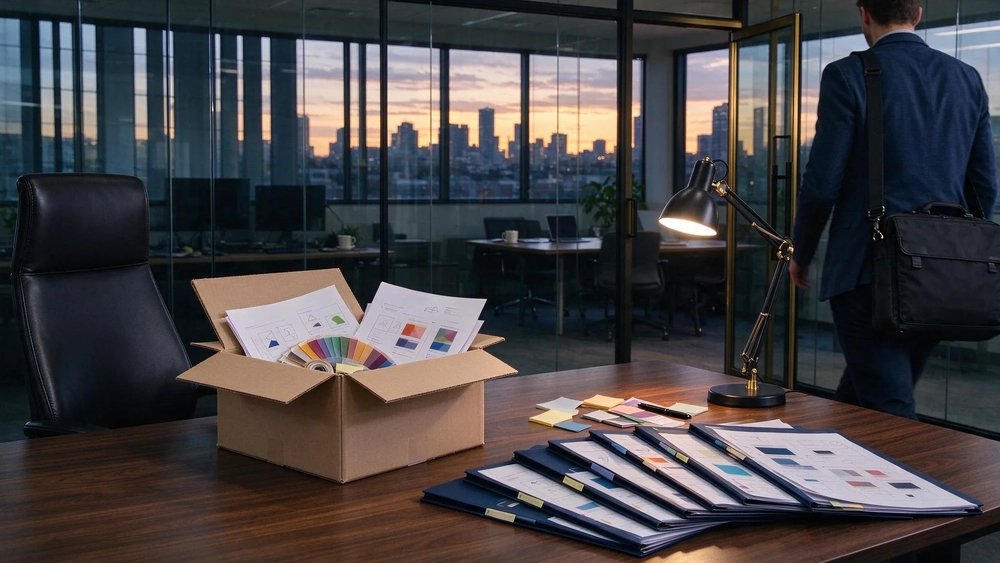
A design director's output is visible in finished work, which makes the role look replaceable until the first new brief lands. What leaves with the person is the reasoning underneath that work. Which version of a logo holds at small sizes, which colour pairing survives a cheap print run, which of two approved templates belongs on a product launch and which on a hiring notice: these calls get made repeatedly and recorded rarely.
Clients meet the same gap from the other side. Brand guidelines usually run to logo clear space, palette codes and type hierarchy, then stop before the awkward cases. The awkward cases are where judgement lives, and judgement is what a decade of approvals builds. After a handover, a video production company and an in-house team both start from finished work rather than from the decisions that produced it.
The reasoning gap
The problem is easier to fix once it has a name. Call it the reasoning gap: the distance between the asset a company keeps and the argument that produced it. A new designer can measure that gap by opening the last approved campaign and trying to answer, unaided, why each choice was made. Where the answer is not in a file, the brand is running on memory, and memory leaves with the person.

The takeover test
A handover can be rehearsed before it happens. The test costs a few hours of a designer's time and produces a list of what is missing, which is more useful than a reassuring conversation about legacy.
Run the test before the handover
- Pick the last approved pieces across different placements, not the most awarded ones.
- Hand them to a designer who has never worked on the account and ask for one new asset in a placement none of them covered.
- Write down every question that designer had to ask, and who answered it.
- Compare that list with the archive. A question with no written answer marks a rule that existed only in someone's head.
What the archive has to hold
A workable brand archive holds more than the logo pack. It needs the approved assets with their source files, the type and colour rules with exceptions spelled out, the templates still in use and the ones that were retired, a specification sheet for each ad placement, and a short note against each rejected direction saying why it failed. The last item is skipped most often and read first by anyone taking over.
Hire, contract or subscribe
Once the gap is visible, the staffing decision gets clearer. The three routes below are not substitutes for one another, and the table compares what each one actually settles.
| Route | What it settles | What it leaves open | Fits when |
|---|---|---|---|
| A new design director | Judgement, priorities and sign-off | Output volume, and any gap before the hire starts | The brand has a steady flow of high-stakes work |
| A freelance designer or studio, briefed per project | One campaign to a standard | Continuity between campaigns, and who holds the rules | The work is occasional and self-contained |
| A monthly creative subscription | A defined set of finished pieces each month | Campaign strategy and final judgement | Promotion runs continuously and volume is the bottleneck |
Reading the table against this story is instructive. What TABOO lost was the sign-off that had shaped a department, which is a different loss from a hole in production capacity. A brand that replaces only the output ends up with finished work and nobody able to say whether it is right.
Where video ad optimization sits after a handover
Testing continues through a handover, and it is often the first place a new lead's judgement gets checked in public. The usual starting point is a small A/B test with visuals that show the benefit, plus a call to action the viewer cannot miss. Weak headlines get replaced, and formats follow whatever the placement rewards, dynamic and video formats included. Narrowing the message to a couple of core selling points and moving budget to the better performer works better when every piece in the test follows the same brand rules.
That is why the archive and the test plan belong together. A test that compares two versions of a film built to different colour rules measures the rules as much as the idea. Running video ad optimization on a monthly cycle keeps the comparison honest, because each batch can be checked against the last one.
None of this promises a result. Creative production is judged on what it delivers, and clicks, conversions and sales move for reasons outside the edit, so a review of video ad optimization should separate the creative change from the media change before drawing a conclusion.

Topkee's view: brand rules on file, output on a schedule
The Topkee Creative subscription service is a monthly arrangement for teams that advertise continuously, delivering ad key visuals and short videos on a planned schedule. It builds a brand archive at onboarding, so brand materials, product selling points, task specifications and versions of past work sit in one place, and each month's work checks the confirmed rules and materials before anything new is drawn. Brand consistency and asset reuse are the point of that record: a rule confirmed once does not have to be rediscovered by whoever holds the account next month.
Output is planned at the start of the month, with production priorities reviewed weekly and the month closed by a count of what was completed. The service covers both sides of the work. Video creative and production runs from concept through script and storyboard to shoot and post. Video editing covers the post work, from colour and effects to audio, and Brand film production handles the longer brand story when a brief calls for one. The same rules travel through multi-platform ad asset adaptation, with assets prepared for Google, YouTube, Instagram, Facebook, Rednote, TikTok, LinkedIn and Yahoo placements. The arrangement is a standing production line; judgement about direction stays with the brand.
Recommended next step
Before the next campaign calendar is locked, assemble the archive the takeover test exposed and give one person the job of keeping it current. The list is short enough to clear in a week.
- Collect approved assets and source files for the last two campaigns.
- Write down the rules that were applied but never recorded, starting with the exceptions.
- Add one line on why each rejected direction was rejected.
- Prepare a specification sheet for every placement the brand buys.
- Run the takeover test with a designer outside the account, and keep the list of questions as the backlog.
Two articles on this site take the production side of the same question further: Tropfest's Dream Small and a Video Production Company Brief covers how a short-format brief is written, and Kleenex's First Nations Packaging: Lessons for Production shows how brand and cultural rules survive into production files. A team that wants the archive and the monthly output from one partner can read what the video production company delivers before the next planning round.
FAQ
What did the report of 16 November 2026 say?
Campaign Brief reported that Dane Falkström left TABOO after 10 years and joined Brisbane agency Boldly as design director. The same story traced his path from a mid-weight designer joining TABOO in Melbourne in 2016, through senior designer and art director, to design director in 2024.
Was his TABOO tenure eight years or ten?
Both figures appear in the record because the same period was counted at two different moments. The May 2024 promotion story called it his 8-year tenure; the November 2026 report puts the total at 10 years, which a 2016 start supports either way.
What should a brand keep when a design director leaves?
Approved assets and their source files, the colour and type rules with their exceptions, the templates still in use and the retired ones, a specification sheet per placement, and a one-line reason for each rejected direction. The last item carries judgement rather than appearance, which is why it matters most.
Can a creative subscription replace design leadership?
No. A subscription delivers a defined set of finished pieces each month under agreed brand rules, which covers output volume. Campaign strategy, brand direction and the final sign-off on a piece stay with the brand or its design lead.
How long does it take to assemble the archive?
Usually less than the handover itself, because the work is collection rather than creation: pulling approved files, writing down rules that were applied by habit, and recording the reasons behind past rejections. Running the takeover test first tells the team exactly which gaps to fill, so the assembly follows real questions instead of an ideal template.
Sources
- "Dane Falkström departs TABOO after 10 years, joins Boldly as design director", Campaign Brief, 2026-11-16. https://campaignbrief.com/dane-falkstrom-departs-taboo-after-10-years-joins-boldly-as-design-director/
- "TABOO promotes senior creative Dane Falkström to design director role", Campaign Brief, 2024-05-21. https://campaignbrief.com/taboo-promotes-senior-creative-dane-falkstrom-to-design-director-role/

Article Author
Pang Sir
