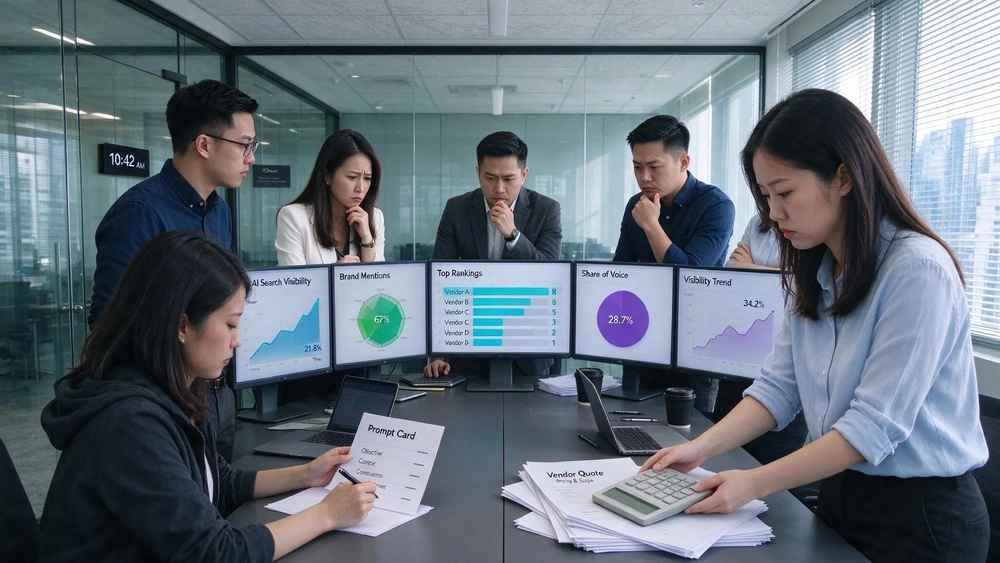
Best AI search analytics tools for marketing teams
As of November 2026, the honest answer is that there is no single best AI search analytics tool. There is only the tool whose measurement matches the decision you need to make, and a handful of questions that will tell you in one demo whether a vendor's numbers can carry that decision. If you are weighing software against an agency that runs geo agency in singapore work, those same questions apply to both.
Key takeaways
- AI search analytics covers five distinct measurements: brand mentions, citations, share of voice, sentiment and AI referral traffic. Few tools do all five well, and several bundle only two or three.
- Vendor capacity numbers are the least comparable part of any quote. HubSpot's entry plan lists a fixed number of prompts per month; another product's "active tracked prompts" may mean something quite different.
- The overlap between Google's top results and AI answer sources fell from 76% to 38% in six months, so rank tracking cannot be reused as a proxy for AI visibility.
- Only 22% of marketers currently track AI visibility and traffic, which means most of your competitors cannot yet answer the question your board will ask this quarter.
- Buy for the report you have to produce, not for the feature list. Price per prompt is meaningless until you know whether prompts are simultaneous, monthly or per engine.
What should AI search analytics actually measure?
The HubSpot blog piece of 11 November 2026 groups the field into mentions, citations, share of voice, sentiment and AI referral traffic. That list is a fair starting point, but it hides a problem: each of those five names is defined differently by every vendor that sells it. Two dashboards can both report "share of voice" and disagree by a wide margin.
Take mentions first. A brand mention rate only means something when the denominator is fixed. A defensible definition counts the answers containing your brand divided by the valid answers collected under identical conditions, with the same questions, same engines, same language, same region, same sampling cadence. Change any of those and you are measuring something else.
Citations are a different measurement altogether. A retrieved source is not the same as a visible citation, and a citation summary that includes pages pulled but never shown cannot be presented as a visible citation rate. When a vendor shows you a citation number, ask which of the two it is.
Sentiment is the easiest to over-trust. HubSpot's own product page states that it measures brand sentiment on a scale from -100 to +100. A single number on that scale tells you nothing about what the AI said, and a brand that is simply absent from answers is not a negative brand. It is simply an unmeasured one.
Why is rank tracking no longer enough?
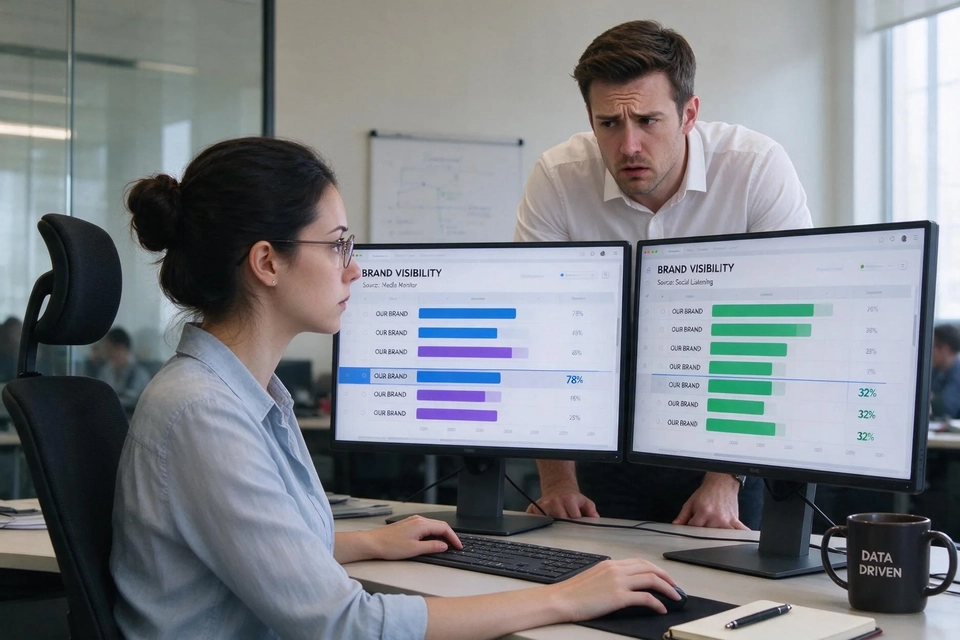
The strongest argument for buying any of this comes from an Ahrefs study of hundreds of thousands of keywords, reported by PR Newswire via Loganix: the overlap between Google's top ten results and AI citation sources dropped from 76% to 38% in six months. A team that ranks well is not automatically a team that gets cited.
The same reporting points to a second reason. Brand web mentions correlate 0.664 with AI citation rates, roughly three times stronger than the correlation for backlinks. If mentions move the outcome and backlinks move it less, then a tool that only counts keywords and links is watching the wrong variable for this purpose.
Semrush's own study adds the traffic side. It projects that, for digital marketing and SEO topics, AI search visitors may start driving more site visitors than traditional search by early 2028. That is a projection, not an observation, but it sets the planning horizon for anyone deciding whether to buy now.
Are AI search visitors worth the same as organic visitors?
The conversion case is the argument a finance team will accept, so it needs to be made carefully. If your team is still working out whether AI visibility is even being measured properly, the explanation of [AEO vs. Search Rankings: AI Visibility Basics](https://www.topkee.com.sg/dynamic/ai-visibility-vs-search-rankings-is-your-agency-measuring) is the place to start. Semrush reports that the average visitor from an AI search source is 4.4 times as valuable as the average traditional organic visitor, based on conversion rate.
Exposure Ninja's analysis puts a harder figure on it: AI search traffic converts at 14.2%, against a far lower Google organic baseline. The advantage varies by platform as well, with Claude leading, ChatGPT following and Perplexity converting least well of the three.
The demand side is moving in the same direction. According to Averi's analysis of citations at scale, 73% of B2B buyers now use AI tools such as ChatGPT and Perplexity in their purchase research. For a Singapore B2B supplier whose buyers are comparing options, that is where the shortlist is being formed.
What none of these numbers tell you is whether your own AI traffic converts at that rate. They are benchmarks from other companies' data. The question to ask any vendor, software or agency alike, is how you would see your own AI referral visits and outcomes in the first ninety days of a contract.
Why do per-engine results disagree so much?
This is the part most buying conversations skip, and it is the part that decides how much you pay. In the same Loganix-reported research, Superlines' cross-platform analysis found that citation volumes for the same brand can differ by a factor of 615 between platforms, and Averi's citation study found that only a minority of domains are cited by both ChatGPT and Perplexity.
If your vendor watches one engine, you are looking at a small slice of a moving picture, and a careful agency will point that out before showing a score. If your vendor watches five, the numbers still cannot be averaged into a single score, because a brand absent from Perplexity and prominent in Gemini is two different facts. Engines have to be counted separately, and the report should say which engine produced which number.
This is where the choice between software and service becomes concrete. A self-serve tool gives you dashboards per engine; a service should hand you the per-engine reading, the sample it came from and the action that follows. Small teams that also need paid media to keep working while AI visibility builds can look at how small businesses compete with big brands using Google Ads alongside the analysis work.
Why vendor capacity figures are not comparable
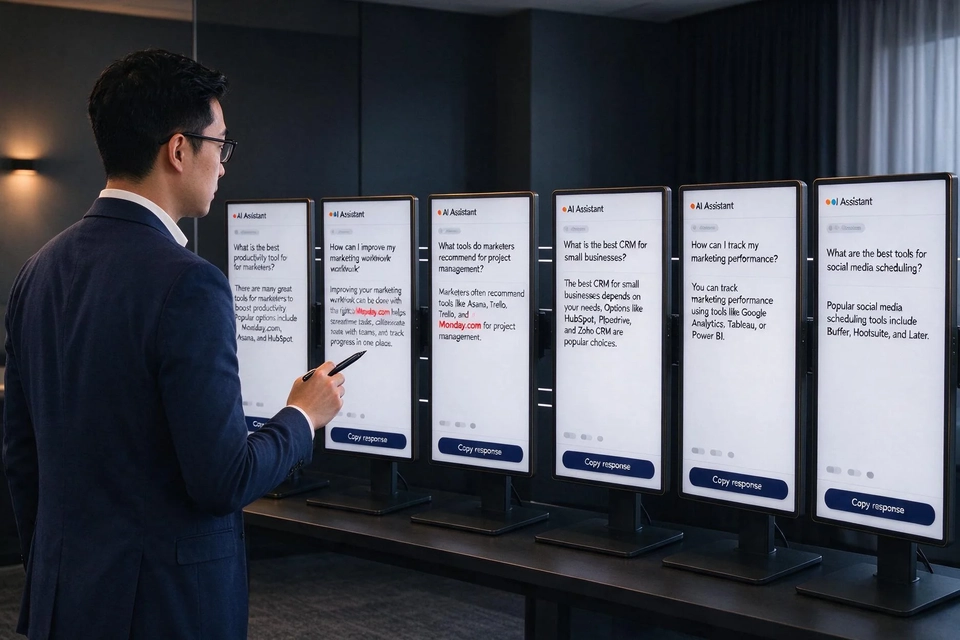
This is the question that separates a serious shortlist from a cheap one, and it is the one the HubSpot list itself does not settle. Every vendor counts capacity differently, and the units are almost never the same physical thing.
HubSpot sells its AEO plan at $50/month, with 25 prompts included; the free trial lets you track 25 prompts across ChatGPT, Perplexity and Gemini. That is a clear monthly allowance, easy to compare against a budget line.
Topkee's GEO service uses a different unit: three tiers of active tracked prompts, rising with the plan. An active tracked prompt is a question that is being monitored at the same time, not a monthly query count. A small set of questions run every week for a month is still that same small set of active prompts, however many runs they accumulate.
Three things follow, and any geo agency singapore shortlist is better for writing them into the evaluation table:
- Ask whether the capacity is simultaneous, monthly, or per engine. A prompt allowance sold across several engines may be sampled on each engine, or split thinly between them.
- Ask how reruns are counted. A monitoring report should list the period, the question version, the engine, the sample size and the failure count; without those, a capacity figure is marketing.
- Ask what happens to the content side. If the quote includes articles, a ledger of what was delivered belongs with it; if it does not, the analysis is separate from the work.
A simple way to normalise quotes is to compute cost per question-month rather than cost per prompt: multiply the number of active questions by the number of months of monitoring you intend to buy, then divide the price. Two vendors quoting different units will suddenly be comparable.
How do you check a vendor's definitions before you sign?
Run this check on the demo, not after the contract. The questions are drawn from the data boundaries a monitoring system should disclose by itself.
- Does the tool sample engines through an API? If so, its results are not identical to what a consumer sees in each product; the report should say so.
- What happens to a source that appears in the retrieval summary but was never shown to the user? It belongs in a separate count, not in a visible citation rate.
- How does the tool handle "not mentioned"? An answer that omits your brand is not evidence of negative sentiment, and a report that merges the two cannot be used to defend a budget.
- Does the vendor guarantee rankings or citations? A report that guarantees them has either a narrow definition of success or something to hide.
- Does the platform cover AI referral traffic separately from AI visibility? Retrieval analysis is not site analytics; referral visits and conversions need your own analytics data.
If a vendor answers every one of these with a documented limitation, you can buy with more confidence than any single benchmark allows. Before the demo, it helps to read [AEO vs. Search Rankings: AI Visibility Basics](https://www.topkee.com.sg/dynamic/ai-visibility-vs-search-rankings-is-your-agency-measuring), which sets out what each number can and cannot prove.
How does Topkee's approach fit a Singapore marketing team?
A geo agency in singapore conversation is where that decision usually gets made, and Topkee's view is that monitoring alone leaves the reader with a dashboard and no next step, so its GEO Insight system sits inside a monthly service rather than being sold as standalone software. GEO Insight shows brand mentions, visibility, competitors and cited sources inside AI answers, and supports prompt tracking, query fan-out analysis, sentiment and brand-description checks, competitor comparison and citation analysis.
Two of its design choices answer the questions above directly. First, capacity is stated in active tracked prompts rather than monthly queries, and Topkee says plainly that the two are not the same. That is the article's own warning, applied to its own product. Second, the system publishes its boundaries: engines are sampled via API, the DeepSeek adapter supplies no web search, citations or fan-out data, Doubao is flagged as experimental, citation summaries include retrieval sources marked inline=false and are not presented as an answer-visible citation rate, and reports carry no guarantee of ranking or citations.
For a Singapore team, that last point matters commercially. Multi-market scoping is assessed separately, so a brand covering Hong Kong and Singapore should expect the question of which market, which site, and which language comes up before any pricing. Teams that want a fixed dashboard with wider third-party coverage, and a product manager to run it, may find a self-serve tool a better fit. A geo agency singapore shortlist deserves the same scrutiny, while a team that wants the reading, the delivered content and the monthly review together is the one the service model suits.
FAQs
What is the difference between an AI search analytics tool and an AI search analytics service?
A tool sells access to dashboards and tracking; a service delivers the reading, the content and the monthly review alongside the monitoring. Teams that want both at once usually talk to a geo agency singapore provider rather than buying another seat. The first suits teams with someone to run it; the second suits teams that need the output without hiring for it.
Can I use my existing SEO dashboard for AI search?
Partly. Rank trackers cannot report whether your brand appears in an AI answer, and the overlap between Google's top ten and AI citation sources fell from 76% to 38% in six months, so rank no longer stands in for citations. Keyword data still matters, but it answers a different question.
How many prompts does a marketing team need to track?
There is no universal number. The right unit is the set of buyer questions your sales team hears most often, repeated on each engine you care about. Ask every vendor whether their capacity is simultaneous questions, monthly queries or per-engine samples before comparing prices.
Do I need AI visibility tracking if my organic traffic is stable?
Stability in organic traffic does not show whether your brand is in the AI answers your buyers read. With 72% of marketing leaders expecting AI to surpass SEO as the primary visibility channel within three years, a team with no measurement has no basis to act when the shift reaches its own category.
Should a Singapore firm buy software or a service?
It depends on who owns the work. If a marketer can read the prompts and write the follow-up content in-house, software costs less to start. If the team needs monitoring plus delivered content from one place, a geo agency singapore service is the simpler contract, especially when it states its data boundaries up front.
One next step before you request a demo
Write one page with three lists: the buyer questions your sales team hears most often, the engines your buyers name, and the content you can realistically edit this quarter. Send it to every vendor before the demo and ask each to return the same sheet filled in. A geo agency in singapore provider will answer it in the same terms as a software vendor, and the two responses side by side are a better shortlist than any feature comparison. If paid search still carries most of your leads, How Small Businesses Can Compete with Big Brands Using Google Ads is the more useful starting point first.
Sources
- Ramona Sukhraj, "Best AI search analytics tools for marketing teams", blog.hubspot.com, 2026-11-11. https://blog.hubspot.com/marketing/ai-search-analytics-tools
- "HubSpot AEO | AEO Tools to Track & Improve Your AI Visibility", HubSpot, 2026-04-30. https://www.hubspot.com/products/aeo
- Rachel Handley, "We Studied the Impact of AI Search on SEO Traffic. Here's What We Learned.", Semrush, 2025-07-21. https://www.semrush.com/blog/ai-search-seo-traffic-study/
- "73% of B2B Buyers Use AI Tools in Purchase Research, Multi-Source Analysis Finds", PR Newswire / Loganix (via Yahoo Finance), 2026-04-03. https://finance.yahoo.com/sectors/technology/articles/73-b2b-buyers-ai-tools-231200431.html