Prove AI Visibility ROI: Metrics a CFO Will Accept
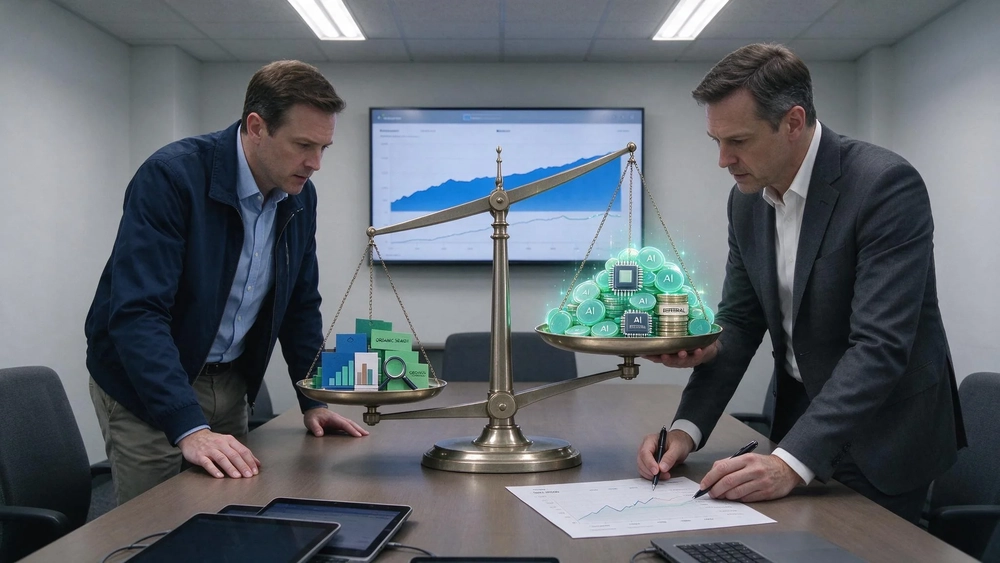
If you are defending the AI visibility line in next quarter's budget, put the conversion comparison in the deck first: a 5% lift in organic search delivers 10.3 additional conversions per site per month, more than doubling AI referral traffic adds. An agency selling generative engine optimization singapore work will still push a visibility score. Ask for the data quality paperwork behind it before the meeting, because most AI visibility dashboards cannot pass it, and the budget conversation becomes much easier once the numbers are checkable rather than impressive.
The traffic and conversion figures in this article come from four datasets published as analysis between 2025 and 2026. None of them shows AI visibility is worthless. All of them show that a visibility score alone will not survive a quarterly review.
Key takeaways
- Organic search delivered 39 times more traffic than AI assistants in the SEO Works benchmark.
- AI referrals converted at 7.18%, but AI traffic converted worse than organic on 23 of 63 websites.
- A 5% organic lift beats doubling AI referral traffic on conversions, 10.3 against the doubling figure.
- Direct traffic growth is mostly noise: total Direct rose 140.9% while engaged Direct changed by \u22121.0%.
- AMEC's four data quality questions are the cheapest filter you can run before reporting any AI number.
Why an AI visibility score will not hold up in a budget meeting
A visibility score is internally consistent by design. It rises when you publish more, falls when a competitor does, and moves on prompts you chose yourself. Consistency is not the problem; prediction is. Across 632 tests, Kevin Indig established no reliable link between AI visibility and later branded search or Direct traffic. When he shifted the same series to deliberately wrong dates, several mismatched alignments correlated about as strongly as the real ones.
That is the crux of the argument. A metric can hold together week after week and still tell you nothing about what buyers do. When a CFO asks what the dashboard predicted, the honest answer today is that no effect could be isolated.
Reading the vendor stat without reading it wrong
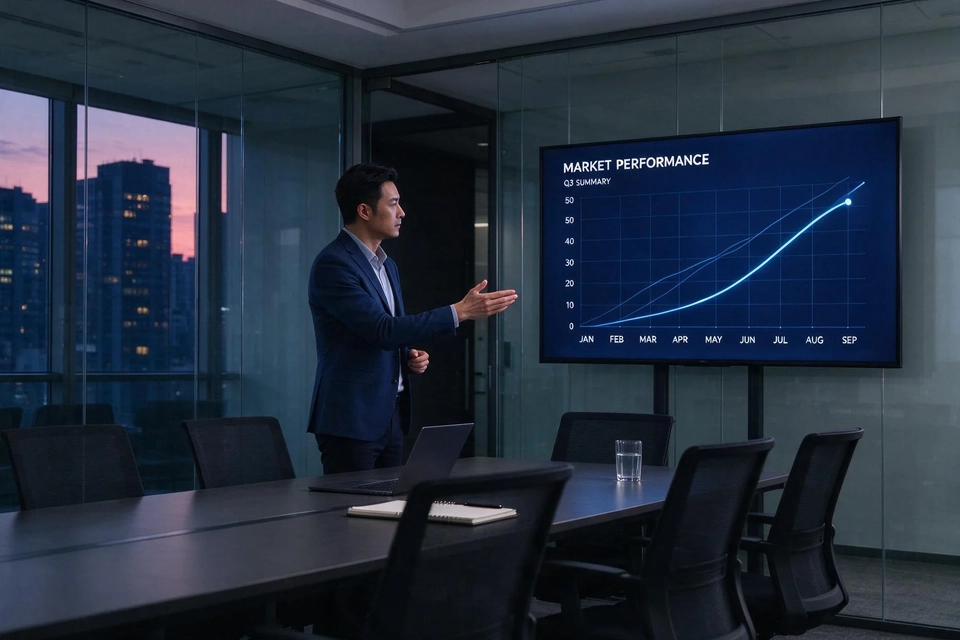
The vendor story usually starts with conversion rate. It is a real finding, and it is narrower than it sounds.
| Measure | What the data shows | What it is safe to say |
|---|---|---|
| Share of traffic | ChatGPT sent 0.62% of Google organic's volume | AI is a small discovery channel, not a replacement |
| Conversion rate | AI referrals converted at 7.18% against 6.08% for organic | Referral quality is comparable, not superior across the board |
| Conversion volume | Organic still drove 27 times more conversions than all LLMs combined | Volume, not rate, is where the budget evidence is thin |
| Conversion spread | AI converted worse on 23 of 63 websites; B2B products at 0.62 times organic | Sector and site matter more than the channel average |
| Scaling potential | 10.3 extra conversions from a 5% organic lift, more than doubling AI | A small organic gain outweighs a large AI gain |
The same pattern shows up from the volume side. Google organic also drove most of the conversions in Marie Haynes' dataset, and organic search kept its lead over all LLMs by a wide margin. Read together, the numbers say AI referrals are worth tracking and not yet worth setting a target on.
The CFO calculation: organic lift versus doubling AI referrals
This is the part to run on your own GA4 property before the review. Take the site's monthly organic conversions, apply a 5% lift, and compare it with what a doubling of AI referrals would add at the current conversion rate. On the published benchmark, the organic side came out ahead at 10.3 additional conversions per site per month, against a smaller gain from the AI side.
Three things make that comparison honest:
- Use engaged sessions on both sides, so bot traffic does not pad either channel.
- Hold the AI conversion rate flat instead of assuming it improves as the channel grows.
- State the assumption where the data is thin, which is any site outside the benchmark's sector split.
If organic wins on your own numbers, as it did across their sample, the roadmap should say so out loud.
Hidden AI traffic in Direct: what the data actually supports
The common defence of AI visibility is that the value sits in Direct and branded search, where an AI answer prompted a later visit. The Direct data does not support it in the form people expect. Across the filtered January-September sample, total Direct rose 140.9%, while engaged Direct changed by \u22121.0%. At one site, GA4 recorded 409,000 Direct sessions, of which a tiny number counted as engaged. Direct sessions with identifiable AI traces were 0.003% of total direct traffic.
That is a bot pattern, not a buyer pattern. It does not rule out a brand effect from AI answers. It does rule out the argument that a spike in Direct traffic proves one.
What AMEC's data quality questions filter out
On May 20, 2026, AMEC launched its GEO Principles at its Global Summit in Dublin. The companion data quality paper, written for social listening and media analysts, proposes four questions any dataset should answer before anyone acts on it. Applied to AI visibility, each one removes a different failure.
| AMEC question | What it asks | Where AI visibility data fails it |
|---|---|---|
| Source | Is the data from the sources we expect, and only those | Bot sessions inflating Direct, as in the 409,000-session example |
| Accuracy | Is the metadata complete and faithful | Mentions, citations and recommendations counted as one thing |
| Real-world | Does it correspond to real-world behaviour | Scores that do not move with branded search, Direct or pipeline |
| Trust | Is it trusted by those who matter | A CFO who sees the AI share of traffic and stops listening |
The third question is the one that decides the budget. AMEC's paper warns that a metric can be internally consistent but externally untrue, and that in an AI era that kind of data does not stay quarantined. A visibility score nobody validated against customer behaviour spreads into every deck downstream.
How to prove AI visibility ROI to a CFO with data quality checks
The search results for this question are full of tactics: chunk-level content, brand mentions, crawlability. None of them answers the question a CFO actually asks, which is which number changed a decision. The answer is a three-step budget defence, and it works without a new tool.
Step 1: demote the referral number. Keep AI referral traffic in the report as a diagnostic. Stop setting a target on it and stop forecasting from it. A channel that delivers 3.2 conversions for every conversions organic delivers in bulk can be worth watching without being worth a goal.
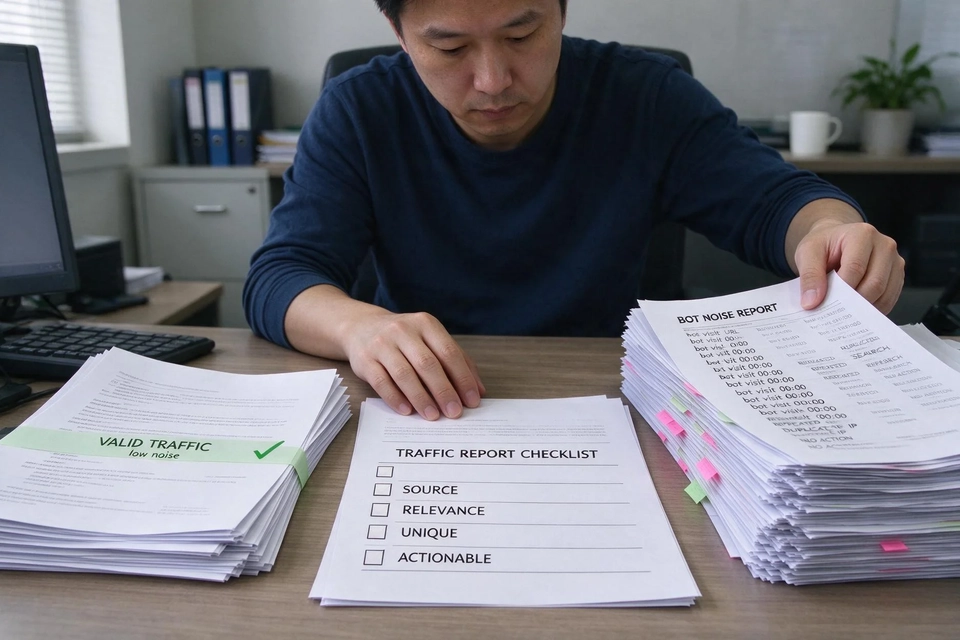
Step 2: run the four questions. For any visibility number going into a deck, document the tools and prompts behind it, whether results were logged in or logged out, and how bot sessions were filtered. Define whether you are counting a mention, a citation or a recommendation, because they are not interchangeable. A number that cannot answer those fails AMEC's first two questions before anyone raises results.
Step 3: test the score against behaviour. Pull weekly AI visibility and line it up against engaged Direct sessions, branded search and pipeline at lags of one to six weeks. Then shift the series to wrong dates and run it again. If the wrong dates correlate as well as the right ones, the score is not predicting anything yet, and knowing that before renewal is worth more than any dashboard feature.
The evidence that does hold points one way. Across sites, the correlation between AI referral growth and organic growth was +0.557. Sites gaining AI referrals were the sites improving in organic search. That is the finding to put in the budget line, because it makes one investment do two jobs.
What Singapore marketing teams should ask an agency
A geo agency singapore pitch usually leads with visibility movement. Ask for the four items below before you compare quotes, and the answers separate a measurement service from a monitoring subscription.
- The prompt list, with how each prompt maps to a real buyer question.
- The tool set and the logged-in or logged-out setting behind every number.
- The bot filter applied to referral and Direct data.
- One test of the score against engaged sessions, branded search or pipeline.
A provider that cannot produce the second and third items is selling a score, not a measurement.
Where AI visibility fits in an agency's measurement stack
Topkee's GEO service positions the work as monitoring, analysis and content delivery connected end to end, steadily closing the brand-knowledge gaps customers need for comparison, selection and purchase. That structure matters for the budget argument, because it treats visibility as an output of content work rather than a channel with its own conversion rate.
For a client, the practical difference is what gets delivered. The service runs generative engine optimization singapore programmes against a governed prompt set, reports what the AI answers say about the brand, and feeds the gaps back into content. None of that is a guarantee of citation. It is a way to keep the visibility number attached to work a CFO can see, which is the standard this article sets. Teams that want the vocabulary before the pitch can start with AEO versus search rankings and AI visibility basics, and teams weighing AI against paid can look at how ads in Google AI answers concentrate in apparel and electronics.
Brand mentions remain the strongest lever the data shows. Branded web mentions correlated 0.664 with AI Overview brand visibility, ahead of branded anchors and branded search volume. The top web-mention quartile averages 169 AI Overview mentions, over tenfold the next quartile's average. Earned mentions do double duty with organic work, which is the least glamorous line and the best supported one.

Recommended reading list for the review pack
Bring three things to the meeting and leave the dashboard screenshots out. A generative engine optimization singapore brief that states which prompts map to buying questions. The internal organic and AI conversion comparison for your own site. The test result against engaged sessions, with the placebo run included.
For the agency side, a geo agency singapore audit that includes the prompt library and the bot filter is worth more than a ranking table, because it is the part a CFO can check.
FAQ
Is AI visibility measurement a sham?
No. The traffic is real and the referral quality is close to organic. What fails is the score: internal consistency without a proven link to behaviour. Measure it as a brand channel, not a traffic channel.
Should we set a target on AI referral traffic?
Not on the published evidence. AI referrals delivered only 3.2 conversions for the large block organic delivered, and a 5% organic lift beats doubling AI referrals on conversions. Report AI referrals, do not forecast from them.
How much traffic do AI assistants actually send?
Across the SEO Works benchmark, organic search delivered 39 times more traffic than AI assistants. Marie Haynes' dataset put ChatGPT at 0.62% of Google organic's volume, with every LLM together only marginally higher.
Why does Direct traffic keep growing if AI is not behind it?
The growth does not survive an engagement filter. Total Direct rose 140.9% while engaged Direct changed by \u22121.0%, and at one site almost none of 409,000 Direct sessions counted as engaged. That pattern points to bots.
Does more AI visibility lead to more branded search?
It has not been shown. Across 632 tests no reliable link was established, and branded search volume correlated only 0.392 with AI Overview visibility, behind branded web mentions at 0.664.
Sources
- "AI Visibility Isn't A Sham – Most Ways Of Measuring It Are", Search Engine Journal, 2026-11-06. https://www.searchenginejournal.com/ai-visibility-isnt-a-sham-most-ways-of-measuring-it-are/594405/
- "AI Referral Traffic 2026: How Much, And Does It Convert?", The SEO Works, 2026-11-06. https://www.seoworks.co.uk/downloads/ai-referral-traffic-benchmark/
- "An Analysis of AI Overview Brand Visibility Factors (75K Brands Studied)", Ahrefs, 2025-05-26. https://ahrefs.com/blog/ai-overview-brand-correlation/
- "Does AI drive more direct traffic?", Growth Memo (Kevin Indig), 2026-10-19. https://www.growth-memo.com/p/does-ai-drive-more-direct-traffic