
AI search strategy for geo agency singapore teams
As of November 2026, an AI search strategy is three stages in a fixed order: make the site readable to AI crawlers, publish pages an answer engine can quote, then measure mentions against a fixed question set. Most teams start with the third and wonder why the number moves.
Choosing a geo agency singapore provider is one way to run all three; building it in-house is another. The sequence is the part that is not negotiable.
Key takeaways
- AI crawlers do not run JavaScript, so content inside a client-rendered app is invisible to them however good the ranking.
- Google requires a page to be indexed and snippet-eligible before it can appear as a supporting link in AI Overviews or AI Mode, so classic SEO basics remain the entry ticket.
- A crawl fix shows up within about a day, while content gains take up to six months, so the two stages should not be judged on the same clock.
- A mention rate without a fixed question set, engine, language and region is not a number you can compare across months.
Start with what the crawlers actually read
AI answers draw on pages an engine has already fetched. That fetching is invisible in most marketing dashboards, which is why the first audit a team should run is on server logs or a crawler test, not on rankings.
Vercel's analysis of its own network gives the scale. OpenAI's GPTBot generated 569 million requests in one month, and the four main AI crawlers together account for a little over 28% of Googlebot's volume on the same network. AI fetching is a real share of crawl load on a modern site, not a rounding error.
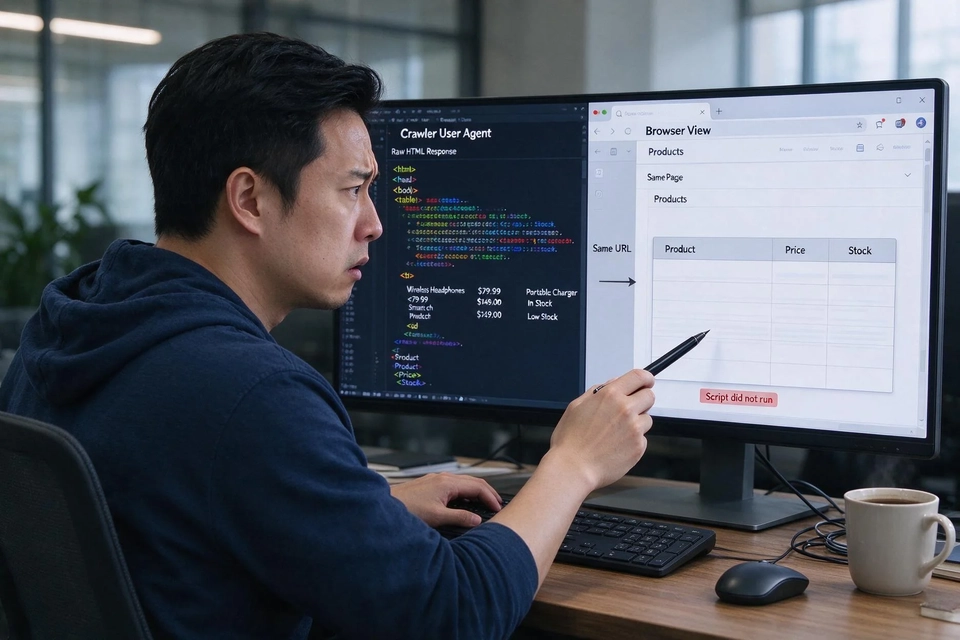
The finding that changes budgets is simpler. None of the major AI crawlers render JavaScript. A product catalogue or price table built in React or Vue reaches the crawler as an empty shell. A Singapore retailer whose spec pages depend on client-side rendering ranks on Google, where Googlebot renders, while an assistant that never runs that script sees nothing.
The check takes an afternoon: fetch your ten most commercially important URLs with a user agent set to GPTBot and read the raw HTML. If the price, the eligibility criteria or the FAQ answer is not in the response, that page cannot be cited.
The eligibility rule that sends SEO teams back to basics
Google's documentation on AI features is short on new requirements. To appear as a supporting link in AI Overviews or AI Mode, a page must be indexed and eligible to be shown in Google Search with a snippet. No separate AI markup, no special file, no submission form.
That sentence carries weight for teams that trimmed their SEO function when AI search arrived. Indexability is still the gate, and a page blocked by a stray noindex, a canonical pointing elsewhere or an over-eager robots rule is out of both search and AI features at once. The same document confirms that AI Overviews and AI Mode may use query fan-out, issuing multiple related searches across subtopics and data sources to build one response.
Fan-out explains why thin pages underperform in AI answers even when they rank. A single page that answers one narrow question gets pulled into one branch of the fan-out; a page that answers the adjacent questions gets pulled into several.
Pew Research Center found AI summaries on 18% of the Google searches it analysed in March. That figure sets the ceiling on how often a query is answered without a click, and it also sets the size of the audience reading AI text about your category.
What AI answers quote: question sets and fan-out
An AI visibility number is only as good as the question set behind it. A mention rate computed from whatever questions the team thought of last month cannot be compared with this month's figure, because the denominator moved.
Write the question set down before the first measurement. A workable starting list for a Singapore brand in a considered-purchase category covers four kinds of question:
- Category questions a buyer types before knowing the brands, such as which marketing analytics platform suits a small retail chain. These measure whether the brand enters the answer at all.
- Comparison questions naming two or more vendors. These measure how the brand is described next to a rival.
- Eligibility and scope questions, such as whether a service suits a company under a certain size. These carry the most decision weight and are usually the emptiest pages on a site.
- Brand-name questions. These measure accuracy and are kept apart from the question-led sample, because a brand-name answer nearly always mentions the brand.
The rule that keeps the set stable: one question asked on two engines counts once in the question list but is sampled per engine, and a different language version counts as a separate question. Report the mention rate per engine, then the combined figure.
Fan-out analysis sits underneath. It reads the sub-queries the engine actually returns and flags the missing ones instead of guessing at them. If the engine fans out into fees, delivery timeline and who it suits, and your site covers only who it suits, the gap is visible in the data rather than inferred from a hunch.
The build order: crawl access before content
The three stages cost different amounts and return results on different clocks, so the order matters for the same reason a funnel does. Fixing what is cheapest and fastest first avoids spending content budget on pages no crawler can read.
| Stage | What it fixes | How long until the change shows | Cost profile |
|---|---|---|---|
| Crawl access | Robots rules, server-side rendering, status codes, indexability | About a day for a robots.txt change, per OpenAI's guidance | Engineering time |
| Extractable content | Missing eligibility, fee and comparison answers on the pages already live | Up to six months for steady gains | Writing and editing time |
| Measurement | A fixed question set, per-engine sampling, a documented report | Immediately after the baseline run | Analyst time and tooling |
Stage one is mostly a decision about rendering. If the commercial pages are client-rendered, server-side rendering or pre-rendering them is the single change with the widest effect, because it moves every page from invisible to readable at once. The same pass should fix crawl waste: ChatGPT sends 34.82% of its fetches to pages that return an error, so a large part of AI crawler budget on your domain is being spent on URLs that no longer exist, which a sitemap clean-up and a redirect map reduce.
Stage two is where the content work goes, and it should start from the question list rather than from the editorial calendar. The mapping that works: an unclear eligibility answer becomes a page with scenarios and limits; a missing fee discussion becomes a page on fee factors and delivery scope; a comparison question with no brand material becomes an evidence-based selection page. Each page is then checked against the same question set, which closes the loop between stage two and stage three.
Stage three exists to stop the other two from drifting. Teams that buy a geo audit singapore measurement before changing anything get this stage cheaply, because the baseline question set is written first. Without a fixed set, a team cannot tell whether a mention fell because the content weakened or because the question changed.

What the results look like on a realistic clock
Teams that ask for a timeline usually have a campaign calendar in mind, and AI search does not fit one. HubSpot's own account puts steady, measurable gains from an AI search content strategy at up to six months.
Their Reddit work is the clearest illustration. Localised community campaigns in France and Germany moved the brand's mention rate in tracked Reddit sources from zero to 33.5% in France within one month. Later, Reddit-driven citations grew to 146,000. The pattern to copy is the source choice and the localisation, not the speed: the first month moved a channel that the engine already read heavily, and the citation growth came afterwards.
The size of the audience is why the work is worth the wait. ChatGPT has more than 900 million weekly active users, according to OpenAI, and 44% of marketers said they have made a business purchase based on brands they found through answer engines, per HubSpot's State of AEO in 2026 report.
Where the data is too thin to conclude: a single month's mention movement on one engine, taken from a handful of answers, is noise. Report it as a direction and wait for the second round before anyone changes the plan.
What Topkee does about the three stages
Topkee delivers the three stages as one service: it monitors whether a brand appears in AI answers, how it is described and which sources are cited, then supplies knowledge content and improvement actions. What it will not do is promise a specified AI recommendation, fixed exposure or query volume. The workflow is ASK, UNDERSTAND, IMPROVE, and a geo agency singapore engagement is planned as one brand, one primary website, one market and one content language, which is the same scoping discipline the question set needs.
The monitoring side, GEO Insight, shows brand ranking, visibility, competitors and cited sources inside AI answers, with prompt monitoring, query fan-out, sentiment, citations and competitor analysis. Its AI browsing analysis is the closest thing Topkee delivers to a geo audit singapore buyer would expect: it analyses retrieval sources, cited pages and basic website readability, and it separates sources that were retrieved from citations visible in the answer. Diagnostic output reaches the client as that readability and source check plus a prioritised action list, not as a standalone audit report.
Delivery is sold in three monthly tiers that differ by capacity: an entry tier covers a stated number of active tracked questions and content pieces, while the two higher tiers raise both on the same analysis. Each tier includes four monthly deliverables: a monitoring report, a content pack with a per-article ledger listing question, source, target page and status, a prioritised action list, and one monthly review.
Two documented limits belong in the same paragraph as the offer. Sampling runs through engine APIs, so it cannot be equated with what any individual user sees in a consumer AI product, and the DeepSeek adapter returns no web search or citation data. Topkee states that the service does not guarantee a specified AI recommendation or fixed exposure. For a buyer comparing proposals, that boundary is more useful than a promise, because it tells you what the monthly report can and cannot prove.
The GEO service documentation is priced in Hong Kong dollars for the Hong Kong market; no Singapore GEO fee or Singapore audit volume is published. Singapore buyers should ask for a scoped quote rather than read the tier table as local pricing.

How to judge a geo audit singapore proposal
The market in Singapore has filled with agency pages that frame the same work as AEO, GEO or AI visibility, and the labels differ more than the delivery does. A geo audit singapore proposal is the shortest way to see the difference, because an audit either names the pages and questions it checked or it does not. Judge the proposal on what can be checked after month one.
Five questions separate a workable proposal from a presentation:
- Which questions are tracked, and is the list fixed for the contract term? A provider that will not show the question list cannot be compared with the next one.
- Is the sampling described per engine, with the API-versus-consumer-product limit stated? An agency that presents API sampling as what users see will overstate the results.
- What are the monthly deliverables, and is there a ledger linking each piece of content to a question and a target page?
- Does the proposal name a rendering or crawl fix, or only content? A content-only plan leaves the JavaScript problem in place.
- What does the provider promise, and what does it explicitly not promise? A named recommendation or a fixed exposure figure is a reason to walk away.
On price, compare the monthly fee against capacity, not against an outcome. A stated number of tracked questions and a set number of content pieces a month is a capacity; a top AI ranking is not. A published tier table, like the one a geo agency singapore provider puts on its service page, is the structure to ask for from any supplier.
If the in-house route is chosen, the same five questions apply to your own plan, with the analyst and the writer taking the roles. The work is the same; the difference is whether the capacity exists on the team.
For the narrower question of how AI visibility differs from a search ranking, [AEO vs. Search Rankings: AI Visibility Basics](https://www.topkee.com.sg/dynamic/ai-visibility-vs-search-rankings-is-your-agency-measuring) sets out the definitions this article uses. If the budget sits with paid media, AI-Driven Trust Transforms Google Ads Marketing | Topkee covers how AI answers and paid placements interact.
FAQ
Is AI search strategy different from SEO?
It overlaps at the eligibility gate and diverges after it. Google requires a page to be indexed and snippet-eligible before it can appear in AI Overviews or AI Mode, so technical SEO still decides whether a page can be cited. The AI-specific work sits in what the page answers, because query fan-out pulls different pages into one response, and in how the result is measured, which is a question set rather than a keyword position.
How long does it take before AI answers mention a brand?
Crawl fixes are fast: OpenAI says it can take about a day for its search systems to adjust after a robots.txt update. Content gains are slower, and steady, measurable gains usually take up to six months. A first read on a small question set can be taken within a month, but treat it as a direction until the second round. A geo audit singapore baseline taken before any change is what makes that second round comparable.
Do we need special markup to appear in AI Overviews?
No. Google's documentation lists no additional requirements beyond being indexed and eligible to be shown with a snippet. Readable server-rendered HTML, clear answers and working internal links do the job; there is no AI-specific file to submit.
Why does our content not show up even though we rank on Google?
The most common cause is rendering. None of the major AI crawlers render JavaScript, so a page assembled in the browser reaches the crawler empty. The second cause is topic coverage: if fan-out sends the engine into a sub-question the site never answers, another page supplies that part of the response.
What should a Singapore team budget for AI search work?
Budget follows capacity: the number of tracked questions and the number of content pieces per month. A documented tier structure is a better starting point for comparison than a single retainer figure, and any proposal should state what it does not guarantee. Prices quoted in another currency should be converted and dated before the budget is approved.
Sources
- Alex Sventeckis, "AI search strategy: A guide for modern marketing teams", HubSpot Blog, 2026-11-10. https://blog.hubspot.com/marketing/ai-search-strategy
- "AI Features and Your Website", Google Search Central Documentation, 2025-12-10. https://developers.google.com/search/docs/appearance/ai-features
- Giacomo Zecchini, Alice Alexandra Moore, Malte Ubl and Ryan Siddle, "The rise of the AI crawler", Vercel Blog, 2024-12-17. https://vercel.com/blog/the-rise-of-the-ai-crawler