
AI search KPIs that hold up in an AI reporting stack
As of November 2026, a Singapore business still reporting AI search with organic sessions and keyword rank is looking at the wrong numbers. A visitor who arrives from an AI engine converts at 4.4 times the rate of a traditional organic visit, according to Semrush, so a site can shed traffic and still win on the channel that matters. Below are the KPIs worth tracking, the formula each needs and the denominator that a geo agency singapore should defend before you sign anything.
Key takeaways
- Traffic and rank remain useful; they stopped being sufficient once AI answers started absorbing the click on most queries.
- Every AI KPI is a ratio, and a ratio is only as good as the sample you divide by. Fix the prompt set, the engine, the language and the region before comparing two periods.
- AI-referred traffic is small and valuable. It pays off in conversion rate and in branded search, not in session volume.
- Citation counts and sentiment scores need manual reading. Automated totals overstate both.
- When you brief a provider, ask for the mention rate, the sample size and the failure count. A dashboard screenshot is not a measurement.
Contents
- Why traffic and rank stopped explaining performance
- The six AI search KPIs worth reporting
- How to measure AI visibility and citation share without fooling yourself
- The denominator is the KPI
- How Topkee structures AI visibility reporting
- A three-month sequencing for a Singapore team
- FAQ
- Sources
Why traffic and rank stopped explaining performance
The click was never guaranteed, but it used to be the default. Zero-click searches, meaning queries that end without a visit to any website, now make up 68% of all Google searches, according to Similarweb's clickstream panel, and the share has grown steadily for ten years. The steepest part of the rise came with AI Overviews, which Similarweb measured on more than 20% of all searches.
Two figures explain the shape of the curve. AI Overviews appeared on roughly 48% of all Google searches at the time of HubSpot's report, up from 31% a year earlier, by BrightEdge's count. Where an Overview appears, organic click-through rates fall by as much as 61% even for the result in the top position. Pew Research put the user-side version of the same effect at 8% click-through with an Overview on screen against 15% without one; Similarweb carried that comparison in its zero-click analysis.
Ranking still matters for the pages AI engines read. It stopped being a proxy for being seen. Semrush's study of over 500 high-value digital marketing and SEO topics projects that these topics may send more visitors from AI search than from traditional search by early 2028. That is a projection, not an observation, but the direction is clear enough to justify building the measurement now.
The six AI search KPIs worth reporting
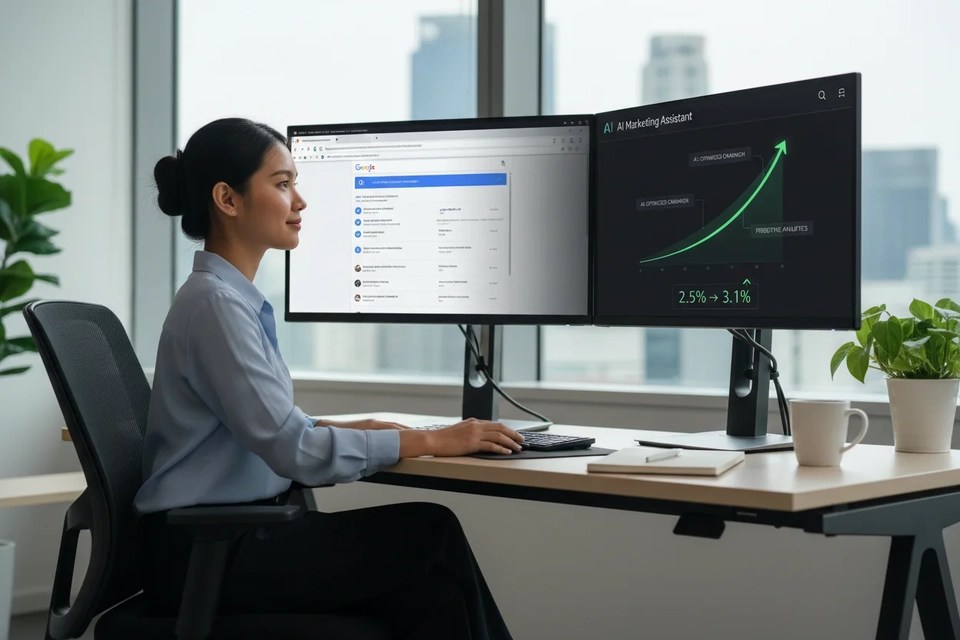
AI visibility rate
The share of a fixed prompt set in which your brand appears in the answer. HubSpot's formula is the prompts where the brand appears divided by the prompts tested, expressed as a percentage.
Two constraints keep the number honest. AI answers vary by user, location and session, so the prompt set needs a fixed schedule rather than an occasional check. And the prompt set needs a size you can defend when someone questions the result.
Citation share
Your citations divided by all citations in the same prompt set, counting competitors. This is a share-of-voice figure, and it is the one that puts a visibility rate in context. A brand sitting in 30% of answers looks different when a competitor sits in 60% of them.
HubSpot warns that the underlying citations are noisy: AI search engines fail to cite sources correctly more than 60% of the time, per a Tow Center/Columbia University study. Citation share is worth tracking as a trend across a period. It is not worth treating as a precise count from one week.
Description accuracy and sentiment
Whether the AI describes your offer, pricing and suitable situations correctly, and whether the tone reads positive, neutral or negative. Both are qualitative. Someone has to run the prompts, read the answers and score them against a rubric. Sentiment scoring without the quoted answer text behind it is guesswork.
Branded search lift
Scrunch's analysis of millions of search events found that a person with no prior exposure to a brand becomes 182% more likely to search for it on Google within the following week after an AI platform recommends it, and 117% more likely to visit the brand's site directly.
Most AI engines pass no referral data, so that later visit lands in organic branded search or direct traffic. The measurement is the month-on-month change in branded impressions and clicks in Search Console, read for direction. Public relations, paid media and social can lift the same number, so it is a signal rather than a proof of cause.
AI-influenced engagement
Per Similarweb's data, the ChatGPT-referred visitor stays 15 minutes against 8 for Google, and views more pages per session. On transactional sites, the same study converted 7% of those referrals and Google visitors at a lower rate. Volume will be small for most Singapore SMEs; the value sits in the session quality, which is why it belongs in the report at all.
Conversion rate and revenue, tagged by source
Segment conversions by AI referral in GA4 and compare the rate with organic and direct. For the revenue side, ask a lead how they first came across you and record the answer in the CRM. Self-reported attribution is imprecise. It is also the only route that captures the discovery path that analytics tools never see, because the answer was read and the chat closed before anyone clicked.
HubSpot puts the benchmark for AI referrals well above the standard organic rate, with the size of the gap depending on industry and method. Treat it as a hypothesis about your own traffic, not a forecast. Use the range to frame a hypothesis about your own traffic. Do not put it in a forecast.
How to measure AI visibility and citation share without fooling yourself
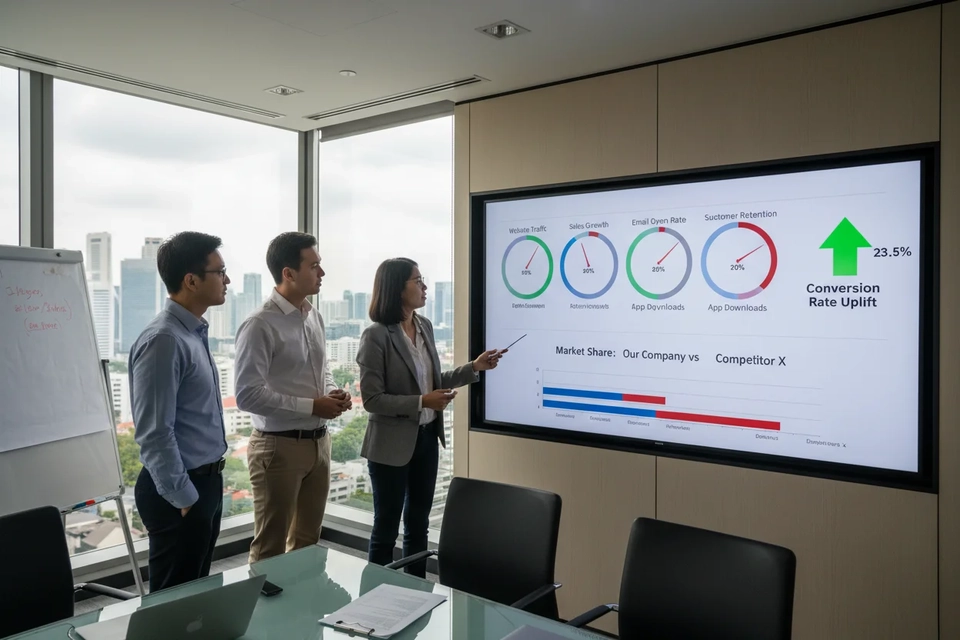
The measurement starts before any tool is opened. Before comparing this quarter with the last, fix five things: the prompt version, the engine, the language, the region and the sampling cadence. Change one of them mid-comparison and the gain or loss you report belongs to the change, not to your work.
Build the prompt set first
HubSpot's suggested starting set is 30 prompts, spread across three question types: category questions about the best tool for a job, problem questions about fixing a process, and comparison questions that name rival vendors head to head. For a firm weighing a geo agency singapore against an in-house run, that list is most of the brief. Keep the prompts in a versioned document so a later edit leaves a trace. Capacity, which the tiers section below sets out, is the other number to pin down.
For a Singapore business, the region setting matters. An answer served to a user in Jurong can cite a different set of pages from one served to a user in London, so a single global sample will not describe the local market.
Run across engines, not one
ChatGPT remains the largest single source of AI referral traffic, and its share is slipping. A later study from Goodie put its share of B2B AI referrals at 63% after eight months, with Claude on 18.5% and Gemini on 10.6%. Reading only the ChatGPT number is the common fault when an aeo plan is built on one engine. A brand visible in one assistant and absent from the others is exposed to that shift. A geo agency singapore should report each engine separately and keep a combined figure only for the executive summary.
Separate the stages
A page can be retrieved by the engine, cited in the answer, visited by the reader and converted into an enquiry. Those are four different events, and one report line that merges them will hide which stage is failing. Keep the visit and conversion figures in the web analytics, and keep the retrieval and citation figures in the prompt monitoring, then join them by date and by prompt set.
The denominator is the KPI
This is the part competitors skip. Two providers can report the same visibility percentage for one brand on the same day and both be correct, because one divided mentions by a large sampled answer set and the other by a few dozen hand-run prompts.
Ask for the denominator in writing. How many questions were run, on which engines, how many rounds, how many answers returned a usable result, and how many failed outright. Then ask how the two samples were kept apart: questions written without the brand in them compared with questions that named the brand. Mixing the two lets a provider add the company name to a prompt and record the mention as a gain.
Definition traps follow from the same habit:
- "No source returned" and "answer missing" are not the same result and cannot share a denominator until you know why the engine returned nothing.
- A citation summary that includes inline retrieval sources is not a count of visible citations. A quote in the answer and a link under it are two different measurements.
- A brand that is absent from an answer is not a brand reviewed negatively. Silence and criticism need separate codes.
- Engine access through an API is not the same as the interface a consumer used that morning. Results from API samples describe the API.
For teams briefing an aeo programme, the auditable version of this is a pilot on a fixed sample. Compare the pattern of results with a small manual check on the same prompts. If the manual read disagrees with the tool on which answers mention the brand, the tool's denominator needs auditing before any monthly report goes to management.
How Topkee structures AI visibility reporting
Topkee's GEO service is built on the premise that a brand's AI visibility should be reported as three measured quantities on an agreed set of buyer questions: how often the brand is mentioned, how accurately it is described, and how the source performs in the answer. The service publishes a formula for each. GEO mention rate is the valid answers containing a brand mention divided by the valid answers produced under identical conditions. Source appearance rate is the valid answers where the owned site appears divided by the same set.
Those two ratios feed a four-layer report: service delivery, covering articles accepted, pages published and monitoring coverage; search and AI visibility, carrying brand mention rate, owned-site source appearance rate and description accuracy alongside per-keyword organic rank; traffic and engagement, with organic visits and identifiable AI-referral visits where the data exists; and business results, counted by the CRM and analytics criteria the client confirms. The observation framework behind it treats retrieved, cited, visited and converted as separate stages.
Capacity is sold as concurrent active questions rather than monthly query volume, in three tiers whose question ceilings are 30, 60 and ninety, each with its own monthly knowledge content allowance. Monitoring reports list the period, the question version, the engines, the sample count and the failure count, and keep the answer-level evidence. Topkee states that it does not guarantee a specified recommendation, fixed exposure or query volume, and its own service documentation treats API sampling as a limitation that applies to every AI visibility figure in the market, including its own.
That last point is the reason to put mention rate and source appearance rate in the contract rather than a monthly score. A provider that will not show the denominator, the sample size and the failure count is selling a chart. A provider that will is giving you a number you can audit in three months when the engines change again.

A three-month sequencing for a Singapore team
Month one belongs to baseline. Assemble the prompt set with the brand's real buyer questions, record the engine, language and region settings, and run the first sample. Two additions earn their place here: a CRM field for the discovery source, and a Search Console segment for branded queries, so the proxy metrics have a starting line.
Month two is for the first content decisions. Read which prompts you lose and who is cited instead, then check whether the page being cited answers the question at all. Many misses trace to a page that never addressed the question, not to a technical fault.
Month three is for the review. Compare delivery figures, AI visibility, traffic and the business results the client confirmed. Hold the engine settings constant again, and write down what you changed. The comparison is only worth the discipline behind it.
FAQ
What should a Singapore SME track first in AI search?
Start with mention rate on a fixed prompt set and the branded search trend in Search Console. Both are cheap to produce, and together they show whether AI answers name the brand and whether readers act on that answer. Add citation share once the prompt set is stable.
Is a GEO agency singapore worth hiring for measurement alone?
Sometimes. A provider earns its fee when it brings the question set, the sampling discipline and the failure logging that an in-house team will not build. If the offer is a monthly visibility score with no sample size, the same money buys a manual prompt run and a spreadsheet.
Is aeo different from GEO in a reporting plan?
The two terms are used interchangeably in most vendor material, and the metrics overlap. Treat an aeo plan as the practice of optimising content so answer engines pick it up, and GEO as the wider programme that includes monitoring and measurement. What matters on the report is the definition of each ratio, not the label above it.
Can we compare this quarter's AI visibility with last quarter?
Only if the prompt version, the engine, the language, the region and the sampling cadence stayed the same. If any of them changed, run the old prompt set again to establish the bridge, or state the change next to the number.
Why does AI-referred traffic show up as direct traffic?
Many answer engines do not pass a referrer, so the reader arrives without a source tag once they move from the chat to a browser. Branded search and direct traffic are where that visit usually lands, which is why the branded-search trend is a necessary companion to the referral report.
Which numbers are not AI KPIs?
Organic sessions and keyword rank still describe search; so does a count of first-page positions. Keep them in a separate section, and never present a ranking movement as evidence of AI visibility.
Sources
- HubSpot, "AI search performance KPIs every marketer should track", Ramona Sukhraj, blog.hubspot.com, 2026-11-04. https://blog.hubspot.com/marketing/ai-search-kpis
- Similarweb, "Zero-Click Marketing: The SEO Strategy For A World Where Most Searches Skip Your Site", similarweb.com, date not shown on the page. https://www.similarweb.com/blog/marketing/geo/zero-click-marketing/
- Semrush, "We Studied the Impact of AI Search on SEO Traffic. Here's What We Learned.", semrush.com, date not shown on the page. https://www.semrush.com/blog/ai-search-seo-traffic-study/