AI search behavior in Singapore: what it means for your marketing
As of November 2026, the honest answer for a Singapore marketing lead is this: AI search has moved the discovery decision away from your ranking and towards whether an engine names and cites you, and the brands that measure that separately are the ones who can tell a traffic problem from a discovery problem. If your organic traffic has flattened while AI answers multiply, this article is for you. Treating generative engine optimization singapore as a serious option starts with understanding the behaviour, not buying the service first.
A note on words first. This article uses the British spelling *behaviour* throughout, as Singapore English does; the HubSpot report that prompted it spells it the American way, and the two mean the same thing.
Key takeaways
- About 60% of Google searches end without a click, and AI Overviews appear on 21% of keywords in Ahrefs' dataset — so ranking is no longer the same as being seen.
- Non-branded discovery is where the shift bites hardest: AI Overviews are 1.9x more common for non-branded than branded queries.
- The traffic that does arrive is often later in the journey: HubSpot measured 3x better conversion from AI-sourced leads.
- Structure alone moved citation rates: lists and tables had 43% better extraction accuracy than prose, and structural rewrites lifted citations by 17.3%.
- 42% of CRM software buyers used AI search to evaluate vendors, which makes the answer engine part of your shortlisting, not your awareness.
What is AI search behaviour, and how is it different from searching?
AI search behaviour is what people do when they ask a conversational system for an answer instead of typing a keyword into a results page. HubSpot's report, published on 11 November 2026, describes the shift as users turning to AI with queries a few sentences long and reading a generated summary that resolves the question on the spot — ChatGPT on one side, Google's AI Overviews on the other.
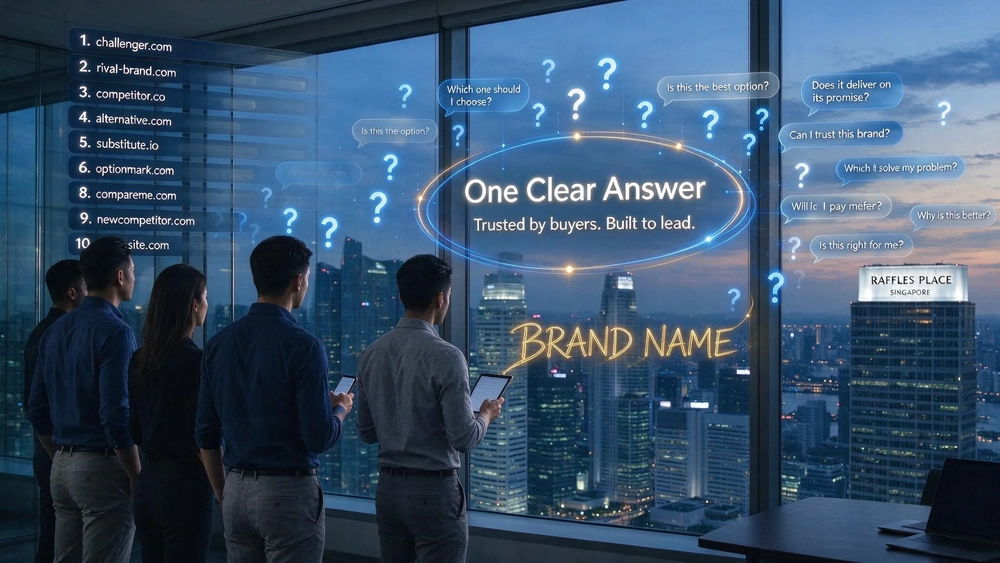
The difference that matters for a marketer is where the click went. Under the old model, a buyer typed a phrase, received ten links, and you competed for a position in that list. Under the new model, the engine composes one answer and decides which sources to name inside it. HubSpot separates the two jobs: SEO decides which pages rank in the underlying index, while answer engine optimization decides which of those pages get cited in the summary. Both run in parallel, and the second one now decides whether the buyer ever sees your name in the first place.
For a small Singapore team that spent years chasing position one, that is a change in the object of the work, not just a new channel to add. Position one on a page the buyer never scrolls past is worth less than a citation inside the summary they do read.
How much of search now ends without a click?
A lot of it, and more for the questions you most want to win. According to SparkToro, as cited in HubSpot's report of 11 November 2026, about 60% of Google searches end without a click. On the evidence, that is a floor rather than a ceiling: HubSpot's own author expects it to keep climbing as more queries trigger a generated answer.
Ahrefs' analysis of AI Overview triggers, published on 10 November 2025, gives the pattern behind that number. In its dataset, AI Overviews appear for 21% of keywords, but the share is far from even:
| Question type | Share of queries showing an AI Overview | What it means for you |
|---|---|---|
| All keywords | 21% | The default answer in most categories now includes a summary |
| Queries of 7 or more words | 46% | Long, specific questions are the most likely to be answered inline |
| Question-format queries | 57.9% | "How", "what" and "which" prompts rarely reach your page first |
| Non-branded vs branded | 1.9x more often for non-branded | Buyers who already know you still find you; new ones meet the summary |
Read the table as a budget instruction. The pages that need the most work are not your homepage and not your product pages — they are the explainer and comparison pages that answer the long, question-shaped queries where the engine is most likely to answer without you.

Why does AI search still send better buyers?
Because the easy questions are being resolved before anyone clicks. HubSpot measured 3x better conversion from AI-sourced leads versus other channels in 2025, and the report's explanation is a funnel argument rather than a traffic one. A reader asking a definitional question gets a definition inside the answer and leaves. A reader who clicks through from an AI answer to a specific, situational question has usually already validated the problem and wants to verify or compare — they arrive closer to a decision.
That reframing is uncomfortable for teams that report on sessions. HubSpot's report argues that clicks become a smaller, later signal in a journey that now happens partly inside the answer engine, and that the metrics capturing the rest look different: how often your brand surfaces in a summary, which competitors it appears alongside, and which prompts route the best traffic to you.
One caution, and it is the author's, not HubSpot's: a 3x conversion figure is a single measurement of one company's leads over one year. It says the direction is worth testing in your own data. It does not say a Singapore SME will see a particular uplift, and it does not tell you how many leads arrived by that route.
What does this change about brand discovery?
It moves the moment of comparison earlier, and mostly away from branded search. HubSpot notes that branded search has held up — buyers who know your name still type it — while category-term discovery is where the damage sits. An answer engine that recommends one or two brands in response to "what is the best [category] for [job]" can settle a comparison before your sales team knows the buyer exists.
HubSpot's State of AEO 2026 puts a sharper edge on this. It found that 42% of CRM software buyers used AI search to evaluate vendors, and the report ranks AI search as the strongest predictor of purchase intent among the evaluation activities it tracked. The same research, summarised on its own report page, found that 44% of marketers have made a business purchase based on brands they discovered through answer engines. That second figure is about marketers as buyers, which is precisely why it lands hard in Singapore's B2B services and software market.
HubSpot's report attributes the outcome to three signals: whether an engine recognises your brand as a distinct entity, whether you have covered a category deeply enough to be eligible for its questions, and whether third-party mentions, reviews and comparison pages give the engine reason to trust you. In other words, the work has moved from links and keywords to being describable — which is a reputation task as much as a content one.

How should you plan content around AI search behaviour?
Plan around questions, not keywords — and around the sequence of questions a buyer actually asks. HubSpot's method starts from a seed question, then writes out the follow-up questions a buyer would logically ask, and answers the set together rather than one page at a time. The follow-ups are where the specific, high-intent traffic lives.
Three restructures do most of the work, and all three are about the passage rather than the page:
- Lead with the answer. Stanford's "lost in the middle" research, which HubSpot cites, describes a U-shaped extraction curve: engines pull most reliably from the opening and closing of a passage. If your direct answer sits four paragraphs down, lift it into the first sentence.
- Make each paragraph stand alone. Engines retrieve passages, not pages, so a paragraph that opens with "this is why" arrives as broken context.
- Convert lists and tables. In a 2026 preprint by Yu et al., which HubSpot's report cites, lists and tables had 43% better extraction accuracy across six engines than the prose versions they replaced.
The payoff is measurable in structure alone: the same study found that structural rewrites, without changing meaning, lifted citation rates across six engines by 17.3% on average. That is the strongest argument for doing the formatting work before commissioning anything new.
Which content structures actually earn citations?
HubSpot's State of AEO 2026 dataset adds two structural findings worth writing down. First, pages with FAQ sections are more likely to be cited in AI Overviews, and the best-performing combination was a descriptive H2 such as "Frequently Asked Questions About [Topic]" with each question as an H3 beneath it — a generic "FAQ" heading did weaker work. Second, the sweet spot is pages with 7 to 15 H2s, and keyword-rich H1s with the year included correlate with more citations.
The practitioners HubSpot interviewed disagree on schema, and the disagreement is worth keeping in view. AEO strategist Kaleigh Moore told HubSpot that schema "is not going to move the needle that much" and prefers to earn citations from in-depth off-site sources. Elie Berreby, head of SEO and AI search at Adorama, told the same article he would recommend using it — but as interlinked entities rather than as decoration, not as a guarantee of citations.
Where does that leave a team with no specialist? Treat schema as a tidy-up, not a lever, and treat the answer-first pass as the lever. The data HubSpot reports is correlational, and its own conclusion is that the citation lift shows up reliably only in combination with a well-structured FAQ section.
How long does a decision like this take to see in the numbers?
This is not a week-long fix and not a rebrand: expect work that runs across several quarters, and judge it by what you measure rather than by a single month's traffic. HubSpot recommends a baseline of your 10 highest-priority prompts run through ChatGPT, Gemini and Perplexity with the sessions logged out, recording which sources are cited, whether your brand appears, and which competitors pull ahead. From there: a re-run of the core prompt set on a monthly cycle, an audit of the pages that lost citation share each quarter, and an immediate re-test after a major model release — HubSpot points to OpenAI's GPT rollout in August 2025 as the kind of change that reshuffles answer patterns.
Singapore readers should note what this baseline is and is not. It is a sample taken under conditions you control. It is not what every buyer sees, and it is not a search-ranking report. If your team reports AI visibility next to organic rankings without saying which is sampled and which is measured, the two numbers will start arguing with each other in the same deck.
How do you read AI traffic when Search Console only tells part of the story?
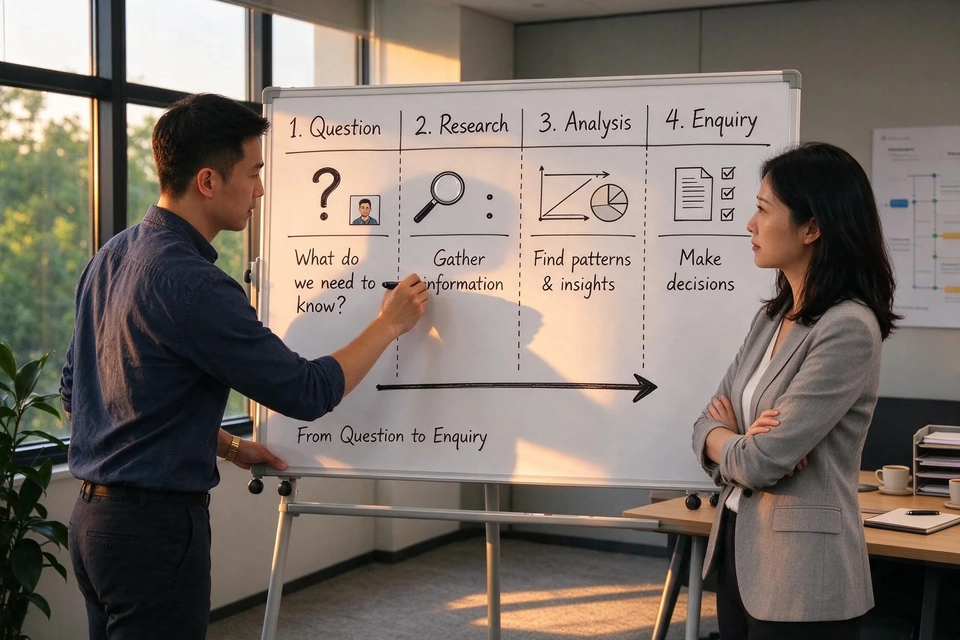
This is the question most Singapore teams ask second, and it is the one where a geo agency in singapore earns its fee or does not. The short answer: separate the layers instead of blending them. There are four distinct states between a question and an enquiry — retrieved, cited in the answer, visited, converted — and only the last two appear in your analytics, while the first two are what you are actually trying to improve.
For the measured layer, be precise about scope. Google Search Console's generative AI performance report can supplement actual AI Overviews and AI Mode impressions where the client's account provides them, but it cannot be stretched to cover full prompts, the engine's internal fan-out or standalone conversions, and an average position there is not a fixed-condition ranking. For the sampled layer — prompts, citations, competitor presence — you need a fixed question set, and comparisons only mean something when the question version, engine, language, region and sampling cadence are held constant.
That distinction is what separates a measurement from a mood. When the numbers go quiet, a team holding only rankings assumes the channel is broken; a team holding a layered view can usually say which layer moved.
Will this approach suit every company?
No, and it is worth saying so plainly before anyone buys a programme.
- Suited: B2B services and software with considered purchases, where buyers compare options by asking questions; teams already publishing explainers or knowledge-base content; businesses whose category questions are the ones engines now answer.
- Less suited: walk-in retail, impulse categories and businesses whose growth comes from paid media or offline referral — the acquisition model moves faster than a content programme pays back.
- Not suited: anyone who needs a fixed number of enquiries next month, or who expects a specified AI recommendation on a named date. No sampling method can promise that, and a provider who does is selling something else.
If you are at the stage of comparing providers rather than building the capability in-house, ask two questions of each: how do you define a mention rate, and how do you keep a prompt set fixed enough for comparison? The answers will tell you whether you are being sold a service or a report.
What Topkee does about AI search visibility
Topkee treats this as a measurement and content problem, not a traffic-recovery one, and that shapes how its geo agency in singapore offer is built. The work starts from real buyer questions rather than brand names and follows an ASK → UNDERSTAND → IMPROVE cycle, sold monthly with a monitoring report, a content package with a delivery ledger, a prioritised action list and one monthly review. Ask what the engine's sub-queries actually are and you get query fan-out analysis — which sub-queries the engine's API returns — rather than a claim to have traced a whole conversation.
The definitions matter more than the packaging. Topkee counts mention rate as the valid answers mentioning the brand divided by valid answers under identical conditions, and source-presence rate as valid answers where the brand's own site appears divided by the same answer set, with comparisons held to a fixed question version, engine, language, region and cadence. Description accuracy and sentiment are scored separately, and "not mentioned" is not recorded as "negative". Google Search Console's generative-AI report is used for what it covers — actual AI Overviews and AI Mode impressions — and not as a stand-in for prompts or conversions.
Topkee's Singapore entity, Topkee Pte Ltd, was established in its first October, with a Raffles Place office and a local contact line — the reason a generative engine optimization singapore buyer can get local week-to-week contact rather than an overseas account manager. The firm's GEO tiers are priced in HKD for its Hong Kong market; no Singapore dollar price is published, so treat any HKD figure you see as Hong Kong pricing until you are quoted otherwise. If you want the method explained before the package, [AEO vs. Search Rankings: AI Visibility Basics](https://www.topkee.com.sg/dynamic/ai-visibility-vs-search-rankings-is-your-agency-measuring) sets out how visibility is counted separately from ranking.
What should you do this week?
Pick one category and find out whether it is a discovery problem or a traffic problem, in that order. Run your ten highest-priority buyer questions through ChatGPT, Gemini and Perplexity, logged out — the same starting point any geo agency in singapore should be able to reproduce, and log three things per question: whether your brand appears, whether you are cited, and which competitors are named. Do it again in a month with the same questions.
If you are missing from the answers, the next step is a content and entity fix, not more link building. The generative engine optimization singapore describes how the monitoring, analysis and content delivery fit together for a team that wants the loop run for it, and our AI-driven strategies for 2026 SEA travel demand shows the same question-led reading applied to a market where discovery is shifting quickly.
FAQ
Is AI search behaviour the same thing as answer engine optimization?
No. AI search behaviour is what buyers do — asking questions conversationally and reading summaries. Answer engine optimization is the work of making your pages the sources those summaries cite. You can do the second without understanding the first, which is how teams end up optimising pages nobody asks about.
Does this mean SEO is dead?
No. HubSpot's report keeps both in play: SEO decides which pages rank in the index, and answer engine optimization decides which of them get cited. Backlinks still matter because answer engines draw on search indexes. What changed is that ranking is no longer the last step before a buyer sees you.
How often should we re-run an AI visibility check?
HubSpot recommends re-running the core prompt set on a monthly cycle, auditing pages that lost citation share on a quarterly cycle, and an immediate re-test after a major model release — for example OpenAI's GPT rollout in August 2025. Keep the questions identical between runs, or the comparison tells you nothing.
Can Google Search Console show our AI traffic?
Partly. Its generative AI performance report covers actual AI Overviews and AI Mode impressions where the account provides them. It does not show full prompts, the engine's internal fan-out or standalone AI conversions, so pair it with a fixed manual prompt set if you need the sampled layer.
Do we need a specialist agency for this?
Only if the work will not happen otherwise. A small team can run a ten-prompt baseline and a content restructure. A generative engine optimization singapore specialist adds a fixed question set, sampling discipline and competitor tracking across engines — worth paying for when comparisons, not curiosity, are the problem, and geo agency in singapore providers should show you that fixed set before you sign.
Sources
- HubSpot Staff, "AI search behavior: What it means for your marketing strategy in 2026", HubSpot, 2026-11-11. https://blog.hubspot.com/marketing/ai-search-behavior
- HubSpot, "The State of AEO in 2026", HubSpot, 2026. https://offers.hubspot.com/state-of-aeo
- Ahrefs, "What Triggers AI Overviews? 86 Factors and 146 Million SERPs Analyzed", Ahrefs, 2025-11-10. https://ahrefs.com/blog/ai-overview-triggers/