AI Leads the 2026 B2B Budget: What to Automate First
As of November 2026, the answer to the budget shift is not another tool purchase. AI has passed account-based marketing as the B2B marketing team's first budget priority, and the money is only well spent when it buys a named process with an owner, a review point and a record of what changed. Any plan for ai automation for business that starts with a product shortlist has the order backwards.
That is what a marketing lead in Singapore faces this quarter. The board has read the benchmark headline, the finance team has asked for a reallocation, and the two obvious moves are both weak: buy one more point tool, or cut the ABM programme to fund something nobody has defined yet. The third option, rebuilding one recurring workflow with AI inside it and leaving a person at the decision points, is the one that survives the next budget review.
Key takeaways
- AI has moved from an experiment to a line item in B2B budgets, and the shift is a reallocation rather than new money.
- Integration breadth is now a commodity: the tools compared in a recent round-up already reach thousands of applications, so connectors no longer separate a good purchase from a bad one.
- The useful split is by work type, and it decides where ai automation belongs. Predictable, rule-bound steps suit deterministic automation; steps that need context and judgement suit an agent with a human approver.
- The first pilot should be one high-frequency task with a defined deliverable, measured against a baseline captured before the trial starts.
- A workflow that cannot name its approval gate, its run record and its publishing owner is not ready for production budget.
Why the budget moved, and what it did not fix
Demand Gen Report reported on 11 November 2026 that AI had overtaken account-based marketing as the leading budget priority, drawing on a benchmark survey of B2B marketers. The detail matters less than the shape of it. The headline changed because the work changed: content production, campaign variants and first-pass analysis are now produced by software in a way they were not a year earlier, and budget follows the line item that produces output.
Two things the headline does not say. First, the survey describes a shift in priority, not a collapse in ABM. An account list is still how a B2B team decides whom to write to; what moved is where the marginal dollar goes. Second, a higher priority does not mean a better run. The same reporting notes that many organisations hold AI tools they use in narrow, workflow-specific ways, which is exactly the situation that produces spend without process.
For a Singapore team, the practical translation is a reallocation exercise. The questions are which budget line the money comes from, which workflow it lands in, and who signs off when that workflow touches a customer or a media budget.
The pilot-stage gap is an operating problem
Read a B2B team's AI shelf honestly and you usually find three states at once: a tool bought for one person's use, a script that runs in one campaign, and a process nobody wrote down. The reporting calls this the pilot stage. From the inside it looks less like a stage and more like an absence of ownership.
A pilot ends when someone owns the output. Until then, the team pays for licences, retries the same prompt each month, and cannot say whether the work got faster because nobody recorded the starting point. The first round produced demonstrations, not measurements, and the second budget request usually stalls there.
The remedy is unglamorous, and it is the same discipline any ai automation rollout needs. For every AI-assisted step, write down four things: the input it receives, the deliverable it produces, the person who checks the deliverable, and where the record of the run lives. A step that cannot fill those four lines is a demo, and demos should not carry production budget.
Stop buying breadth
The strongest argument against treating the budget as shopping money is that the tool market has already converged on connection. A recent round-up of ai automation tools, published this year, evaluates eight AI automation tools on what each is designed to do rather than on feature counts, and the integration figures it lists are large across the board: one platform integrates with over 5,000 applications through the Model Context Protocol, another connects more than 1,000 apps for no-code automation, and a third reaches over 1,000 applications through direct integrations and MCP support.
| Purchase argument | What it actually buys | Where it fails |
|---|---|---|
| "It connects to everything" | Reach into CRM, calendars, spreadsheets, help desks | Reach is table stakes; the vendor with the longest list rarely wins the process test |
| "It has the most features" | A wider menu to configure | A menu is not a process; unconfigured capability is unused capability |
| "It is the cheapest per seat" | Lower licence cost | The cost that matters is rework and human review time, which a seat price hides |
None of this makes connectors worthless. It makes them a poor reason to spend. The differentiator sits one layer up: whether the tool can be held to a workflow with an approver, a record and a clear owner when the work ships.
Which steps go to AI, and which stay with a person
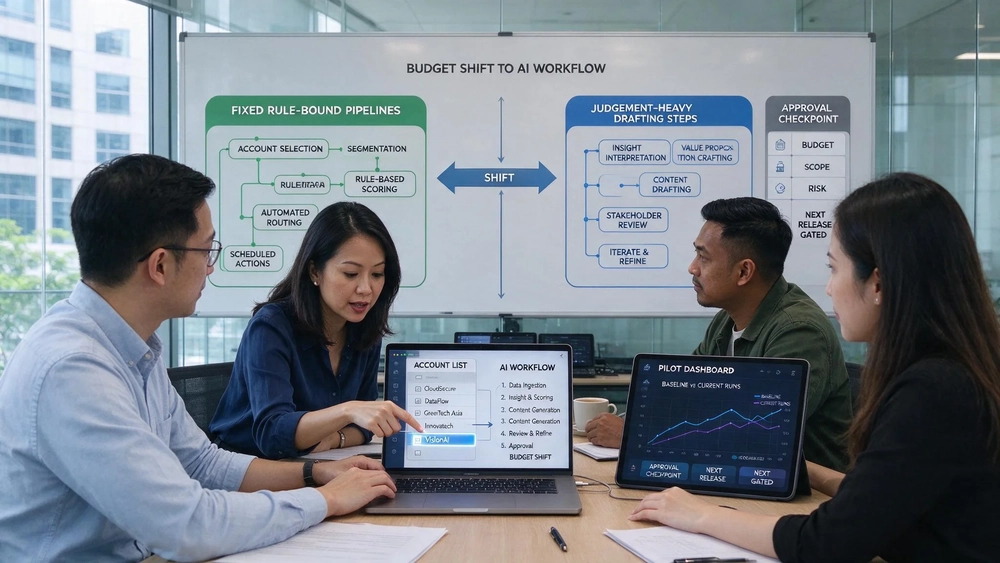
The round-up's own framing is the most useful line in it: agents earn their place when work needs context and flexible judgement, while predictable processes may be better served by deterministic automation. That sentence is a sorting rule a marketing lead can apply this week, by putting every step of a workflow into one of three buckets.
- Deterministic steps: data moves between systems, a report is assembled on a schedule, a list is cleaned against a rule. No judgement is required, and the output is checkable. These go to workflow automation, and the test is whether the output is the same every run.
- Context-dependent steps: a first draft of an email for a named account, a summary of a call, a suggested next action. The work needs reading and interpretation, so it suits an agent, with a person reviewing before anything leaves the building.
- Judgement that stays human: pricing concessions, commitments to a client, the decision to pause a campaign, anything that spends money or publishes under the company's name. Automation can prepare these decisions; it should not make them.
The most common mistake is putting bucket-one work through an agent and calling the result autonomy. It is slower, harder to audit, and it costs more per run than a fixed workflow. The second most common is leaving bucket-two work entirely with people, which is where the hours actually go, and where most ai automation for business programmes put their first pilot.
What to automate first, and how to pilot it without wasting the budget
This is the question the benchmark headline leaves open, and it deserves a specific answer rather than a framework.
Pick one high-frequency task with a defined deliverable, where the goal, the inputs and the owner are already clear. For most B2B marketing teams the candidates are the same three: the first draft of account-specific outreach, the weekly campaign report assembled from channel data, and the first pass of content draft for a known format. Choose the one your team repeats most often and already knows how to judge, because you cannot pilot what you cannot grade.
The pilot itself runs in four phases.
- Choose the scenario and write the deliverable specification. One page, no ambiguity about what a finished piece of work looks like.
- Connect and configure. Verify service permissions and approval rules before the first real task; a permission discovered mid-pilot stops the trial and damages trust.
- Run a small pilot on real tasks and record every human edit. Capture the baseline before you judge the return, on four measures: completion rate, time taken, rework, and human intervention.
- Consolidate and expand. Fold the rules learned into a template, then add the next task.
Before launch, check four things: that the catalogue and its dependencies exist, that the business services are subscribed and permissioned, that the runtime (nodes, models, quota, page access) is provisioned, and that the publishing responsibility is named. A draft that arrives in a queue with no owner is not a delivery.
The failure mode to plan for is a pilot that succeeds technically and fails commercially. It happens when nobody captured the baseline, so the after-state is argued rather than measured, and finance declines the second tranche. The countermeasure costs almost nothing: write the four numbers down on day one.
The Topkee view: turning budget into a governed workflow
Topkee's position on this is that the gap is not capability but process. The Topkee AI Agent is built as an AI partner for enterprise digital work: it matches a natural-language task to Skills and tools, connects authorised business services, and delivers files, pages and business objects that stay reusable in a Library. That design targets exactly the three things a pilot-stage team lacks.
The first is professional method. Experience is written into role rules, Skills and Playbooks, so judgement is configured once and reused across tasks instead of being rebuilt for each project. The second is system operation: queries and actions happen in the same conversation, which removes the copy-and-paste between tools where most review time is lost. The third is output reuse: reports, images, pages and business objects are kept and reused, so each round accumulates instead of restarting.
The catalogue in the company's published product snapshot lists a set of Skills, role templates and Plugins, described in the documentation as template entries rather than finished products, and not all have completed business acceptance. That wording matters for budgeting: what a team buys is a starting point to configure, not a finished automation.
The same applies to governance. Topkee's implementation method runs in four phases: choose one high-frequency task; connect and configure the services and approval rules; pilot on real tasks against a baseline; reuse and expand. Approvals gate spend, publishing and key changes, and run records tie the task list to its evidence. Default delivery is a draft, and scheduling is not publishing. The method is guidance rather than a promise of a fixed cycle, a fixed cost or a fixed return, which is why the baseline numbers belong in your own pilot report rather than in a vendor's deck.
What to watch next quarter
Three signals will tell you by early next year whether the reallocation worked, and none of them is the licence count.
The first is whether the pilot's four measures exist for more than one workflow. If completion rate, time, rework and human intervention are recorded for one task only, the team learned a demo. If they are the standing format for every AI-assisted step, the budget bought an operating habit.
The second is the approval trail, the clearest sign that ai automation for business is operating rather than being demonstrated. A team that can show which runs needed a person and why is a team whose next budget request will be taken seriously. A team that cannot is one audit away from losing the spend.
The third is how the tool conversation changes. When a marketing lead stops asking which platform has the most integrations and starts asking who reviews the draft, the budget has moved from purchasing to operations, and that shift is worth more than the headline number that started it.
For teams planning the rest of the quarter, AI-Driven Google Ads Automation for Marketing Success and AI & Automation Boost Hotel & Retail Marketing with Google Ads show how the same principle applies to paid media, where spend and publishing are the clearest natural approval gates.
FAQ
Is this the end of account-based marketing?
No. Account-based marketing remains how B2B teams choose whom to talk to. What changed for 2026 is budget priority, and the two disciplines work on different layers: ABM sets the target list, AI automation changes how the work against that list is produced and reviewed.
Should we cancel other tools to fund AI?
Not by default. Cancel a tool when the workflow it served has genuinely moved, and keep any tool whose output still gets used. The safer sequencing is to name the workflow, pilot it, record the baseline, and let the measurement justify the reallocation.
How long should a pilot run before we judge it?
Long enough to see the same task twice in its normal cycle, and with a baseline captured first. The exact length depends on the task's frequency. What matters is that the before and after figures are recorded the same way, on the same work.
What is the first thing to write down?
The deliverable specification and the four measures: completion rate, time taken, rework and human intervention. Before that exists, no comparison between months means anything, and no vendor demonstration can be judged.
Does using more integrations make a tool better?
Not on its own. Integration breadth has become common, with platforms in the current market reaching thousands of applications. What separates tools now is whether the work they do can be checked, approved and handed back to a person at the right moment.
Sources
- Demand Gen Report, "AI Overtakes Account-Based Marketing as the Top B2B Budget Priority for 2026", demandgenreport.com, 2026-11-11. https://www.demandgenreport.com/blog/ai-overtakes-account-based-marketing-as-the-top-b2b-budget-priority-for-2026/55242/
- Botsify, "Best AI Automation Tools for Businesses in 2026", botsify.com, 2026-08-21. https://botsify.com/blog/best-ai-automation-tools-for-business/
- Olive & Vine, "AI Business Automation", oliveandvinehk.com. https://www.oliveandvinehk.com/insights/consulting/ai-business-automation