AEO audit: what a geo agency in singapore checks first
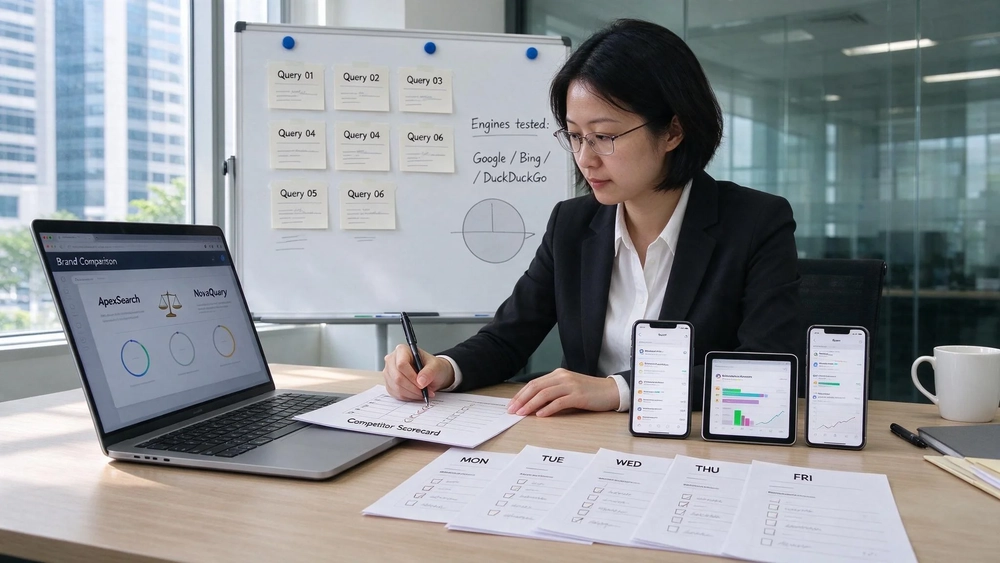
An AEO audit measures whether answer engines name your brand, describe it correctly and point to your own pages, then traces why that happens. As of November 2026 this is a job a content team can run in a week: pick 15 to 20 high-intent queries, run them across ChatGPT, Perplexity and Gemini, score every answer 0 to 2, and only then decide what to fix. A geo agency in singapore engagement starts from the same baseline before it touches a page.
Key takeaways
- The audit is a scoring exercise before it is a software purchase. A four-step workflow, each step taking one to two days, produces a scorecard and a fix list without a subscription.
- Buyers now ask ChatGPT, Perplexity or Gemini for a recommendation instead of scanning 10 blue links, so a rank report no longer covers the surface where many decisions start.
- Keep the prompt list fixed between runs. Change the list and every later comparison measures the list, not the brand.
- Check whether the top pages carry answer-first intros, Q&A blocks and comparison tables before paying for any tracker.
- Report a mention rate and a visible citation rate separately. Combined, they hide which one the brand lost.
The weekly scene that starts the audit
A marketing lead opens a competitor's name in a chat window, asks which of the two firms is better for a mid-size contract, and reads an answer built entirely from pages that never mention her company. The team's rank tracker shows green across the board. Nothing in it reports the paragraph she just read.
That gap is what makes an audit necessary, and it is also why the first pass should be manual. The HubSpot workflow behind this guide sets each of its steps at one to two days and needs no paid tooling to begin, which fits a two-person content team more comfortably than an annual contract does.

Step 1: fix the prompt set before anything else
The baseline test checks visibility across ChatGPT, Perplexity and Gemini, and every audit starts there. What has to be settled first is the list of questions those engines will be asked.
Choose 15 to 20 high-intent queries the brand should own, and spread them across three kinds:
- Branded queries, where the buyer already has the name: "is [brand] good for X".
- Category queries, where the buyer is browsing: "best [category] tools 2026".
- Comparison queries, where the buyer is deciding: "[brand] vs [competitor]".
Write the list down, date it and do not edit it between runs. A query added halfway through makes the next comparison useless, because the two numbers no longer describe the same question.
One habit worth adding to the source's list: keep the branded queries in a separate block from the category ones. A branded query tests whether the model describes you correctly. A category query tests whether it reaches for you at all. Pooled into one total, the first flatters the second.
Step 2: score each answer, and keep the answer
The scoring scale in the workflow is coarse on purpose: score each query 0 to 2, where 0 means the brand is absent, 1 means it is mentioned but inaccurately or as a secondary option, and 2 means it is cited accurately as a primary recommendation.
| Score | What the answer showed | What it means for the audit |
|---|---|---|
| 0 | No mention of the brand | Content or crawler gap, not a copywriting problem |
| 1 | Mentioned, but wrong or listed as an also-ran | A fact or positioning problem to fix first |
| 2 | Cited accurately as a primary recommendation | Keep the page; watch it after the next model update |
Two rules keep the score honest. Store the raw answer beside each score, because a score without its evidence cannot be re-checked after the next model update. And score each answer once, not once per engine mention inside it, so a chatty answer does not outweigh a silent one.
The scale is blunt, and that is the point. A finer rubric invites a long argument about whether a listing is nearly there when the decision worth making is simply whether the brand appears.

Step 3: test whether the page can be extracted at all
A scorecard of zeros tells you the brand is missing. It does not tell you whether the page was read and rejected or never fetched, and those need different fixes.
Three checks separate them, and none needs a new licence:
- Reachability. Confirm that nothing in the site's robots rules blocks the crawlers behind the engines you tested. One rule can remove a whole section from the answer surface.
- Structured data. Validate the markup on the pages that should be cited, and check that the article, product and question-answer types are present and free of errors.
- Sections the model can lift. Read the first screen of the page and ask whether it answers the query in one paragraph, whether a question-and-answer block follows, and whether any comparison appears in a table rather than in prose.
The third check is the one most often skipped, because it needs a reader rather than a report. It is also the one that explains a 0 most often: the page ranked, the model fetched it, and the answer sat three scrolls down.
Step 4: audit the top pages against the structural test
This is where the audit turns into a decision about money. Audit the top 50 pages against the structural standard: answer-first intros, question-and-answer blocks and comparison tables. If fewer than 30% of those pages pass, reformatting the existing content is a better investment than new software.
The source applies the same bar before any tool purchase: at least 30% of a brand's top pages should already carry those three elements. Below that line, a paid tracker buys a dashboard over content that cannot be extracted; above it, monitoring starts to answer a question worth paying for.
The practical test for a single page is shorter still. Cover everything except the first two paragraphs and the nearest table, and see whether the query is answered. If it is not, the page is not ready, whatever its rank.
What the audit produces, and what it does not
A finished audit leaves three artefacts: a dated prompt list, a scorecard with the raw answers attached, and a ranked fix list for developers and writers. It does not produce a trend.
For the trend, set the cadence before the second run. HubSpot describes a three-tier cadence, running the same fixed prompts at three different intervals. The short interval catches a stale price or a retired service before it circulates; the longer one re-tests the whole set and reassesses which pages are worth keeping.
When the team does add automation, start weekly alerts on a limited set of 20 to 30 queries and compare them against the manual scores before widening the list. A tool that diverges from the hand run on those queries will diverge on the rest, and the calibration is what makes the divergence visible.
The most common failure is bookkeeping, not technology. A team that cannot show a trendline after 90 days has almost always failed to record the starting metrics, and no tracker recovers a baseline nobody saved.

Which numbers hold up in a report
Two rates carry an AI visibility report, and each needs its denominator printed beside it. Both definitions below come from Topkee's AI visibility measurement rules, which is the part the HubSpot workflow leaves open.
Brand mention rate is the count of valid answers that contain a brand mention divided by the valid answers collected under identical conditions. A brand named five times inside one answer counts once. "Not mentioned" is not the same as negative, and both deserve a label separate from missing data.
Visible citation rate counts only answers where the owned site appears in the answer text, divided by the valid answers of the same group. A source the engine retrieved but did not display is not a visible citation, and most trackers fold the two together, so the figure needs filtering or a manual pass before it reaches a slide.
A third measure, description accuracy, has no percentage formula worth trusting. Read the answers and compare the brand's strengths, limits, service scope and cost factors against the facts the business would stand behind; keep the raw answer as the evidence.
How much does the trendline depend on the denominator?
The case for printing conditions beside every figure is easier to see in a worked example than in a rule.
Topkee's own report format is such an example, labelled by the page as a simulated screenshot rather than a client result, so it works as a template and not as a benchmark. It fixes one engine, one mode, one region, one language and one prompt version, then reports a brand mention rate and an owned-site visible citation rate side by side, each against its own baseline. Each answer counts once, however often it repeats the brand.
The arithmetic is the easy part; the conditions are the work. Swap the engine, the region or the sample size and the same percentage describes a different population. Every figure in an audit report should carry its conditions on the same line, and a reader who cannot see them should treat the number as a working note.
Why a Singapore team often hands the re-measurement over
For a Singapore firm weighing an in-house spreadsheet against an agency, the deciding point is rarely the first audit. It is the second and third month of the same prompts, run the same way, after the pages have changed.
Topkee has no separately named AEO audit product. The audit is the diagnostic layer inside its GEO service, run as a baseline diagnosis, six analyses and a monthly monitoring report. The six are prompt tracking, query fan-out, sentiment and brand description, competitor comparison, AI browsing, source analysis and knowledge content writing. The baseline and the brand fact base are built before the first monthly report.
The repair side is written content, and it is where a geo agency in singapore budget usually lands: one page per clearly defined buyer question, each with a direct answer, applicability conditions, verifiable facts, sources and a sensible next step. The service also keeps article completion, client approval, publication, indexing and AI citation as separate states, which stops a delivered article from being reported as a citation.
Topkee's GEO Insight system carries the monitoring half: brand ranking and visibility in AI answers, tracked prompts, competitors, citation sources and sentiment, with the sample size kept next to each figure. It also states where its data ends. Engines are sampled through APIs rather than as a consumer sees them, one adapter returns no web search, citation or fan-out data, and query fan-out shows only the sub-queries an API actually returns. Tiers are priced in Hong Kong dollars and come with no guarantee of rankings or AI recommendations.
What a test over a week tells you, and what it does not
The manual workflow fits where the team controls the pages and can commit an owner to the re-run. One to two days per step leaves room for a shared scorecard and a round of fixes before the next model update, and a geo agency singapore brief is the alternative when that owner does not exist in-house.
Either way, the audit is a measurement habit rather than a one-off document. The prompts, the scoring and the stored answers are the asset; the report is only what the habit looks like in a given month.
What it cannot do is hold conditions stable across months while the content moves. If the audit ends with a scorecard and nobody named to run it again, the second run is the part to fix before buying anything.
FAQ
Is an AEO audit the same as an SEO audit?
No. An SEO audit reads rankings, crawl health and indexation. An AEO audit reads what an answer engine says when a buyer asks, and whether it points at your page. They share the technical checks but not the scorecard, and a team that reports only the first has left the second unmeasured. Many firms start with a geo agency in singapore diagnosis for exactly that reason.
How many prompts should an AEO audit use?
Start with 15 to 20 high-intent queries across branded, category and comparison types. That is small enough to run by hand and large enough to show a pattern, and it should stay unchanged between runs.
How long does the audit take?
The workflow is paced at one to two days per step, so roughly a working week if one team owns all the steps and a developer is available for the crawling and markup fixes.
Do we need a paid tool to begin?
No. The baseline test, the structural audit and the markup checks run on free tools and the crawling software the team already has. Add a tracker only once the top pages pass the structural bar.
Which engines should we test?
ChatGPT, Perplexity and Gemini. Each draws on different sources and applies its own citation logic, and a single-engine test hides the gap that matters.
What separates a mention from a citation?
A mention means the brand name appears in the answer. A citation means the answer points to your own page. One can exist without the other, and a report that adds them together hides which one is missing. A geo agency singapore engagement keeps the two apart for that reason.
What to watch next quarter
Two questions deserve a calendar entry. Whether the answers you scored still look the same after the next model update, since each answer is generated rather than stored. And whether the pages winning citations are the ones the content team still maintains, because a cited page that stops being updated becomes a liability with a good score.
Also worth watching: whether the engines that cited you begin to answer a comparison query without your name at all. That is the earliest signal that a competitor has rewritten the page the model was drawing on, and it shows up in a fixed prompt set long before a rank report moves. Keeping the same prompts and a named owner for the re-run is the cheaper half of a geo agency in singapore scope.
A scorecard with a fixed prompt list, dated runs and a named owner beats a larger report nobody re-runs. For the measurement definitions underneath it, what an AI visibility dashboard and a rank report each show starts where the scorecard stops, and the audit disciplines behind an advertising readiness review show how the same signals feed paid placements.
Sources
- Stephanie Trovato, "AI engine optimization audit: How to audit your content for AI search engines", blog.hubspot.com, 2026-11-11. https://blog.hubspot.com/marketing/aeo-audit