
One brand platform, many films: what Afterpay's rollout asks of a video production company
As of November 2026, the useful lesson in Afterpay's It's About Time launch is a production one. A brand platform only pays back if each market and each placement gets a finished film of its own, on a schedule someone can plan, and that is where a video production company earns its place next to an in-house team.
Key takeaways
- A platform needs one repeatable creative rule before it needs more films; Afterpay's rule is a single, continuous camera movement set off by a purchase.
- A production plan should define what one finished film is, how many arrive each month, and which versions are separate films.
- Regions where the brand trades under another name belong in a master-plus-local-version grid, not in a second campaign.
- Paid media tests need one consistent cutdown length per batch, so a performance difference points at the idea and not at the edit.
Contents
- What Afterpay put in the market, and when
- Why the camera rule is a production decision
- Turning one idea into a monthly production calendar
- How the version matrix works across markets
- Where the numbers should come from
- The Topkee view on an always-on execution layer
- Common questions
What Afterpay put in the market, and when
Campaign Brief reported the launch on 9 November 2026, and the dates in its report are the ones to plan around. Out-of-home ran first, from 19 October, and the brand films followed from 2 November across TV, BVOD, YouTube, Meta and TikTok. The platform runs in Australia and New Zealand alongside the UK, where the brand trades as Clearpay.
The size of the commitment is worth noting for anyone weighing in-house versus outsourced production. Afterpay describes It's About Time as its most significant brand investment to date, and the creative was built by its in-house team working with Berlin production company Anorak and director Harrison Adair. The platform also widens the categories the brand appears in, spanning tools and materials, home, travel and apparel, so the films now cover both large life moments and ordinary spending.

Why the camera rule is a production decision
Every film in the platform rests on a single, continuous camera movement, a slow rotation that starts when a purchase happens. The camera keeps turning and the frame fills with what the purchase made possible: a season, a milestone, a memory. Reporters and award entries tend to file that kind of device under craft. For a production plan it does something more practical: it fixes the shot that cannot be changed between films.
That constraint is what allows a brand film to be cut down without a new shoot. If the rotation is the structure, an editor can stop it earlier, start it later or run it at another pace, and the result still reads as the same campaign. If each film were built from a conventional shot list, every placement would need its own edit decision and its own approval, and the video ad optimization question would turn into a question about how many edits the budget allows.
The end line works the same way. Each film reaches the platform name by a different route, and a line such as "It's not about the new tools. It's about time." carries the idea in one breath. That gives an editor a second fixed element, the line, which usually survives a shorter cut even when a scene does not.
Turning one idea into a monthly production calendar
The first document in any production plan should be the definition sheet: what counts as one film, how long it runs, how many arrive this month, and who signs them off. A video production company that states its film length and monthly volumes in the plan gives you that sheet in a form you can hold it to. Without that sheet, a monthly production cycle drifts, because every request looks reasonable on its own and the total is never agreed.
A workable monthly rhythm has four stages, and each one produces a record the next stage depends on.
- Set the month in one session. Agree the goal, the offer or product focus, the placements and the technical specifications before anything is written.
- Produce in batches against that plan. Send feedback on the batch together, in the revision rounds already agreed, so a round of notes does not turn into a second round of production.
- Deliver versions with their file names stated. Record the language, the size and the run time of each version, then file the approved cut with the rest of the month's work.
- Review at month end against the sheet from stage one. Count what was planned, what was delivered, what each version was for, and keep the footage that can serve the next cycle.
The fourth stage is the one most teams skip, and it is the one that lowers the cost of the next month. Materials already approved remain approved material; a cutdown request that can be answered from filed footage needs an editor, not a crew.
For a platform like Afterpay's, where out-of-home runs ahead of film, the calendar also has to handle the gap. The out-of-home work sets the visual language before any film exists, and the first film batch has to match a look that has already been printed and posted.
How the version matrix works across markets
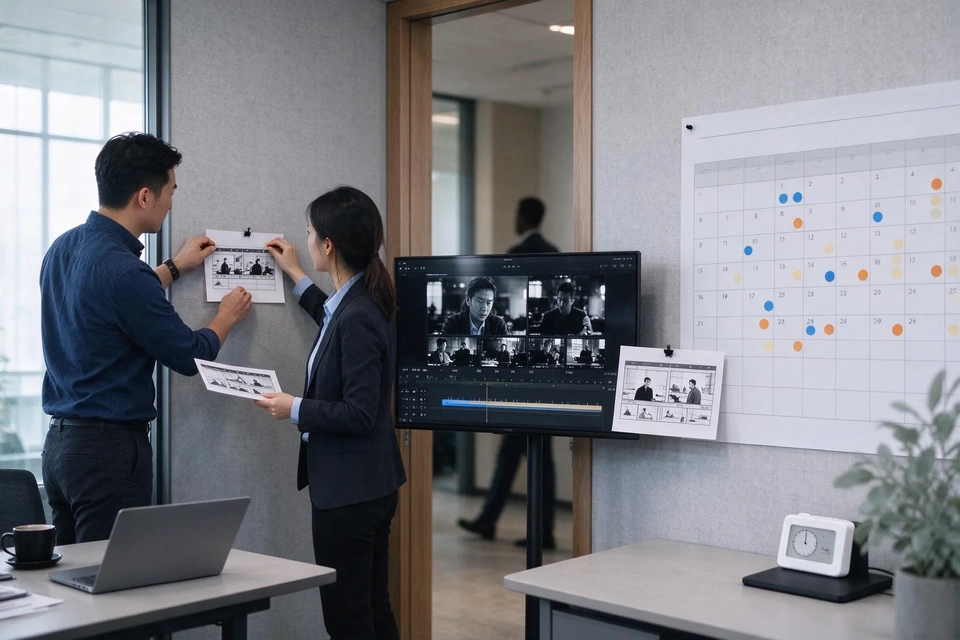
One brand expression rarely means one file. A platform that runs in Australia, New Zealand and the UK needs a separate version for a market where the brand name itself changes, as it does for Clearpay. Add the placements in the media plan, and a single film concept can become a grid of finished assets.
The grid is easier to control when it is written as masters plus local versions. A master carries the creative idea and the structure. A local version states which element changed: the end line, the brand name, the cultural reference, the product shot. Each local version names the person who approved the translation or the local adaptation, because approval on a master does not transfer to a version whose copy was rewritten.
A version table built at planning time keeps the count honest, and it gives the editor a clear job for each output. Two rows drawn from a typical rollout look like this.
| Output | Based on | What changes | Who approves |
|---|---|---|---|
| Long film, AU/NZ | Master | brand name in end line | brand lead, AU/NZ |
| Long film, UK | Master | brand name changed to Clearpay | brand lead, UK |
| Cutdown, paid social | Long film | run time, aspect ratio | media lead |
| Cutdown, BVOD | Long film | run time, clearance copy | media lead, brand lead |
The table also settles a question that otherwise returns every month: whether a size variation counts as a new film. Decide it once, in writing, and both the production side and the finance side work from the same definition.
Where the numbers should come from
Reading a launch like this one as a sign of a trend is easy. Turning it into a decision for your own budget needs a smaller set of numbers, each with a definition and a date.
Three counts are worth holding before a platform rolls out. The first is the number of finished films per month, with the definition of a film attached. The second is the number of markets and language versions, counted as separate outputs. The third is the number of revision rounds included per film, agreed before the first batch.
Each count should also have a source and a time range. A figure taken from a pitch deck, a platform report and an internal spreadsheet will not agree, and the disagreement usually sits in the definition rather than in the work. If a media report shows one cutdown outperforming another, the useful comparison holds the run time, audience and placement constant; otherwise the difference may come from the placement rather than the edit.
The Topkee view on an always-on execution layer
Topkee Creative sells the execution layer rather than the platform itself. Its creative subscription delivers ad key visuals and short films on a monthly plan, from S$590 per month, and its standard-plan films run up to 15 seconds. The Everyday Plan is S$590 per month and offers a choice of 10 key visual graphics, 2 films plus five graphics, or 4 films. The Advanced Plan, at S$980 per month, doubles the volume on the same three-option structure.
Two details in those plan terms matter to anyone planning a platform rollout. The options are alternatives, not cumulative, so the month's volume is fixed at sign-off, and sizes, languages and revision rounds are confirmed before the service starts. Multi-brand and multi-market work falls to the enterprise creative plan, quoted on request, where volume, versions and batches are agreed by brand and market first.
The brand narrative layer is separate. Bespoke brand films, with concept, script, storyboard, shoot and post-production, are project work outside the subscription. A company running a platform can therefore keep the narrative film with an agency or a bespoke production team while buying its routine cutdowns and key visuals on a monthly plan. Our own view is that this split keeps the cost of volume visible: the fixed monthly output tells you what the platform costs to sustain, and the project fee covers the occasional film that carries the idea. That is a planning position, not a claim about any client's results.

Common questions
What does Afterpay's It's About Time platform consist of?
Campaign Brief reported a global brand platform from Afterpay's in-house creative team, made with Berlin production company Anorak and director Harrison Adair. Out-of-home launched on 19 October, with the brand films following from 2 November across TV, BVOD, YouTube, Meta and TikTok.
How long should a cutdown from a brand platform run?
There is no universal length. For paid media, a length the plan fixes in advance is what makes a test readable. Topkee's standard creative subscription films run up to 15 seconds, which suits placements that need the idea in a short slot.
How do you handle markets where the brand name changes?
Write the programme as a master plus local versions. The master holds the creative idea; the local version states exactly what changed, such as the end line or the brand name, and who approved it. Translation or adaptation approval belongs to the local market, not to the master's sign-off.
Should a brand platform be produced in-house or bought monthly?
The two routes answer different needs. An in-house team keeps the platform's rules and its long films close to the brand, while a monthly plan covers steady volume for paid media across many placements. Running both costs more, and it removes the risk that a single approval queue holds up every market at once.
What should a monthly creative plan define before it starts?
A film definition, the monthly volume, the version grid, the languages, the revision rounds and the approval route. A video production company should be able to put those terms in writing before the first batch, and the same sheet is what makes a month-over-month comparison of video ad optimization possible, since a test only means something when the length and the volume are held steady. Once those terms are agreed, produce in batches against that plan rather than against individual requests.
Recommended next action
For a planning comparison, a video production company that publishes its monthly volumes is easier to size against a rollout than one that quotes per project, and the subscription page sets those volumes out. Two site articles read alongside it: what an agency's five senior hires buy a video client, on the team a production brief depends on, and Tropfest's Dream Small and a video production company brief, on how a creative platform is briefed to producers.
Sources
- Ricki Green, "Afterpay champions time well spent in new global brand platform 'It's About Time'", Campaign Brief, 2026-11-09. https://campaignbrief.com/afterpay-champions-time-well-spent-in-new-global-brand-platform-its-about-time/
- "Good Creative, Keeps Happening | Topkee", Topkee, no publish date. https://www.topkee.com.sg/creative-subscription