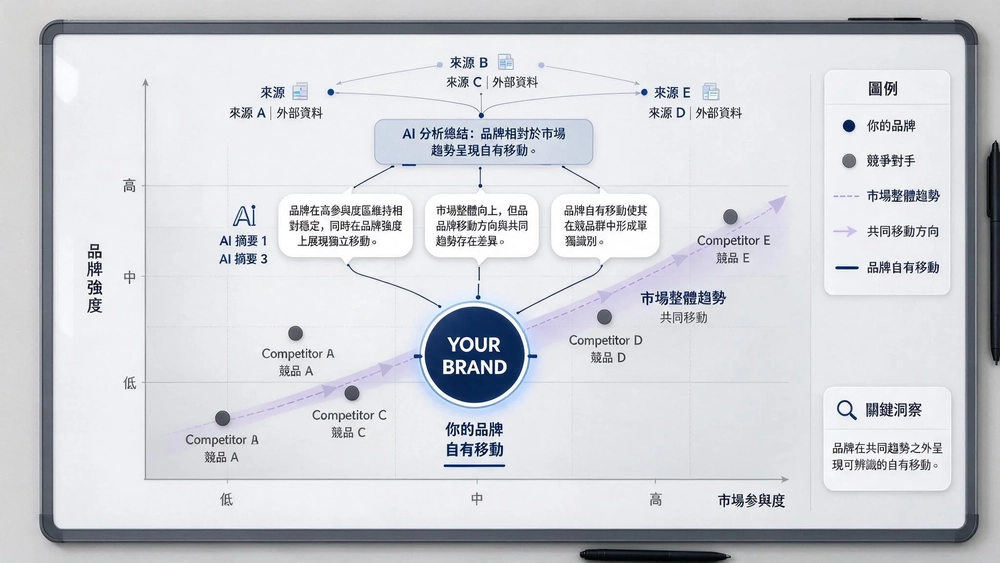
AEO benchmarking: is AI search visibility improving?
AEO benchmarking compares your brand's presence in AI answers with competitors and with the market, so a movement can be traced to your own work or to everyone's. As of November 2026 the market is moving with you: HubSpot's AEO report, updated that month, found 58% of marketers say their businesses are optimising content for answer engines. Before you sign anything, a geo agency in singapore should fix the questions, the engine and the region that the number will be quoted against.
Key takeaways
- Most of the movement you will see in an AI visibility report is a change in the market, not in your own standing, so a comparison needs a fixed baseline.
- HubSpot's own funnel data links AI search to purchase behaviour, and its organic traffic fell while AI-optimised accounts grew.
- Pew's click study explains why an AI answer can reduce clicks even when your brand appears in it.
- The number of tracked questions a quote includes matters more than the monthly fee, because the question set is the unit being bought.
What is the question this data is trying to answer?
Most teams ask whether AI search is worth investment at all. That question is already settled by the buyer behaviour data. HubSpot surveyed more than 3,000 CRM purchase decision-makers worldwide in January, and 42% of buyers used AI search during their evaluation. Those buyers were 36% more likely to purchase than the ones who did not use it.
The harder question, and the one this article is about, is whether a change in your own visibility means anything. The same release reports that 44% of marketers have made a business purchase based on brands they discovered through answer engines. That is a market statement. It tells you the channel matters, and nothing about your position in it.
Why does a single visibility score mislead?
An answer engine draws on a pool of sources. Pew Research Center's study of Google AI summaries, published in July, counted how many sources sit behind one. 88% of AI summaries cited three or more sources. The median summary was 67 words long, and 18% of the Google searches studied generated a summary at all.
Sitting among at least three citations inside a 67-word answer, your visibility moves with the other answers as much as with your own pages. A report without a fixed baseline cannot tell you which happened, which is why a geo agency singapore proposal deserves scrutiny on exactly that point.
Which benchmark is it: the market or your brand?
Separate the layers before you read a single number.
| Question | What it measures | Where the data comes from |
|---|---|---|
| Is AI search growing? | Market adoption | HubSpot's survey and its customer base |
| Are buyers clicking less? | Answer format | Pew's click study |
| Did we improve? | Your own standing | Your tracked question set |
A market benchmark answers the first question. It cannot answer the third without an observation of your brand under fixed conditions. HubSpot's benchmark pages cover the market side from 6+ answer engines, and that breadth is useful for context, not for scoring your account. If a provider cannot show you which layer its report covers, ask a geo agency in singapore to explain the methodology in writing before you sign.
Is your own funnel showing the AI search effect?
HubSpot's newsroom release of 15 September looked across nearly 300,000 businesses on its platform and found organic traffic to customer websites dropped 27% year over year. In the same release, HubSpot reports that customers actively optimising for AI search generated 20% more traffic from AI visits, 170% more MQLs, and 82% more deals than comparable customers who were not.
Those are platform figures from HubSpot, published in September, not a controlled trial on your own CRM. Take the direction and check whether your pipeline shows the same shape; a Singapore B2B business with a short sales cycle is likely to see the MQL effect before the deal effect.
Why do AI summaries reduce clicks even when you appear?
Pew's study puts numbers on the answer format itself. Its dataset covered 68,879 unique Google searches, drawn from the browsing data of 900 US adults in March. Users who encountered an AI summary clicked a traditional search result link in 8% of all visits. Users who did not encounter one clicked a search result in 15% of visits.
Inside the summary, users clicked a link in just 1% of visits. They ended the session on 26% of pages that carried an AI summary, against sixteen per cent of pages with only traditional results. A brand can be visible in the answer and still lose the click, which is why AI search visibility and traffic have to be read as separate measures.
Search format also shapes whether an answer appears. Only 8% of one- or two-word searches resulted in an AI summary, and that share climbs sharply once a search runs longer than two words. 60% of queries beginning with a question word produced one. If your tracked questions are two-word product names, you may be measuring a search type that rarely produces an answer at all.
How do you fix a baseline before you change anything?
Set the comparison before you write a single new page. The method below follows the measurement practice Topkee publishes for its own service, and it works the same whether you run it in-house or hire it out.
- Write a list of questions in the words buyers use, at the comparison and purchase stages, not just your brand name.
- Fix the engine, language, region and sampling cadence for the whole period, and version the question list so changes are visible.
- Keep question-led and brand-led samples apart, so inserting the brand name cannot manufacture a lift.
- Record brand mentions, description accuracy and cited sources from the same valid answers.
- Compare period over period on the same version, then compare once against competitors under the same conditions.
- Treat a change as a movement, not a result, until traffic and pipeline data agree with it.
The trap at step 1 is the most expensive one. A quote built on twenty questions and a quote built on ninety cover different ground, and the comparison table you make from either will look equally convincing.

The Topkee view: how we fix the benchmark
When you shortlist providers, a geo agency singapore should be able to describe the baseline it will use before any work starts. Topkee runs AEO benchmarking as a measurement view inside its GEO service rather than as a separate report. The programme follows an ASK, UNDERSTAND, IMPROVE sequence: it begins with real buyer questions, samples how your brand is described in AI answers, and delivers knowledge content with a monthly improvement action list. The comparison run uses identical questions and identical observation conditions across your brand and its competitors, so the change you see is scored against the same baseline each period.
Its three tiers differ only in capacity. The entry tier starts at HKD three thousand two hundred per month with thirty active tracked questions and twenty knowledge articles; the higher tiers raise both the question allowance and the article count. The visibility report format documents thirty questions sampled across four rounds as a fixed set of valid answers per period; in the sample report, brand mention came to 42 of those answers and own-site visible citation to twenty-four of them. Topkee marks that example as a simulated report, not a client result, and the movement it shows proves no causality. Sampling runs in an agreed API environment, not what every consumer sees in a consumer AI product, and the service makes no guarantee of AI recommendation or fixed exposure.
When should you run the benchmark in-house?
If you have an SEO analyst who can already export AI answer citations and a writer who can act on them within the same month, the tool layer may be enough. Teams where one marketer covers paid, SEO and content usually find the monthly reading and briefing is the first task to slip.
The middle route is a short engagement with a geo agency in singapore to set the question list and take the first baseline, then run the monthly reading in-house from that fixed set.

Frequently asked questions
How is AEO different from GEO?
AEO is the practice of optimising content to appear in answer engines; GEO is the broader discipline of shaping how a brand appears and is described in generative answers. Many agencies use the terms interchangeably, and when a geo agency singapore quotes you, ask which measurement it will report.
How many questions should a benchmark track?
Ask instead which questions the number will be quoted against. Cover the comparison and purchase stages across your main product lines. Topkee sells capacity in bands of active questions, starting from thirty, and the right band depends on how many products you sell rather than on how large the company is.
Can market data tell me whether our visibility improved?
No. Market data from HubSpot and Pew tells you the channel is growing and how the answer format behaves. Your own change only shows up on a fixed question set observed under constant conditions, and that is the figure to put beside an agency's monthly fee.
Does appearing in an AI answer guarantee clicks?
Not by itself. Pew reports that users who encountered an AI summary clicked a traditional result link in 8% of visits, and a link inside the summary in 1% of visits. Presence in the answer and traffic are separate outcomes, so a benchmarking report should track source citation and clicks together.
Should we stop SEO work while we benchmark AEO?
It is better to keep both. SEO and GEO are separate jobs over one shared content base: SEO targets organic ranking for commercial keywords, GEO targets whether and how your brand appears in AI answers. Cutting the first to fund the second takes away the pages the second leans on.
For background, see our explainer on [AEO vs. Search Rankings: AI Visibility Basics](https://www.topkee.com.sg/dynamic/ai-visibility-vs-search-rankings-is-your-agency-measuring), and for how much ad space AI results already carry, AI answer ad counts: what apparel and electronics show.
What should you ask before you sign?
Come to the meeting with four questions and write the answers down. Which engine, language, region and question version will the report use? How many questions does the fee cover, and what counts as one? Will the comparison against competitors run on the same questions and conditions? What will the report show for source citation beside brand mention?
A provider who answers all four has a method you can hold them to. One who answers in generalities is selling a dashboard.
Sources
- Tristen Taylor, "AEO benchmarking: What market data reveals about AI search", HubSpot Blog, 2026-11-10. https://blog.hubspot.com/marketing/aeo-benchmarking
- "The State of AEO in 2026", HubSpot, 2026-11-10. https://offers.hubspot.com/state-of-aeo
- "HubSpot AEO data: Buyers using AI search are more likely to purchase", HubSpot Newsroom, 2026-09-15. https://www.hubspot.com/company-news/aeo-data-buyers-using-ai-search-more-likely-to-purchase
- "Google users are less likely to click on links when an AI summary appears in the results", Pew Research Center, 2025-07-22. https://www.pewresearch.org/short-reads/2025/07/22/google-users-are-less-likely-to-click-on-links-when-an-ai-summary-appears-in-the-results/